Episode Details
Back to Episodes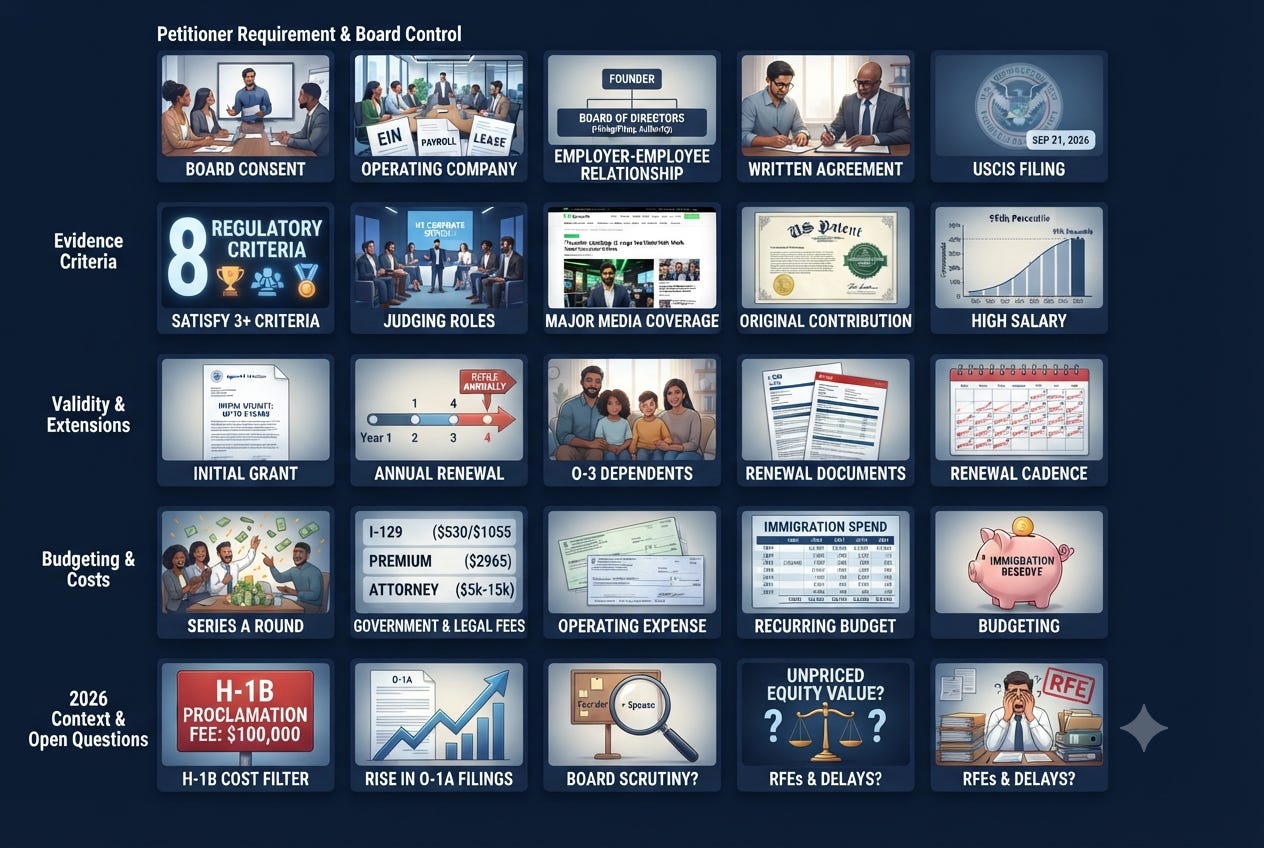
Self-Sponsoring Your O-1A Visa
Description
USCIS Lets Founders Self Petition for O-1A Visas in 2026
United States Citizenship and Immigration Services lets a startup founder obtain an O-1A extraordinary ability visa only when the founder’s own company, not the founder, files as petitioner under 8 CFR 214.2(o). USCIS Policy Manual Volume 2, Part M makes the underlying rule explicit: an O beneficiary may not petition for himself or herself, so what founders call a self petition is really a corporate petition built around a board authorized to hire, direct, and remove him. The founder still has to prove at least three of eight regulatory criteria under 8 CFR 214.2(o)(3)(iii), evidence that typically comes from media coverage of the company, a salary or priced equity package above the market for his role, judging roles at startup competitions, or an original contribution the field itself has recognized as significant. A presidential proclamation that took effect September 21, 2025, and attached a 100,000 dollar fee to new H-1B petitions has pushed the O-1A from a niche option to the default strategy for founders who cannot absorb that cost for a single hire. The visa’s initial grant runs up to three years, but every renewal after that runs in one year increments, not three, a detail that changes how much of a Series A or Series B round a founder should set aside for immigration counsel.
why can’t a founder petition for the visa alone
USCIS tests for an employer employee relationship using common law agency principles: the right to hire, fire, supervise, and set the terms of someone’s work. A founder who controls his own hiring and firing is not, in the ordinary legal sense, anyone’s employee, which is why the petition has to run through the company rather than the individual. The fix is a board of directors with at least one member besides the founder who holds real authority: to approve the O-1A filing, to set the founder’s compensation, and to retain the power to remove him.
In board consent language I draft for founder clients, the operative sentence is never about the founder’s accomplishments. It is the sentence instructing the board, not the founder, to set his salary and terminate his employment, because that sentence is what turns the filing into an employer’s petition rather than a worker’s request for himself. Federal litigation has narrowed how aggressively USCIS may demand proof of constant, on site supervisory control. In the 2020 settlement of ItServe Alliance, Inc. v. Cissna, USCIS agreed to rescind guidance that had required hour by hour, on site control for H-1B placements and to accept indirect, contractual control instead, a standard that grew out of the same common law test adjudicators apply when they decide whether a founder’s board actually directs his work.
what evidence proves three of the eight criteria
The eight criteria at 8 CFR 214.2(o)(3)(iii) run from major prizes and association membership to scholarly authorship, but four come up most often in founder petitions. Published material about the founder satisfies the criterion only when a major trade or general media outlet writes substantially about his work, not when he is named in a funding round press release. The high salary criterion compares his compensation to others in the same occupation and metropolitan area, typically against Bureau of Labor Statistics wage data, with practitioners treating pay in the top five percent of that comparator group as persuasive, and equity counts only once a financing round or a formal valuation prices it.
A judging role has to show he was selected to evaluate others’ work, at a pitch competition, an accelerator demo day, or a technical hackathon, not merely that he attended. Original contributions of major significance is the least defined and most contested criterion on appeal: an issued patent a company has commercialized, or a product a distinguished organization has purchased or integrated, carries