Episode Details
Back to Episodes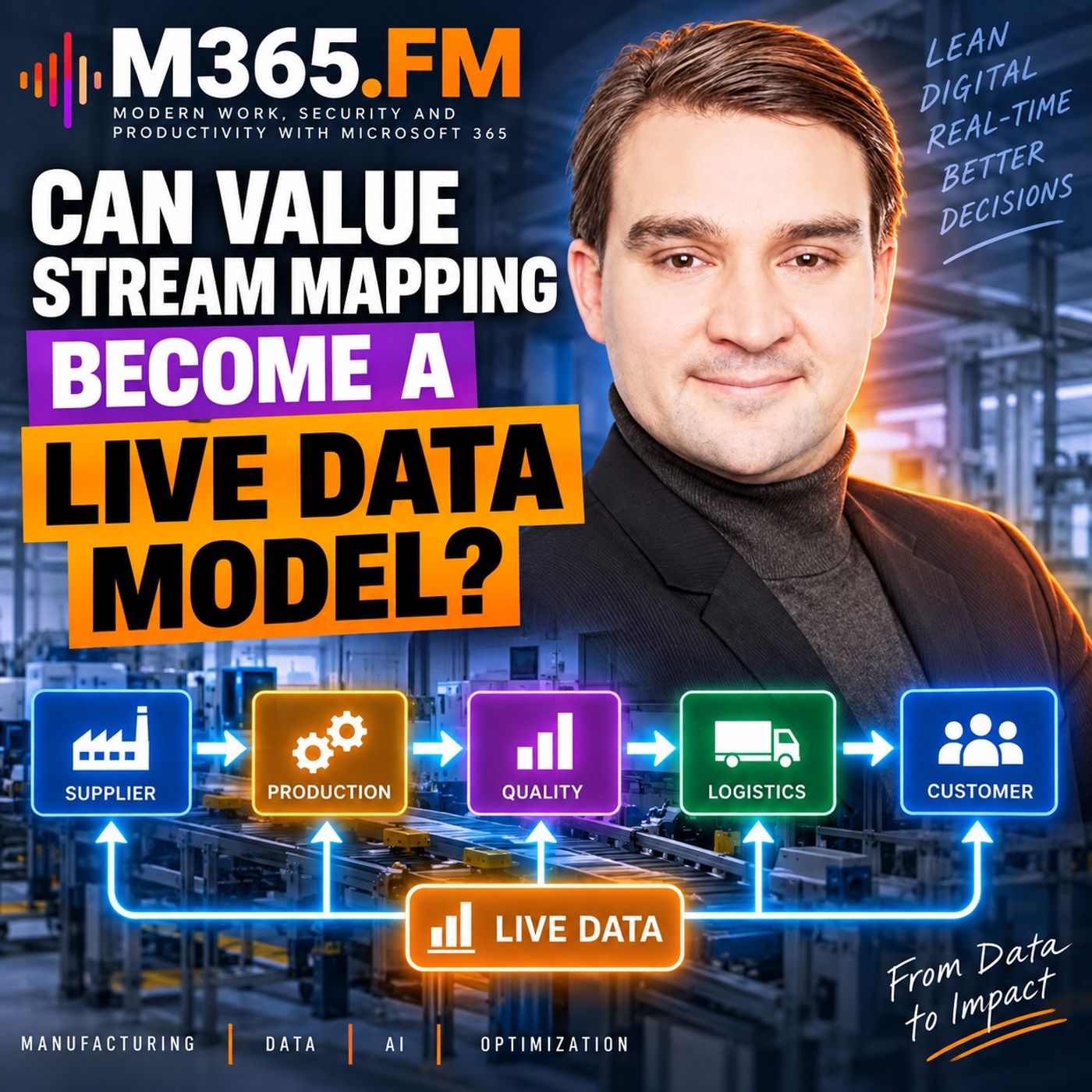
Can Value Stream Mapping Become a Live Data Model?
Season 4
Published 1 month, 2 weeks ago
Description
Value Stream Mapping has been one of the most useful tools in Lean Manufacturing for understanding how material, information, and decisions move through a production system.But traditional Value Stream Mapping has a fundamental limitation.The factory keeps changing. The map does not.You can bring production, planning, quality, maintenance, supply chain, and operations into the same workshop. You can map cycle times, queues, batch sizes, handoffs, waiting times, information flows, and bottlenecks. At the end of the workshop, everyone may finally share the same picture of how the production system works.Then reality changes.A supplier shipment arrives late. A customer places an urgent order. A machine goes down. Quality blocks a batch. Maintenance removes a resource from production. A setup takes longer than expected. Material waits in the wrong location.The Value Stream Map hanging on the wall still describes yesterday's factory.So what if a Value Stream Map could become something more?In this episode, we explore how Value Stream Mapping could evolve from a static Lean Manufacturing document into a live manufacturing data model connected to ERP, MES, quality, maintenance, machine, and shop-floor data.The goal is not simply to digitize a Value Stream Map.The goal is to create a model that continuously reflects how production actually behaves.
THE PROBLEM WITH STATIC VALUE STREAM MAPPING
Traditional Value Stream Mapping captures an important snapshot of a production system.It helps teams understand the sequence of processes required to produce a product, but its real value goes much further than drawing boxes and arrows.A Value Stream Map can describe processing times, waiting times, queues, inventory, batch sizes, changeovers, information flows, replenishment signals, production control rules, and handoffs between different parts of the organization.That makes Value Stream Mapping extremely useful for understanding flow.But production is dynamic.The conditions captured during a workshop may already be different several days later.Demand changes.Resources become unavailable.Orders receive different priorities.Quality issues create rework.Material arrives late.Production schedules change.Actual cycle times differ from planning assumptions.These changes affect the real flow of production, but they are usually not reflected automatically in the Value Stream Map.This creates an interesting question for modern manufacturing:Can Value Stream Mapping become a continuously updated model of the factory?
FROM VALUE STREAM MAP TO LIVE DATA MODEL
A live Value Stream Model would be fundamentally different from simply putting a traditional Value Stream Map on a screen.Digitizing a diagram is relatively easy.Creating a model that understands the relationships between orders, operations, resources, materials, constraints, events, and production states is much harder.A live manufacturing model needs to understand questions such as:Where is an order right now?Which operation was completed last?What should happen next?Which resource is required?Is that resource actually available?Is material waiting?Is quality blocking production?Has maintenance reduced available capacity?Is the order waiting because of a physical constraint or because of an information delay?And most importantly:What evidence proves the current state of production?This moves Value Stream Mapping from documentation toward operational intelligence.
ONE ORDER, MANY MANUFACTURING SYSTEMS
Consider a make-to-order manufacturing environment.A customer order enters the business with a required delivery date.ERP creates the sales order, generates production requirements, checks material availability, and provides routing information describing the expected sequence of operations.But ERP only provides part of the picture.On the factory floor, the Manufacturing Execution System may dispatch work, record operator confirmations, track production