Episode Details
Back to Episodes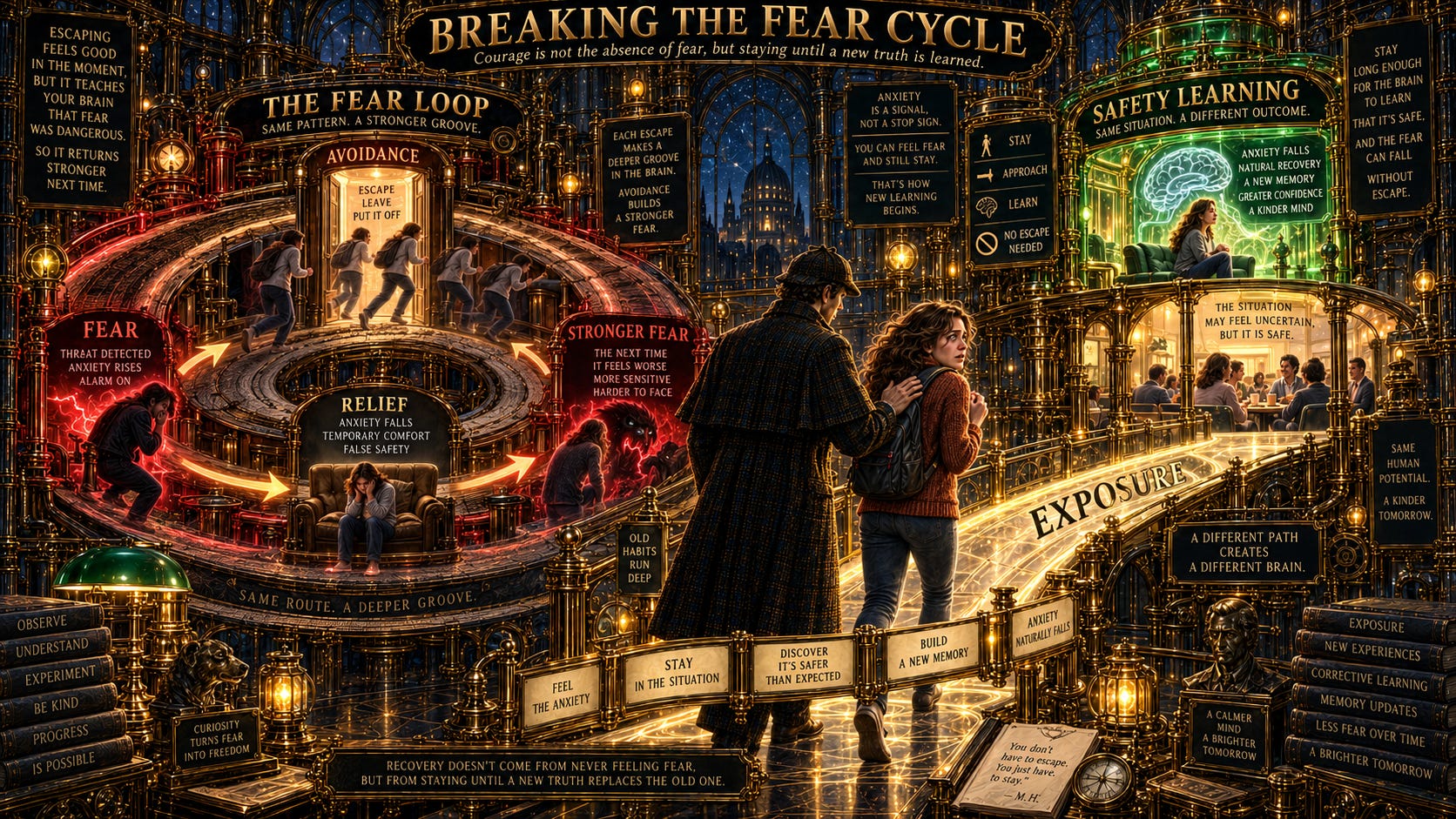
PSYCH 122: Anxiety Disorders - Cognitive-Behavioural Therapy
Description
Medlock Holmes enters an immense Victorian experimental laboratory called The Institute of Fear and Learning.
Around him, patients are trapped within apparently different mysteries.
One avoids dogs. Another fears crowded trains because a panic attack might occur. Another rehearses every sentence before speaking, terrified of humiliation. Another spends hours worrying about disasters that may never happen.
Yet Holmes notices the same mechanism running beneath them all.
Threat → Anxiety → Escape or Safety Behaviour → Relief → Stronger Future Fear.
Avoidance works remarkably well in the short term. That is precisely why it becomes such a problem.
Each escape produces relief. Relief negatively reinforces avoidance. And every avoided encounter prevents the person from discovering something potentially transformative:
Perhaps the predicted catastrophe would not have happened.
Cognitive-behavioural therapy breaks this cycle.
At its centre lies the concept of the fear structure: interconnected representations of stimuli, responses, and meanings. A dog becomes associated with danger. Palpitations become associated with heart attack. Social attention becomes associated with humiliation. Uncertainty becomes associated with intolerable catastrophe.
The fear itself is not necessarily pathological. The problem is that the structure inaccurately represents reality.
For therapeutic change to occur, two things are required. The fear structure must first be activated. Then the patient must encounter information incompatible with its pathological predictions. Modern formulations describe this in terms of prediction error: the brain predicts catastrophe, encounters a different outcome, and is given an opportunity to update its model.
This explains why exposure sits at the heart of CBT for anxiety disorders.
Exposure may be in vivo - entering the avoided lift, touching the feared animal, speaking in front of others.
It may be imaginal - deliberately approaching distressing memories, images, thoughts, or feared future scenarios.
Or it may be interoceptive - deliberately producing the bodily sensations that have themselves become feared, such as dizziness, breathlessness or a racing heart.
But exposure is not simply a test of endurance.
Its purpose is learning.
The patient predicts:
“If my heart races, something terrible will happen.”
The experiment produces a racing heart.
The catastrophe does not occur.
Or perhaps something uncomfortable does happen - embarrassment, anxiety, uncertainty - and the patient discovers that even this is tolerable.
The prediction begins to change.
Holmes therefore realises that falling anxiety during a single exposure is not the ultimate objective. Someone may feel better because they distracted themselves, escaped psychologically, performed a ritual, sought reassurance, or relied upon another safety behaviour.
The more important question is:
What did they learn?
That distinction also explains why safety behaviours matter. The patient who survives a feared situation while gripping a bottle of water, checking their pulse, rehearsing every sentence or staying beside a trusted companion may conclude:
“I survived because my protection worked.”
The old fear remains intact.
CBT therefore combines exposure with cognitive work: identifying catastrophic predictions, examining evidence, using Socratic questioning, uncovering deeper meanings, and designing behavioural experiments that allow beliefs to collide with reality.
Different anxiety disorders require different experiments.
In panic disorder, treat