Episode Details
Back to Episodes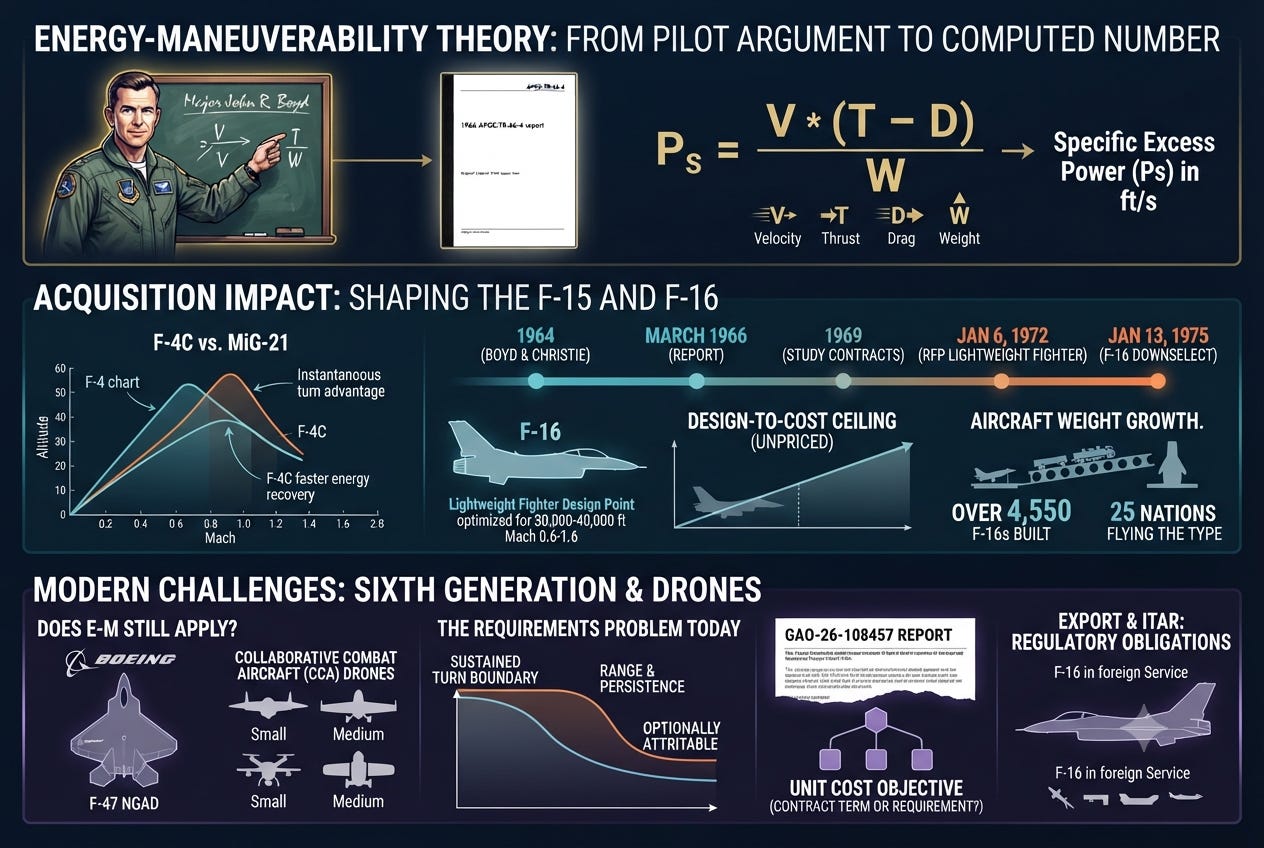
How Energy-Maneuverability Theory Built the F-16
Description
Energy Maneuverability theory converted a fighter pilot’s argument into a computed number, and the number won. The method that Major John R. Boyd and mathematician Thomas P. Christie built at Eglin Air Force Base, published in March 1966 as Air Proving Ground Center report APGC-TR-66-4, let the Air Force compare any two aircraft at any point in the flight envelope on a single quantity. That capability reshaped the F-15, produced the F-16, and set the pattern American fighter requirements have followed for sixty years. The pattern is under stress right now. The Air Force asked Congress for $2.37 billion in fiscal 2027 for Collaborative Combat Aircraft, and no published equivalent of the Ps chart exists that would let a congressional staffer, a protest attorney, or an outside analyst test whether the aircraft being bought meet the requirement being claimed.
Executive Summary
Energy Maneuverability theory, published by the Air Proving Ground Center at Eglin Air Force Base in March 1966 as report APGC-TR-66-4, made fighter performance measurable and therefore contestable. The method reduces an airframe’s combat potential to specific excess power, written as Ps equals velocity multiplied by thrust minus drag, divided by weight. Compute that value across altitude and Mach number and the result is a map of what the aircraft can do at every point it can reach. Overlay two maps and the comparison becomes an argument no program office can answer with adjectives.
Boyd, Christie, and First Lieutenant James E. Gibson ran the first such comparison for the F-4C against the MiG-21. The charts showed the Soviet aircraft holding a large instantaneous turn advantage while the American aircraft recovered energy faster across most of the envelope. That result is a tactical instruction. It tells a squadron commander what to do, and it does not turn on anyone’s opinion of either airframe.
The consequences ran in two directions. Technically, the method gave the F-X program a way to trade wing area against thrust against gross weight, and it gave the Lightweight Fighter program a design point: an airframe under 20,000 pounds gross weight, optimized between 30,000 and 40,000 feet at Mach 0.6 to 1.6. Commercially and legally it did something less appreciated. It created an analytical record outsiders could audit. A requirement expressed as a curve is falsifiable. A requirement expressed as a capability statement is a matter of taste.
Two things in this history are settled and two are contested. Settled: the equation, the March 1966 report, the Lightweight Fighter design point, and the production record of more than 4,550 F-16s with 25 nations still flying the type. Contested: whether Boyd originated the energy method, since a Douglas Aircraft aerodynamicist published an energy approach to the general aircraft performance problem in 1954, and whether the close in turning fight that the method was tuned to optimize was the right lesson to carry into the missile era.
The stake today is measurable. Report GAO-26-108457, issued July 2, 2026, found that the Pentagon’s costliest weapon programs now carry more than $2.4 trillion in planned investment and an average delivery timeline exceeding twelve years. Section 1801 of the National Defense Authorization Act for Fiscal Year 2026, signed December 18, 2025, now directs that capability requirements be validated through direct engagement, experimentation, and iteration with end users. That statutory language asks for exactly what Boyd and Christie produced without authorization in 1964, and it does not say who computes the number or who gets to see it.
Detailed Findings
what is energy maneuverability theory and how does the Ps equation work
Energy Maneuverability theory treats a fighter as a machine that manages an energy budget, and its output is a single computed quantity: specific excess power, Ps equals V times the quantity T minus D, divided by W. Thru