Episode Details
Back to Episodes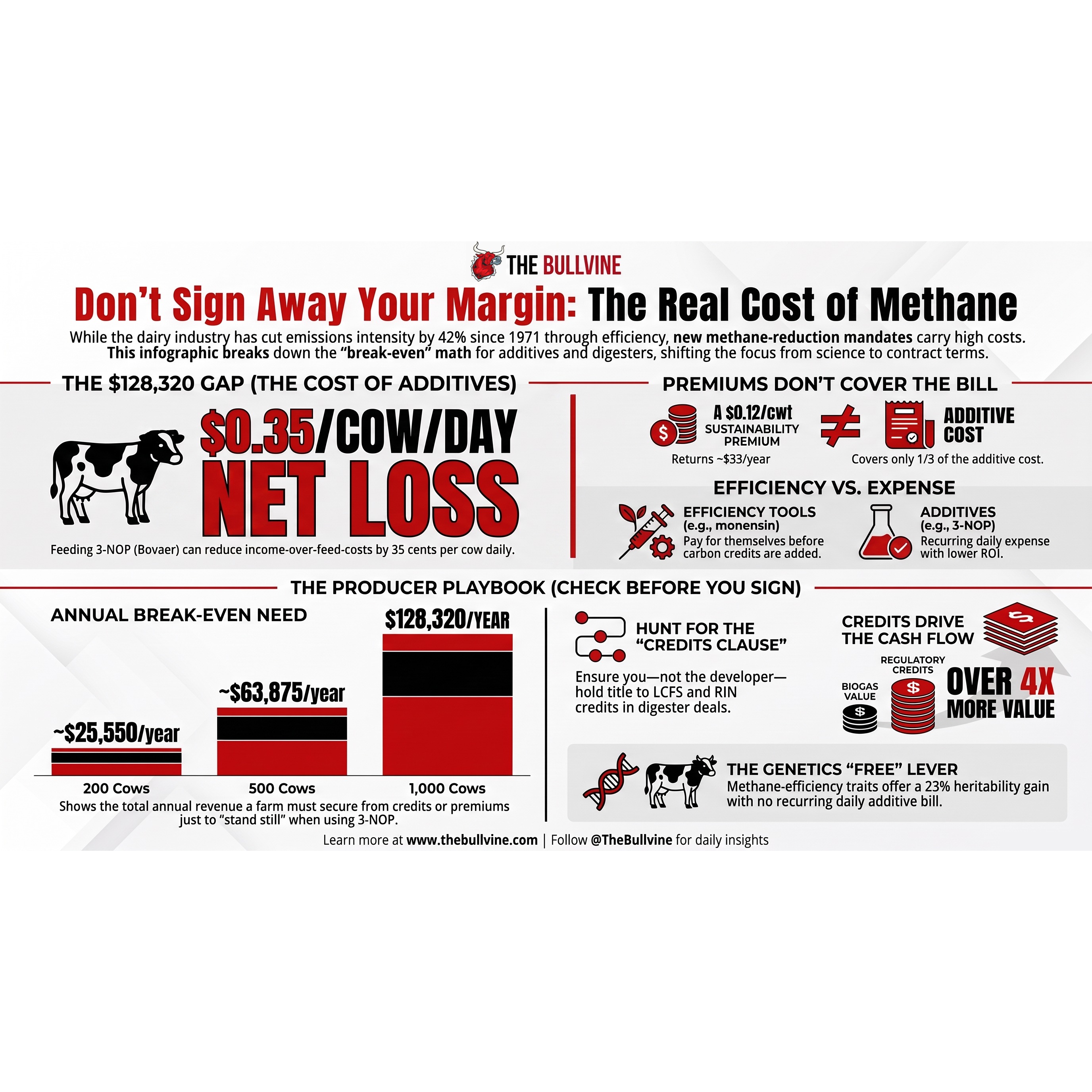
E651 The $128,320 Additive Bill: Why the First Dairy Carbon Credit Wasn’t Bovaer
Description
Feeding 3-NOP costs 35 cents a cow every day you do not get back. That is $128,320 a year on 1,000 cows your milk check cannot absorb.
The first U.S. dairy methane credit ever sold did not use Bovaer. Texas dairyman Jasper DeVos banked credits with Rumensin, an FDA-approved efficiency tool that already earned its keep before the carbon check arrived. In this episode of The Bullvine Podcast, we break down the contract trap waiting for producers as corporate buyers rush to hit 2030 climate deadlines on your margin.
What You'll Learn:
• Why 3-NOP creates a 35-cent per cow daily income-over-feed-cost deficit
• How a 12-cent sustainability premium leaves up to $73 per cow unfunded
• The real lesson from Jasper DeVos and why Rumensin changed the carbon math
• Why California digester operators generate $2,827 per cow but developers keep it
• How dairy cut emissions intensity 42% while total volume climbed 14%
Why This Episode Matters: At an August 2026 Class III milk price of $16.64/cwt, there is zero slack to quietly absorb a $128,320 annual cost on 1,000 cows or $25,550 on 200 cows. Nestlé needs 21 million metric tons of supply-chain cuts by 2030, and corporate roadmaps push mitigation down to the farm gate. When methane reductions fail to pay for themselves at the bulk tank, the fine print in your contract decides whether you protect margin or fund a processor's climate ledger.
Full article and sources: https://www.thebullvine.com/environmental-regulations/methane-additive-cost-break-even/. Subscribe for straight-talking dairy analysis. Share this with a producer who needs it.