Episode Details
Back to Episodes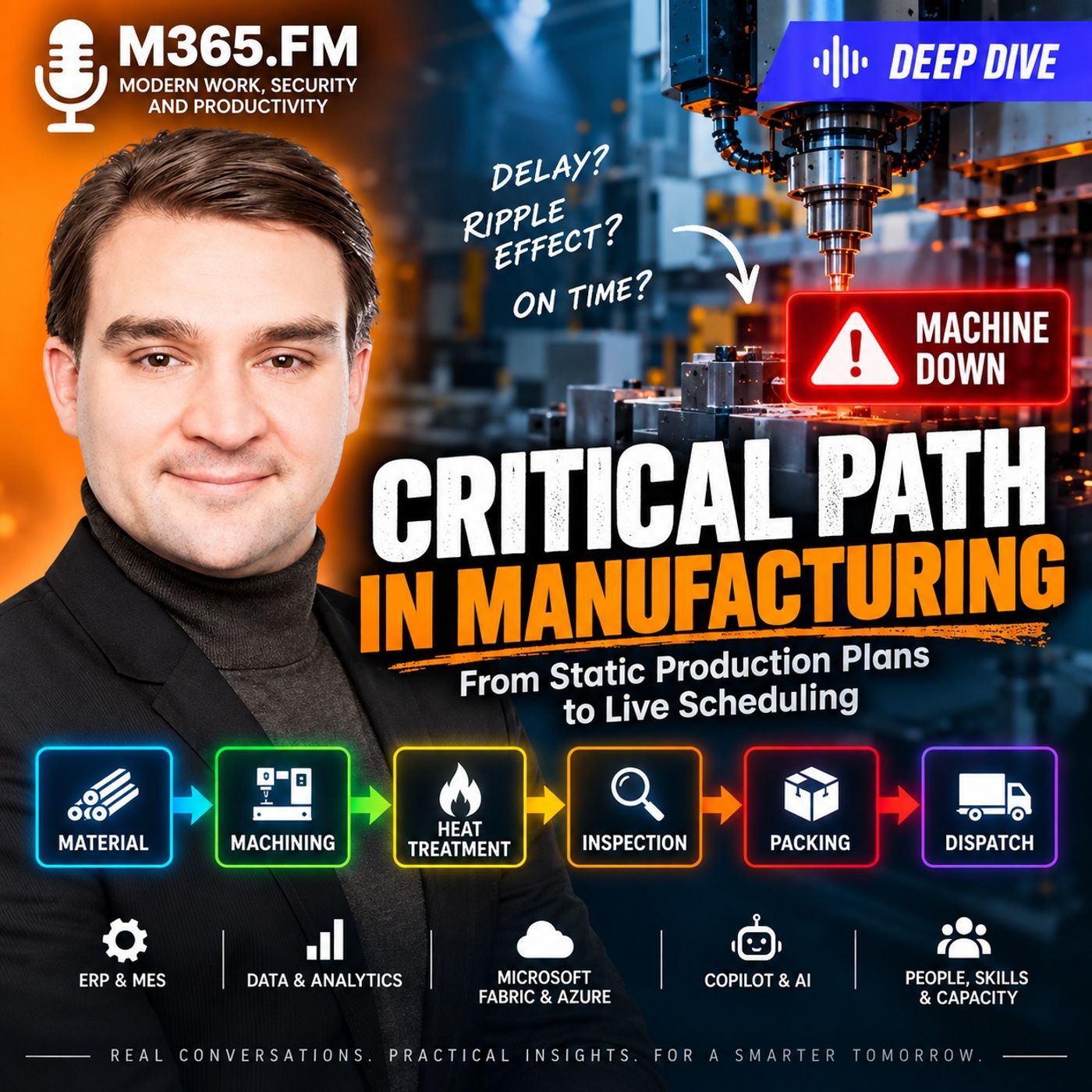
Why Your Critical Path Changes When Production Changes
Season 4
Published 1 month, 2 weeks ago
Description
A production plan can look perfectly reasonable — until production actually starts.One machine runs late. A material release slips. A qualified operator becomes unavailable. A quality inspection takes longer than expected. A batch misses its furnace window. Suddenly, a delay of only a few hours can put an entire customer delivery at risk.In this deep dive, we explore how the Critical Path Method (CPM) can be adapted from traditional project management to modern manufacturing and production planning.The central idea is simple: the critical path in manufacturing should not be treated as a fixed sequence created when the production order was released.Instead, manufacturers need to understand the live chain of dependencies that currently determines the earliest possible completion and shipment date.That chain can change throughout the production day.A machine breakdown may initially be the problem. Once the machine recovers, however, the critical dependency could move to a furnace slot, a qualified operator, an inspection queue, a missing fixture, a quality release, or even the carrier cutoff at the end of the process.This episode examines how manufacturers can connect production orders, machines, materials, people, quality states, ERP, MES, IoT, and shop-floor events into a dependency model capable of supporting more dynamic production scheduling.
WHY CRITICAL PATH METHOD MATTERS IN MANUFACTURING
Critical Path Method is normally associated with project management.A project contains tasks with durations and dependencies. Some activities can run in parallel, while others cannot begin until previous work has finished.The critical path represents the sequence of dependent activities that determines the earliest possible project completion date.Manufacturing has many of the same characteristics.A released production order contains operations that need to happen in a particular sequence. Those operations can depend on:
WHEN ONE LATE OPERATION CHANGES THE DELIVERY DATE
Consider a machine assembly that must ship by the end of the week.Its route could include:
THE CRITICAL PATH IS NOT STATIC
In manufacturing, the critical
WHY CRITICAL PATH METHOD MATTERS IN MANUFACTURING
Critical Path Method is normally associated with project management.A project contains tasks with durations and dependencies. Some activities can run in parallel, while others cannot begin until previous work has finished.The critical path represents the sequence of dependent activities that determines the earliest possible project completion date.Manufacturing has many of the same characteristics.A released production order contains operations that need to happen in a particular sequence. Those operations can depend on:
- Machine availability
- Material availability
- Qualified operators
- Fixtures and tooling
- Inspection results
- Quality releases
- Batch windows
- Maintenance schedules
- Shift calendars
- Process approvals
- Downstream capacity
- Packing and dispatch requirements
WHEN ONE LATE OPERATION CHANGES THE DELIVERY DATE
Consider a machine assembly that must ship by the end of the week.Its route could include:
- Machining
- Heat treatment
- Surface finishing
- Final inspection
- Packing
- Dispatch
THE CRITICAL PATH IS NOT STATIC
In manufacturing, the critical