Episode Details
Back to Episodes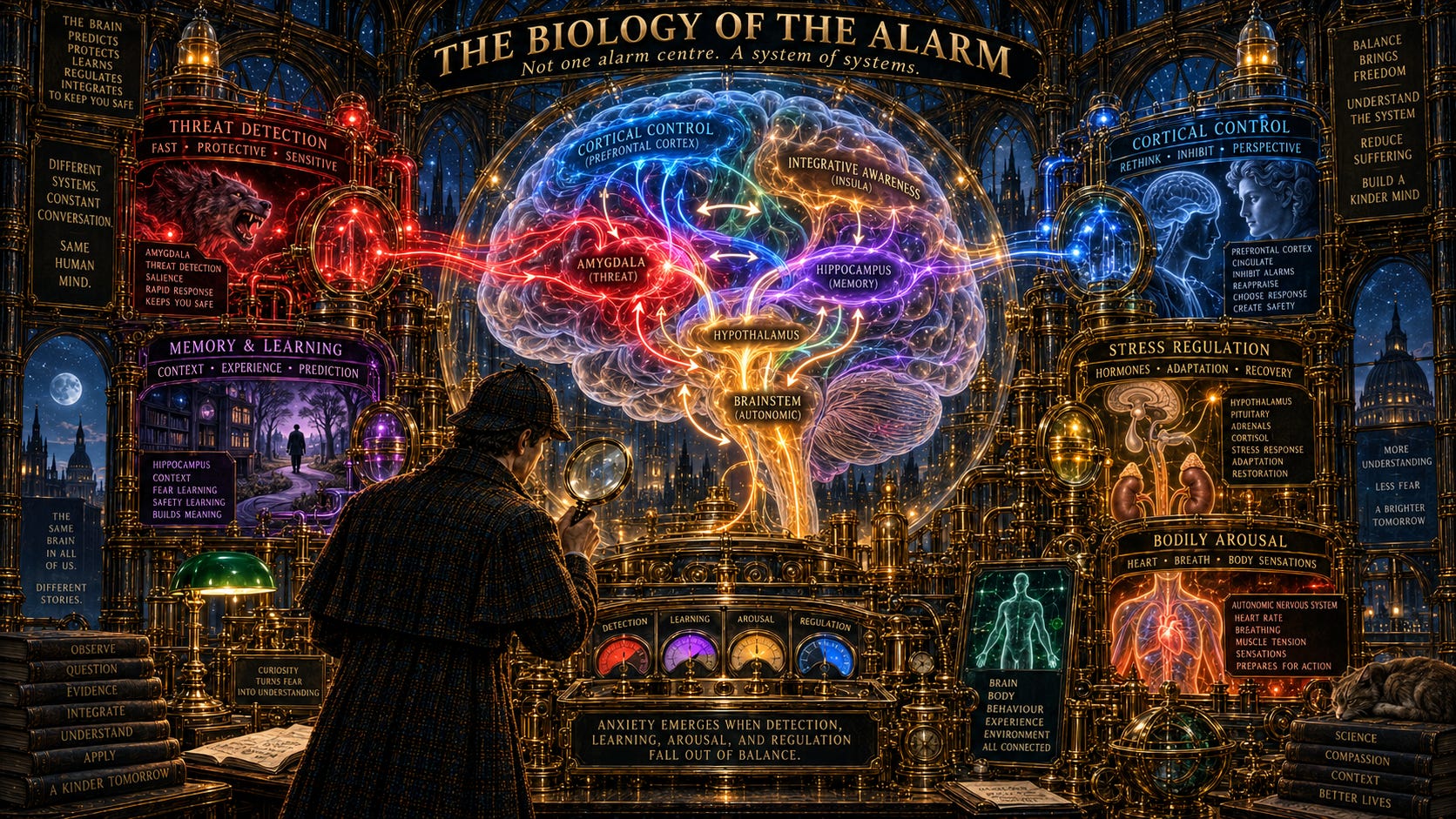
PSYCH 120: Anxiety Disorders - Neurobiology and Neuroscience
Description
Medlock Holmes enters the Neurobiological Citadel of Fear.
At its centre stands an enormous transparent brain.
It is not silent.
Signals move constantly between the amygdala, hippocampus, prefrontal cortex, thalamus, hypothalamus, locus coeruleus, and brainstem.
Some pathways detect threat.
Others generate autonomic responses.
Others encode memories.
Others decide whether a stimulus is dangerous.
Others determine whether the alarm can finally be switched off.
Holmes immediately sees the problem.
Anxiety is not produced by a single fear centre.
It is produced by a network.
The central diagram on page 4 captures this clearly. The thalamus contributes to autonomic and endocrine regulation. The hippocampus and amygdala participate in salience detection and associative learning. The locus coeruleus projects widely to cortex and helps regulate attention, arousal, and pain evaluation. The prefrontal cortex helps coordinate higher-order regulation of these responses.
The first chamber belongs to norepinephrine.
The locus coeruleus sits in the pons like an emergency broadcasting tower.
When danger appears, norepinephrine surges.
Heart rate increases.
Pupils dilate.
Breathing accelerates.
Attention narrows.
Vigilance rises.
The organism becomes ready to fight or flee.
In the short term, this is adaptive.
But when the noradrenergic system becomes excessively active, the same protective response can become pathological.
The person remains hyperaroused when danger has passed.
Startle becomes excessive.
Attention remains locked onto threat.
Autonomic symptoms themselves become frightening.
This is particularly relevant to panic disorder and phobic states.
Holmes sees the paradox.
Drugs that increase norepinephrine acutely may provoke anxiety.
Yet SNRIs and tricyclic antidepressants can treat anxiety disorders over time.
The explanation lies in adaptation.
Their therapeutic effects emerge not from the immediate increase in monoamine signalling, but from longer-term receptor and network changes.
The next chamber is the HPA Axis Observatory.
Stress activates the hypothalamus.
CRH rises.
ACTH follows.
The adrenal glands release cortisol.
Again, the system is protective.
Cortisol mobilises energy.
Sharpens vigilance.
Modifies memory.
Suppresses nonessential processes.
Helps the organism survive an acute threat.
But Holmes watches what happens when the system stays active for too long.
Persistently elevated glucocorticoids affect the hippocampus.
Cell survival changes.
Morphology changes.
Memory becomes impaired.
Metabolic and cardiovascular effects accumulate.
The source describes hypertension, osteoporosis, immunosuppression, insulin resistance, dyslipidaemia, coagulation abnormalities, and cardiovascular disease among the possible consequences of prolonged glucocorticoid exposure.
Yet when Holmes compares patients with different anxiety disorders, he does not find one uniform HPA abnormality.
Panic disorder shows mixed findings.
GAD may show increased, decreased, or dysregulated cortisol activity.
Some studies of long-term hair cortisol in GAD even suggest lower concentrations, raising the possibility that chronic anxiety can eventually downregulate the stress axis.
Social anxiety also shows inconsistent findings influenced by age and sex.
Specific phobias, however, can produce clear cortisol increases during exposure to the feared stimulus.
The lesson is important:
The stress system is dysregulated in anxiety, but not in one identical direction across all disorders.
Holmes then enters t