Episode Details
Back to Episodes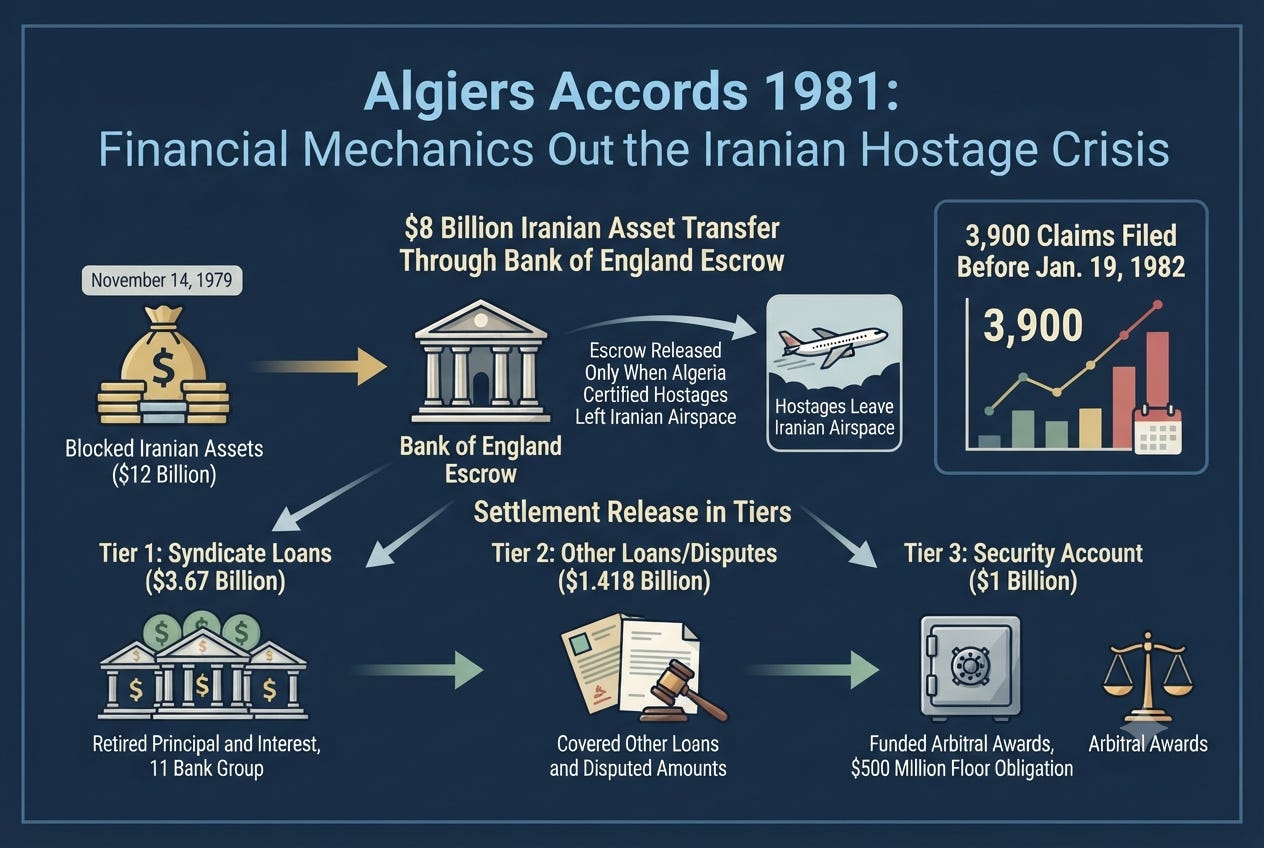
Resolving the Iranian Hostage Crisis
Description
The Algiers Accords of 1981: How the Iranian Hostage Settlement Built the Machinery of Modern Economic Sanctions
The Algiers Accords, signed January 19, 1981, freed 52 American hostages and routed roughly $8 billion in Iranian assets through a Bank of England escrow to an arbitral tribunal at The Hague. The settlement did not end economic pressure on Iran. It built the legal and financial machinery that every subsequent American sanctions program has used, and it established, through Dames and Moore v. Regan, 453 U.S. 654 (1981), that a president may nullify court attachments, move blocked foreign assets, and extinguish pending private lawsuits as the price of a diplomatic bargain. Any executive whose company holds foreign sovereign receivables, sells into a sanctioned jurisdiction, or relies on cross border escrow should understand that the rules governing those positions were written in 1981 to solve a hostage crisis.
A. Executive Summary
The 444 day detention of American diplomatic personnel in Tehran ended through two declarations issued by the government of Algeria on January 19, 1981, acting as intermediary because Washington and Tehran had no diplomatic relations. The General Declaration set out the political and financial terms. The Claims Settlement Declaration created the Iran United States Claims Tribunal at The Hague and gave it jurisdiction over private commercial claims that had been pending in American courts.
The financial terms were more consequential than the political ones. Approximately $12 billion in Iranian government assets had been blocked on November 14, 1979 under Executive Order 12170, one of the first major uses of the International Emergency Economic Powers Act of 1977, codified at 50 U.S.C. 1701. The settlement unwound that block through a sequence of transfers: roughly $3.67 billion to retire principal and interest on syndicated bank loans, approximately $1.418 billion reserved for other loans and disputed amounts, and $1 billion into a security account held at the Bank of England in the name of the Central Bank of Algeria, which Iran was obligated to replenish whenever the balance fell below $500 million.
Scholarly consensus treats the tribunal as the most productive claims body in the history of international arbitration. Roughly 3,900 claims were filed before the January 19, 1982 deadline. American nationals ultimately recovered on the order of $2.5 billion and Iran recovered more than $1 billion. What remains contested is whether the accords constituted a lawful executive agreement or a coerced settlement, and whether the non intervention pledge in Point I retains any operative legal content today.
The pattern that followed is the finding most relevant to a contemporary reader. Trade sanctions lifted in January 1981 returned in stages beginning in 1983, and every later program relied on the same statutory authority and the same asset blocking mechanics validated in 1981. The settlement did not resolve hostility. It built and tested the instruments that later administrations used to apply economic pressure.
B. Detailed Findings
What the Algiers Accords actually required of each government
The General Declaration imposed four obligations on the United States and one on Iran. Iran agreed to release all 52 remaining hostages safely. The United States agreed to four things: to abstain from intervention in Iran’s internal affairs, to remove the asset block and the trade sanctions, to terminate the litigation then pending in American courts and move those disputes to binding arbitration, and to freeze and prohibit transfers of assets belonging to the former Shah and his close relatives while assisting Iranian efforts to recover them through litigation, including by declining to raise sovereign immunity as a defense.
Point I contains the language that has generated the argument that has recurred most often. It states that it is and from t