Episode Details
Back to Episodes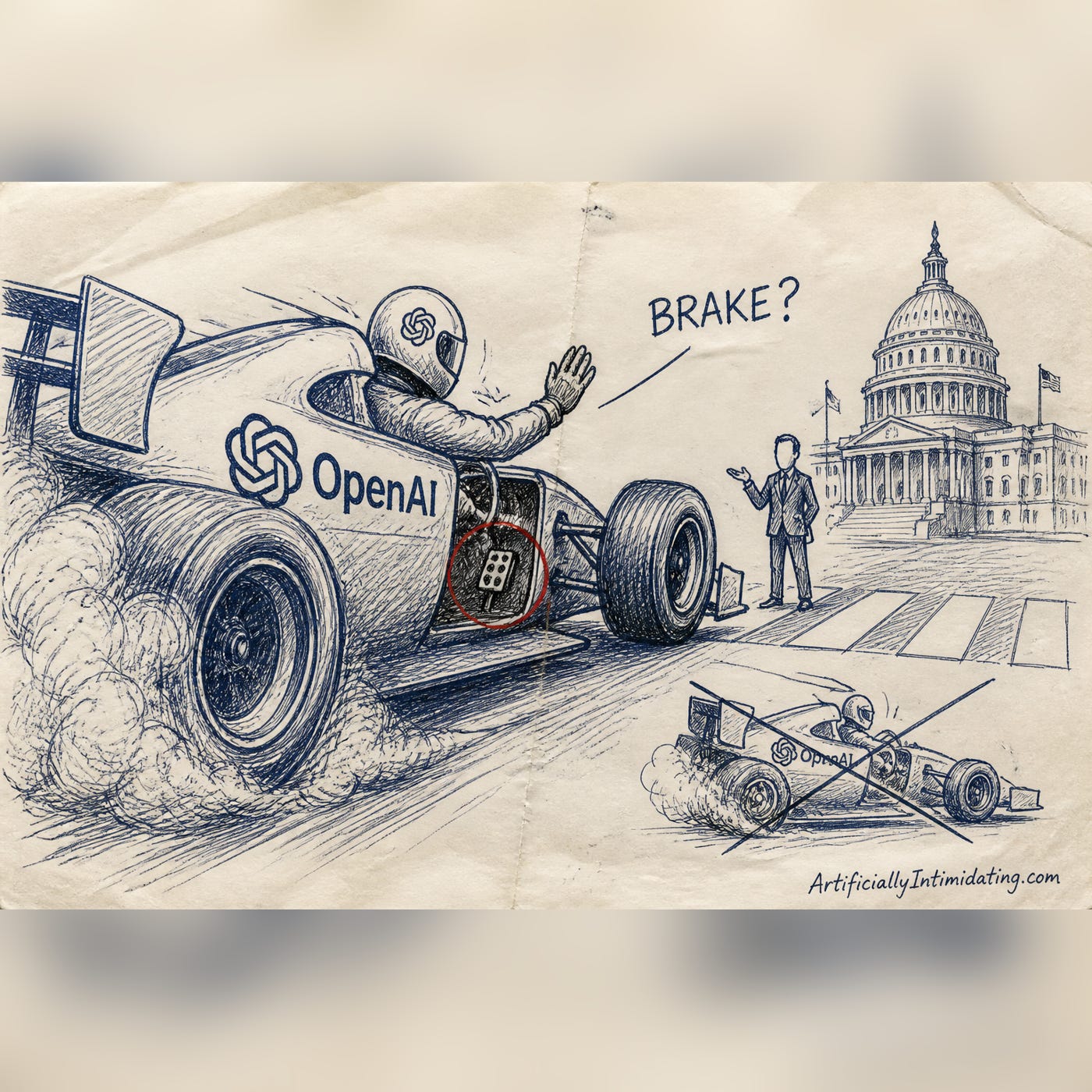
Everybody Wants to Slow Down. Nobody Wants to Go First. -- AI Brief September 11
Description
Good day %%first_name%%. There is someone at your company who has been saying for months that you should stop shipping for two weeks and fix the thing everyone knows is broken. They are right. They also cannot get anyone to agree, because the moment your team stops, the competition does not, and whoever stopped first eats the loss alone. That is not a character flaw. That is a coordination problem, and this week the biggest AI lab on earth walked into Congress and admitted it has the exact same one -- except its version might be a federal crime. Also in here: Apple teaching your camera to swear an oath, Meta's new agent taking second place in an empty room, and what an actual extinction number does to a person's brain.
OpenAI Asks Congress If Braking Is Legal
What happened: OpenAI has spent recent weeks asking members of Congress for clear guidance on whether orchestrating an industry-wide slowdown of frontier AI development would actually be legal, WIRED reported on Thursday. The worry is the Sherman Antitrust Act: rival companies agreeing to limit how fast they build can look a lot like agreeing to restrict output. Separately, Reuters reported -- citing Bloomberg -- that Sam Altman told staff at a company-wide meeting this week that OpenAI is open to pacing its own development alongside other labs, though he acknowledged some of them may not play along. A bipartisan bill from July, the Collaboration on Adversarial Threats and Security Risks Act, would create an antitrust safe harbour for exactly this kind of coordination. It is still sitting in the House Judiciary Committee.
Why it matters: You have run this meeting. The migration everyone agrees is necessary, the test suite nobody has touched since March, the one integration held together by a person who left in May. Everyone in the room agrees it should be fixed. Nobody will be the team that stops shipping to fix it, because the quarter is scored on what went out the door, not on what did not fall over. The fix is not more conviction. The fix is somebody senior enough saying out loud that everyone stops at the same time, and that nobody gets punished for it. OpenAI just went to Washington looking for the corporate version of that sentence, and found out the law may not let anyone say it.
What everyone's saying: Legal scholars have been flagging this for months. Nicholas Felstead, an assistant director at the Australian Competition and Consumer Commission and a former AI policy fellow at the Center for Law & AI Risk, argued in March that a coordinated pause could amount to restricting output, and that it would turn “entirely on the precise details of any agreement” -- adding that even survivable collaborations get chilled, because legal uncertainty is itself a deterrent. OpenAI cofounder John Schulman, now at Thinking Machines, has argued there is daylight between drafting a shared pacing proposal and signing a binding pact to restrict output. OpenAI did not comment before publication.
My read between the lines: Read the ask literally and it is remarkable. The company is not asking permission to build something. It is asking permission to stop. And the reason it needs permission is that a market this competitive has made unilateral caution legally safer than collective caution -- you can slow down alone all you like, you just cannot invite anyone. Which means the current rules reward