Episode Details
Back to Episodes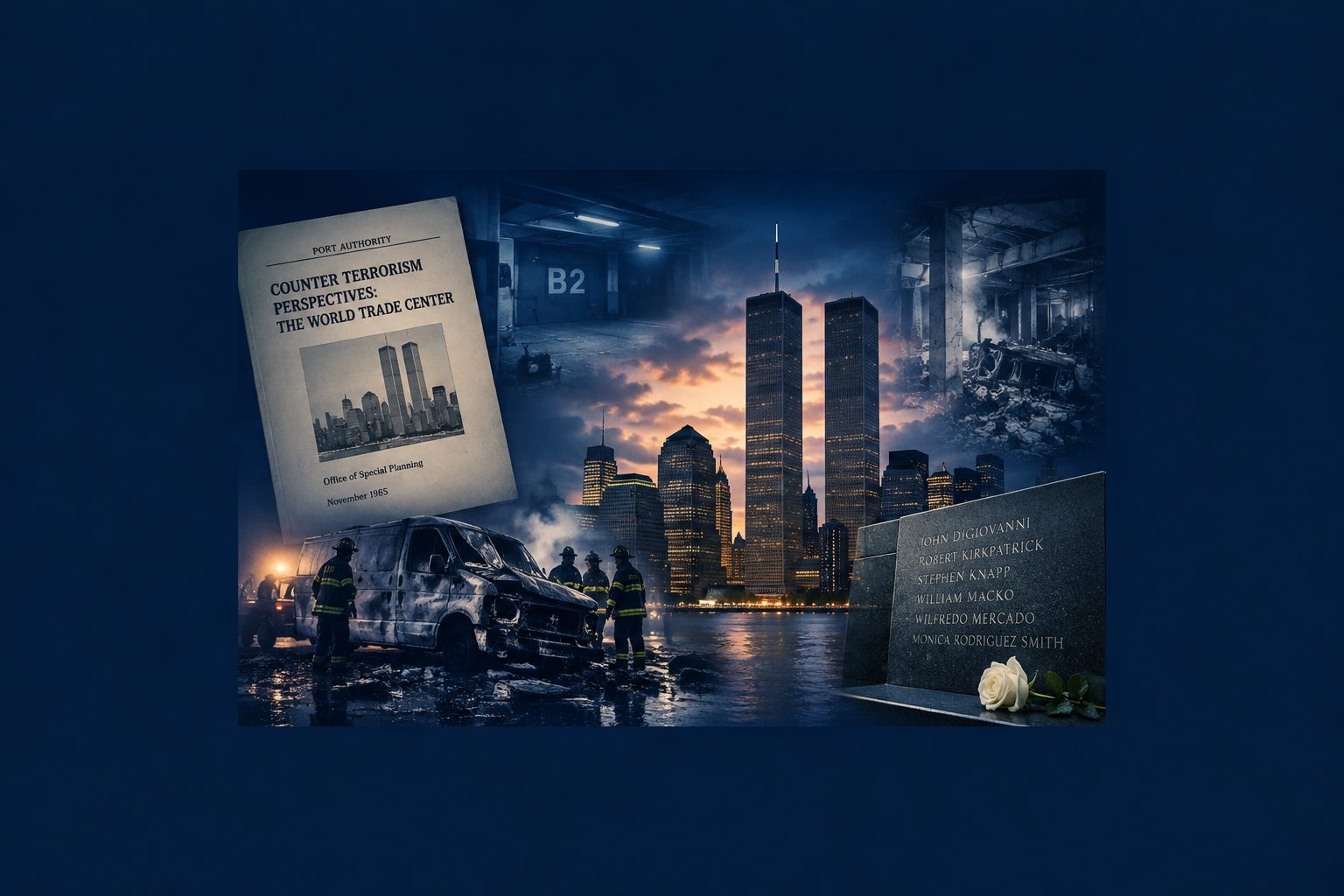
The 1993 World Trade Center Bombing Was Described Eight Years Early
Description
The 1993 World Trade Center bombing killed six people on February 26, 1993, eight years after the Port Authority’s own study described the exact attack. That study, titled Counter Terrorism Perspectives: The World Trade Center, was issued in November 1985 by the agency’s Office of Special Planning, and it posited a time bomb laden vehicle driven into the public parking area beneath the complex. It rated the threat low risk and recommended eliminating public parking anyway; the recommendation was not adopted. This is settled history, with the criminal record closed in 1998 and the civil record closed in 2011, and the gaps that survive are narrow and specific.
A. Executive Summary
A yellow Ford Econoline rented from a Ryder outlet in Jersey City carried a urea nitrate main charge of roughly 1,310 to 1,500 pounds onto the B 2 parking level under Tower One, where it detonated at 12:18 p.m. on February 26, 1993. Six people died, one of them seven months pregnant, and federal records count 1,042 injured. Roughly 50,000 people evacuated a complex whose emergency lighting and public address systems had failed with the power, which is why the injury count ran to more than a hundred and seventy times the death toll. Smoke did what the charge could not.
Attribution came fast. It came from paperwork. Investigators pulled a vehicle identification number from a frame fragment on February 28 and traced it to the rental agency. Mohammed Salameh was arrested on March 4 when he returned to recover a $400 deposit on a van he had reported stolen the day before the attack. Approximately 700 agents worked the case worldwide; four men were convicted in March 1994, Ramzi Yousef and Eyad Ismoil followed in November 1997, and Yousef received life plus 240 years on January 8, 1998.
The attack was directed at the structure of the buildings and not merely at the people inside them, which is the fact that determines where the case belongs in the historical sequence. Yousef placed the charge against a load bearing element on the theory that Tower One would fall into Tower Two, and he later put the intended death toll at roughly 250,000. The engineering failed and the intent survives in the record. That intent is why the 1993 attack sits in the same analytical line as the 2001 attacks and not in the line of conventional bombings that preceded it.
What followed the attack was statutory and not military. Congress created a weapons of mass destruction offense in 1994 and wrote both a transnational terrorism offense and a Foreign Terrorist Organization designation authority into law in 1996. The armed forces received a domestic consequence management role in the defense authorization act for fiscal year 1997. No missile flew and no state was named. What remains contested is whether a division of labor designed for an event the emergency system could absorb was the right structure for a threat that had already stated its ambitions in six figures.
B. Immediate Tactical Assessment
how many people died in the 1993 world trade center bombing
Six people were killed and 1,042 were injured, and both figures are Established in the federal record. The dead were John DiGiovanni, 45, a dental products salesman; Robert Kirkpatrick, 61, Stephen Knapp, 47, and William Macko, 57, all Port Authority maintenance supervisors eating lunch in a basement break room. The others were Wilfredo Mercado, 37, a restaurant receiving agent checking deliveries, and Monica Rodriguez Smith, 35, a secretary who was seven months pregnant and whose unborn child also died. Five of the six were at work in the sublevels where the charge was parked.
Proximity determined who died. Prominence and position entered into none of it. The victims were maintenance staff, a delivery agent, a salesman, and a secretary, all of them working below street level on an ordinary Friday at midday, and none of them selected for anything beyond their location.
<