Episode Details
Back to Episodes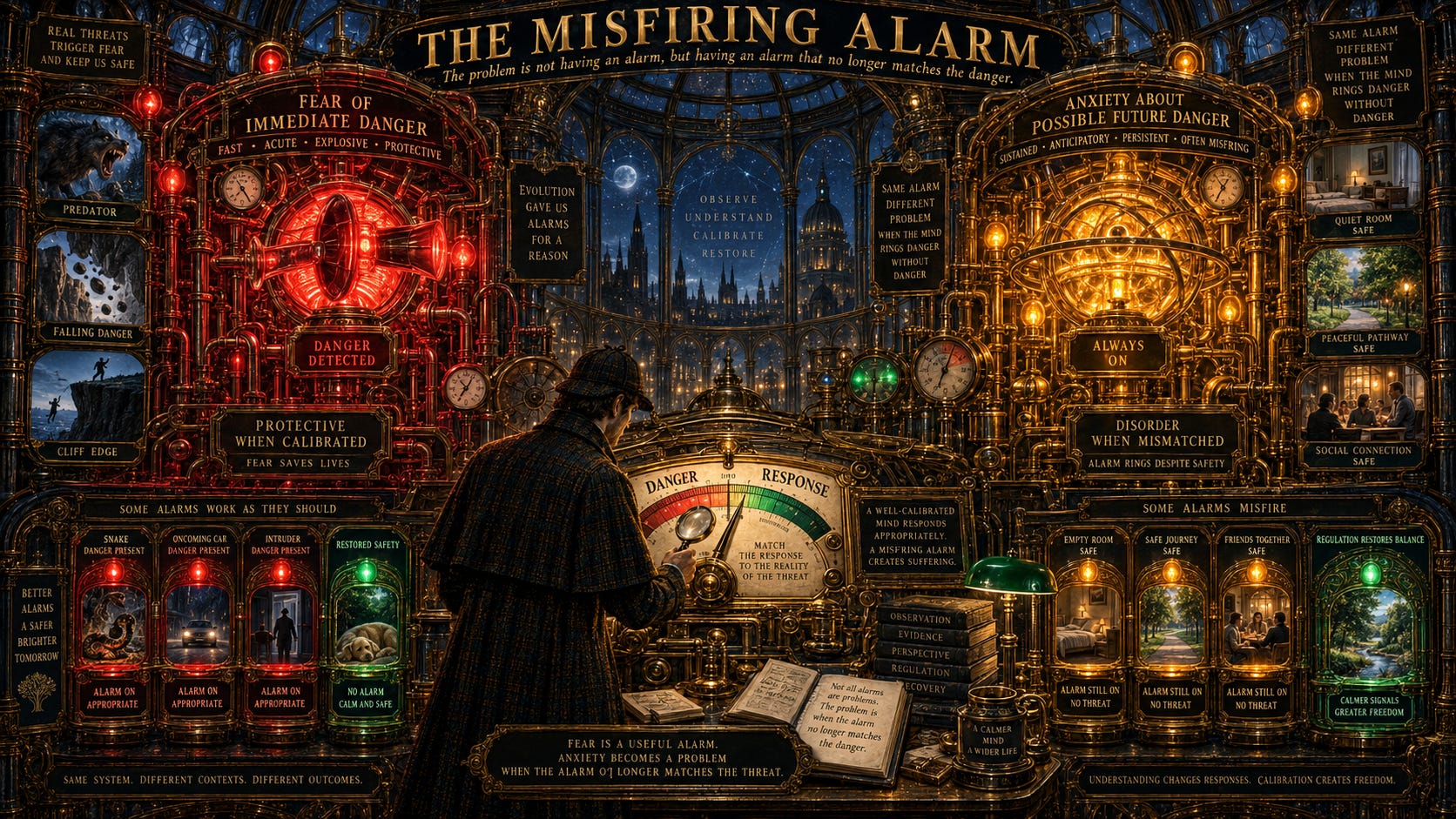
PSYCH 117: Anxiety Disorders - Introduction and Overview
Description
Medlock Holmes enters the Grand Observatory of Fear and Anxiety.
At the centre stand two enormous warning systems.
One is labelled:
FEAR
The other:
ANXIETY
At first they appear identical.
Both activate the body.
Both sharpen attention.
Both pull behaviour towards avoidance.
Both exist to protect the organism from harm.
But Holmes quickly sees the difference.
Fear is immediate.
A threat is here.
A predator appears.
A car swerves towards the pedestrian.
A dangerous person approaches.
The brain mobilises rapidly.
Anxiety is different.
The threat is not yet present.
It may be distant.
Ambiguous.
Possible.
The organism prepares for what might happen.
The chapter distinguishes them across both time and space.
Fear is the acute response to proximal, overt danger.
Anxiety is the sustained response to distal, anticipated, or uncertain threat.
Holmes walks into a laboratory where a simple conditioning experiment is underway.
A tone predicts an aversive event.
When the tone appears, the animal freezes.
That is the analogue of fear.
But later, when the animal is returned to the same environment without the tone, its body remains vigilant.
Nothing dangerous is currently happening.
Yet the context itself has become threatening.
That is closer to anxiety.
The distinction is not perfect.
When an immediate threat becomes especially intense, the acute state may be better understood as panic.
Holmes therefore draws three circles:
Anxiety → Fear → Panic
Not as separate diseases, but as increasingly immediate forms of defensive response.
The chapter then asks a more difficult question:
When does normal anxiety become abnormal?
The answer cannot come from intensity alone.
Humans are supposed to feel anxious.
A student before an examination.
A parent waiting for medical results.
Someone walking alone through an unsafe environment.
Anxiety becomes clinically significant when it produces substantial distress or interferes with normal functioning.
But Holmes notices a complication.
Impairment depends partly upon environment.
Two people could have similar internal fear responses, yet one has greater resources, social support, financial security, or environmental flexibility.
The same neural response may therefore create very different levels of disability.
Clinical definitions and neuroscience do not always draw their boundaries in exactly the same place.
This becomes one of the chapter’s central ideas:
Anxiety exists at the intersection of brain, behaviour, and context.
Holmes then enters the Hall of Classification.
The DSM-5 anxiety-disorder family includes:
* Panic disorder
* Agoraphobia
* Specific phobia
* Social anxiety disorder
* Generalized anxiety disorder
* Separation anxiety disorder
But two familiar conditions have moved elsewhere.
Obsessive-compulsive disorder is now classified among obsessive-compulsive and related disorders.
Post-traumatic stress disorder belongs among trauma- and stressor-related disorders.
Agoraphobia has become independently diagnosable rather than being defined only through panic disorder.
Social phobia has become social anxiety disorder.
And separation anxiety disorder is no longer restricted conceptually to childhood.
Holmes recognises what classification is trying to achieve.
Not perfect biological truth.
A practical structure for identifying recurring clinical patterns.
T