Episode Details
Back to Episodes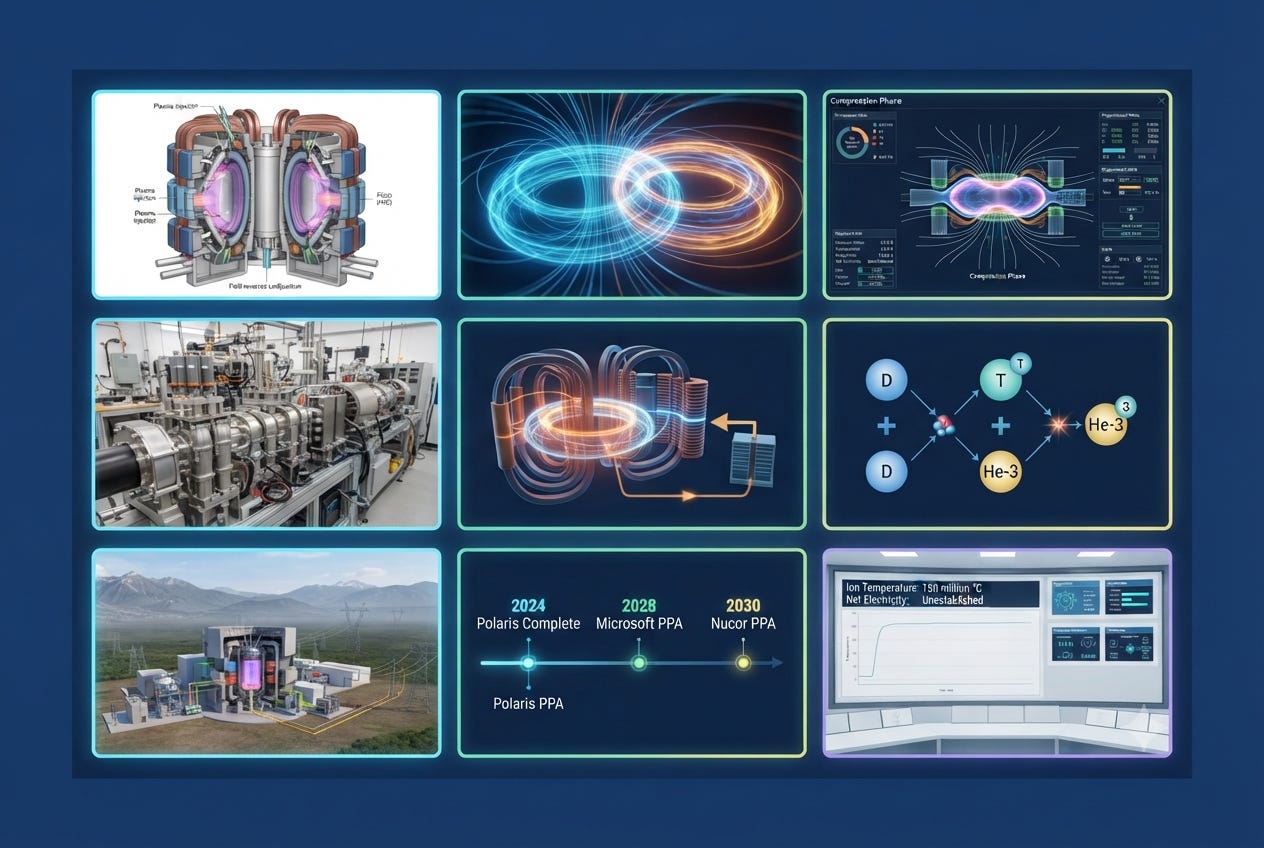
The Helion Polaris Fusion Reactor
Description
A. Executive Summary
Helion Energy’s Polaris reported 150 million degrees Celsius in February 2026 with no published Q value, so the 2028 Microsoft delivery date rests on schedule, not measured fusion gain.
Polaris is Helion’s seventh generation pulsed field reversed configuration machine in Everett, Washington, and the February 2026 result ran on deuterium tritium fuel, not the deuterium helium 3 mixture the commercial design requires. Helion has published no target gain and no recirculating power figure for Polaris or for Orion, the fifty megawatt electric plant under construction in Chelan County, Washington, that carries the 2028 obligation to Microsoft. Chief executive David Kirtley and coauthor R. Milroy’s 2023 Journal of Fusion Energy scaling paper argues deuterium helium 3 can outperform deuterium tritium in fusion power density above 10 to 20 kiloelectronvolts, without a measured gain from Polaris.
Three facts bear on 2028. Helion already missed one prior target, a 2024 net electricity demonstration on Polaris that did not occur. The company raised 425 million dollars in January 2025 and 465 million dollars in June 2026 to fund Orion’s construction, reaching 1.5 billion dollars against a 15.5 billion dollar valuation. Washington issued Orion’s state radioactive material and air emissions licenses in June 2026 under the byproduct material treatment the Commission set for fusion machines in October 2023, while the Commission’s own implementing rule for that treatment sat as a proposal past its May 27, 2026 deadline.
The principal technical dispute is whether a temperature milestone on the wrong fuel mixture, with no published Q or recirculating power number, supports an inference about grid ready electricity three years later. The most consequential fact for Microsoft is that Helion’s dollar exposure for missing 2028, described by Kirtley as carrying financial penalties, has never been made public, and no independent party has metered a single Polaris figure.
B. What Question Does This Report Answer
Does Helion Actually Deliver Electricity To Microsoft In 2028
Helion Energy says Polaris leads to electricity delivered to Microsoft in 2028 under their power purchase agreement. Where does that actually stand technically and legally, and how credible is the date.
This report reads the question as a request for three distinct findings: the measured technical state of Polaris and its bearing on Orion, the legal instruments, licenses, and contract terms that currently govern the Microsoft delivery obligation, and an assessment of how much weight the 2028 date can bear given the schedule and funding history on the record. It does not survey the fusion field, and it does not resell Helion’s own marketing account of its technology. A reader who wants the answer to change should look for three things: a published Q, target gain, or facility gain figure for Polaris measured by a party other than Helion, a public capital cost or recirculating power figure for Orion, and a final Nuclear Regulatory Commission rule implementing byproduct material licensing for fusion machines instead of a proposed one.
C. Device and Confinement Approach
How Does Helion Polaris Actually Work
Polaris is Helion Energy’s seventh generation machine, a nineteen meter, hourglass shaped device that forms two magnetized plasma rings, called field reversed configurations, at opposite ends of a linear chamber, drives each ring toward the center at roughly 1.6 million kilometers per hour, merges them, and compresses the merged plasmoid with a rising external magnetic field in under one millisecond. The approach belongs to the magneto inertial fusion family: it borrows the pulsed, transient character of inertial confinement while using magnetic fields rather than a laser or a liner to compress the fuel, and it runs the entire cycle, injection, merging, compression, burn, and expansion, as a repeat