Episode Details
Back to Episodes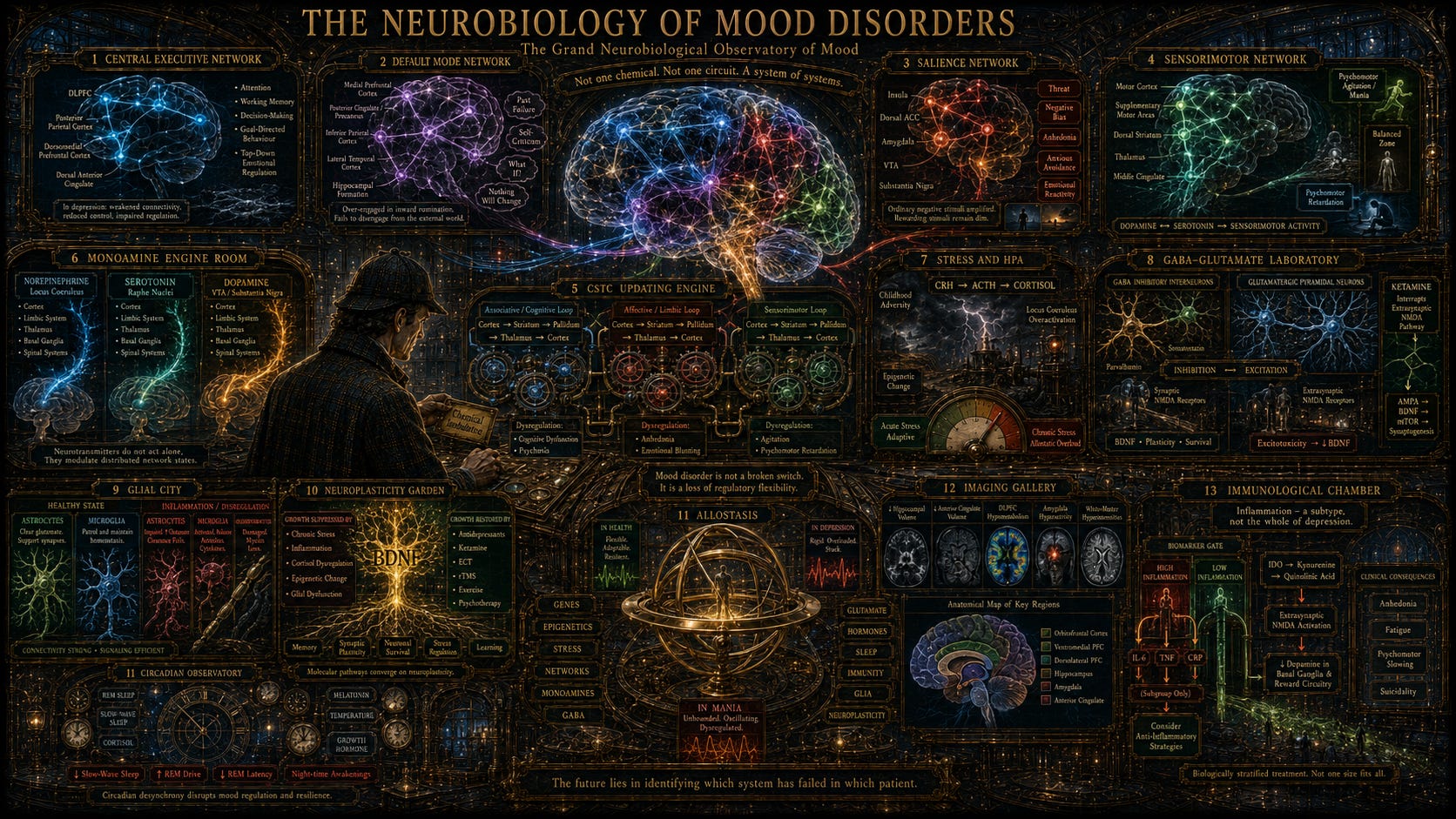
PSYCH 116: Mood Disorders - Neurobiology
Description
Medlock Holmes enters the Grand Neurobiological Observatory of Mood.
At its centre is not one brain map, but an enormous interconnected city of systems.
One district controls attention and executive function.
Another processes salience and threat.
Another turns inward towards memory, self-reflection, and rumination.
Another regulates movement.
Another tracks reward and motivation.
Above them all, stress hormones, immune signals, monoamines, glutamate, GABA, and neurotrophic factors move like weather systems across the city.
Holmes quickly realises that the old search for a single biological cause of depression is inadequate.
The modern question is different:
How do multiple systems lose their ability to regulate one another?
The investigation begins with clinical phenomenology.
Depression alters cognition, reward, movement, sleep, appetite, libido, energy, and biological rhythms.
Negative cognitive bias implicates prefrontal, hippocampal, amygdala, and limbic circuitry.
Anhedonia points towards reward circuits involving the ventral tegmental area, nucleus accumbens, anterior cingulate, thalamus, hypothalamus, and prefrontal cortex.
Psychomotor slowing and agitation implicate subcortical and sensorimotor systems.
Sleep and circadian disturbance draw attention towards hypothalamic, thalamic, and brainstem regulation.
The symptoms themselves therefore offer clues to the underlying neural architecture.
Holmes then enters the Network Chamber.
The first structure is the Central Executive Network, centred on the dorsolateral prefrontal and posterior parietal cortices.
It supports working memory, attention, decision-making, goal-directed behaviour, and top-down regulation of emotion.
The diagram on page 8 maps this network across the dlPFC, posterior parietal cortex, dorsomedial prefrontal cortex, dorsal anterior cingulate, and inferior temporal regions. When this system underfunctions, indecisiveness, poor working memory, impaired attention, and weak emotional control can emerge.
The next chamber is the Default Mode Network.
Its hubs include the medial prefrontal cortex, posterior cingulate/precuneus, inferior parietal regions, lateral temporal cortex, and hippocampal formation.
The figure on page 10 shows the network underlying self-reflection, autobiographical memory, future planning, social cognition, and internally directed thought.
In depression, abnormal DMN connectivity may promote rumination, negative self-focus, and difficulty disengaging from internal thought to solve external problems.
Holmes then examines the Salience Network.
The insula, dorsal anterior cingulate, amygdala, ventral tegmental area, and substantia nigra help determine what deserves attention and emotional significance.
The page 12 diagram links dysfunction here with anhedonia, anxious avoidance, negative emotional bias, inattention, and impaired emotional control.
A fourth system is the Sensorimotor Network.
Its disturbances may help explain why depression can physically slow a person while mania can accelerate them.
The source proposes that mania may involve elevated salience and sensorimotor activity with reduced default-mode self-monitoring, whereas depression may involve reduced sensorimotor activity alongside greater internally focused processing.
The psychomotor balance diagram on page 29 captures this beautifully: changes in sensorimotor activity and the balance between dopamine and serotonin are shown along a continuum from severe psychomotor retardation to agitation.
Holmes reaches a key conclusion.
Mood disorders may involve less a failure of individual brain regions than a failure of dynamic coupling between networks<