Episode Details
Back to Episodes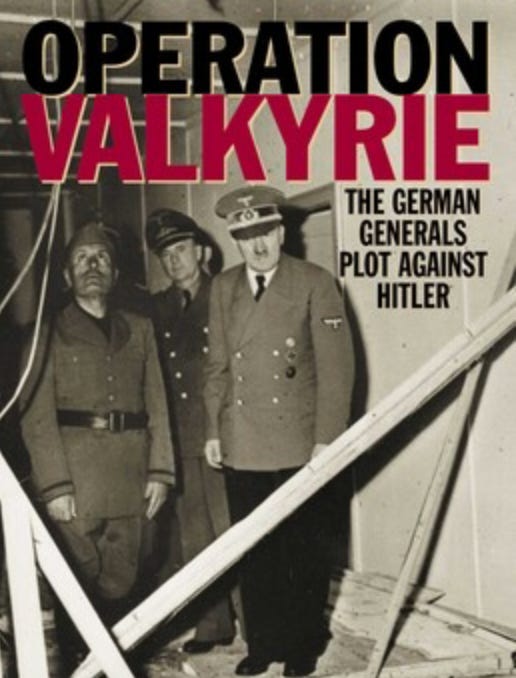
Operation Valkyrie and the July 20, 1944 Plot
Description
Operation Valkyrie was an internal security plan approved by Hitler, and German staff officers rewrote it between August 1943 and July 1944 into a coup blueprint. The attempt failed on July 20, 1944 for reasons that had little to do with the bomb and much to do with authority, authentication, and control of communications. More than 7,000 arrests followed, and the German officer corps ceased to function as an independent institution. The operative lesson for anyone who holds emergency authority documents is that a plan written to preserve an institution can be turned against that institution by the people trusted to hold the pen.
A. Executive Summary
The July 20, 1944 attempt on Hitler’s life failed at 12:42 pm inside a wooden briefing hut at the Wolfsschanze headquarters near Rastenburg in East Prussia. Roughly one kilogram of plastic explosive detonated beneath a heavy oak conference table. A stenographer and three officers died. Hitler walked out with a perforated eardrum, singed trousers, and conjunctivitis in one eye; the coup that depended on his death collapsed in Berlin over the following eleven hours.
The plan the conspirators used was not their own invention, and Valkyrie was drawn up inside the General Army Office under Friedrich Olbricht as an emergency plan for the Replacement Army, and it carried approval at the highest level of the German state. Its stated purpose was maintaining order during civil breakdown caused by Allied bombing, sabotage, or a rising among the more than seven million foreign workers and prisoners inside German industry. Authority to release the plan rested with two men: Hitler and Colonel General Friedrich Fromm, commander of the Replacement Army since 1938.
Henning von Tresckow drafted the supplementary orders that converted the plan into a coup instrument, working between August and September 1943, and those orders directed mobilized units onto ministries, telephone and telegraph exchanges, broadcasting sites, and Nazi Party offices. Claus von Stauffenberg refined the text after his appointment as chief of staff to Fromm on July 1, 1944, an appointment that delivered both access to Hitler’s briefings and proximity to the single signature that could release the plan. Three compounding failures then decided the day. Colonel Heinz Brandt moved the briefcase behind the table support, only one of two explosive packs was armed, and the communications blackout attempted by chief of communications Erich Fellgiebel did not cover the SS circuits that carried word to Berlin.
What followed was the most extensive internal purge of the German officer corps during the war, and scholarship differs sharply on the totals, and the difference matters for how the event is understood.
B. Detailed Findings
What was Operation Valkyrie designed to do before the conspirators changed it?
Valkyrie was an internal security and continuity plan for the Replacement Army, the training and depot organization that held Germany’s uniformed manpower inside the borders of the Reich. Its object was keeping state functions running during civil breakdown, whether caused by Allied bombing, sabotage, or a rising among the foreign labor force that exceeded seven million people by the summer of 1944. The plan was developed in the General Army Office under Friedrich Olbricht and approved at the top of the state. Execution authority rested with two men.
That authority structure is the whole story of July 20, and a plan releasable only by two named individuals carries a single point of failure by design; the conspirators understood the problem precisely. Their operational design reduced to one question: whether Fromm would sign, or whether his signature could be bypassed long enough to make the mobilization irreversible. Olbricht added a second stage after March 1943, identified in the orders as Valkyrie II, which converted alert