Episode Details
Back to Episodes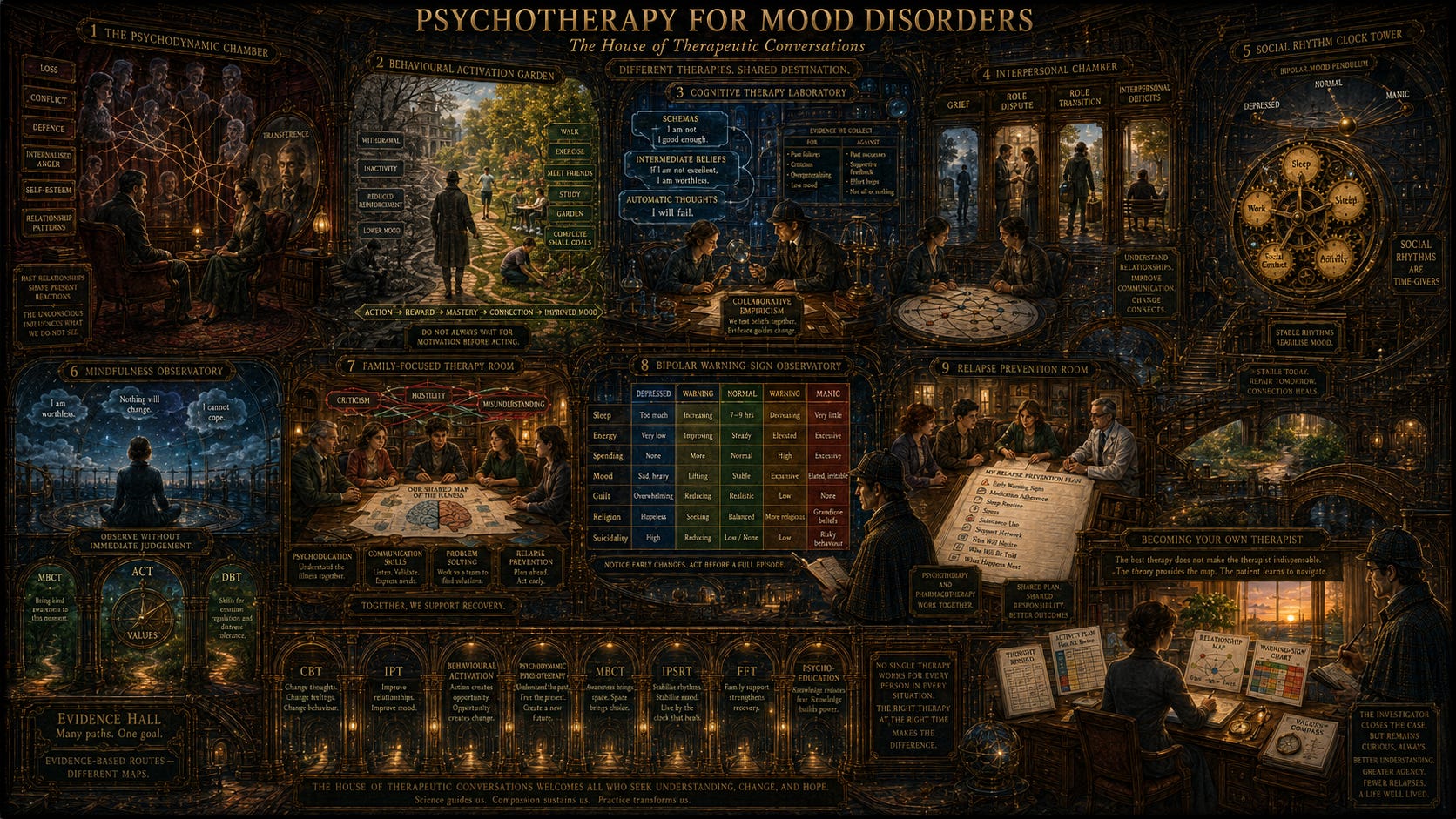
PSYCH 115: Mood Disorders - Psychotherapy
Description
Medlock Holmes enters the House of Therapeutic Conversations.
Unlike the pharmacological observatory, there are no bottles, serum levels, or receptor maps here.
Instead, there are rooms.
Each room represents a different way of understanding and changing mood disorder.
One contains memories, conflicts, and unresolved relationships.
Another contains automatic thoughts and deeply held beliefs.
Another contains grief, role transitions, and interpersonal disputes.
A fourth is filled with routines, clocks, families, values, mindfulness, and behavioural experiments.
Holmes quickly realises that psychotherapy is not one treatment.
It is a family of treatments built upon different theories of how suffering is maintained and how change occurs.
The historical journey begins with psychoanalytic and psychodynamic therapy.
Early models conceptualised depression as arising from unconscious conflict, internalised anger, loss, and disturbed object relationships. Therapy was long term and aimed at insight through free association, interpretation, and examination of transference.
Modern psychodynamic treatments are often much more focused and time limited, but retain the central idea that current symptoms may be shaped by patterns of relationship, defence, and meaning that are not fully conscious.
The next chamber belongs to behavioural therapy.
Here the model becomes concrete.
Depression is associated with withdrawal.
Withdrawal reduces access to pleasure, achievement, social contact, and reinforcement.
Reduced reinforcement worsens mood.
Worsened mood drives further withdrawal.
The treatment therefore aims to interrupt the cycle.
Get up.
Re-engage.
Schedule meaningful activity.
Reconnect with people.
Test whether action can precede motivation rather than waiting for motivation to appear first.
From behavioural therapy emerges one of the most influential approaches in psychiatry:
Cognitive Behavioural Therapy.
Holmes stands before three levels of cognition.
At the surface are automatic thoughts.
Beneath them lie intermediate beliefs.
At the deepest level are schemas.
A student receives a poor mark and thinks:
“I will never succeed.”
Behind the thought may lie a rule:
“If I am not excellent, I am a failure.”
And beneath that:
“I am not good enough.”
CBT teaches the patient to observe these thoughts, examine their accuracy, test them against evidence, and develop more balanced alternatives.
The therapist does not simply tell the patient they are wrong.
Instead, therapist and patient become joint investigators.
Beck called this collaborative empiricism.
The patient learns to conduct experiments in everyday life.
The thought record shown on page 18 of the source captures this process clearly: a situation, emotion, automatic thought, rational response, and resulting emotional shift are tracked systematically so that assumptions can be tested rather than merely believed.
Holmes then enters the Interpersonal Chamber.
Here depression is viewed within relationships.
Unresolved grief.
Role disputes.
Role transitions.
Interpersonal deficits.
Interpersonal psychotherapy, or IPT, is time limited and focuses on one or more of these current relational problem areas.
The aim is not to prove that relationships caused the depression.
It is to identify a tractable interpersonal problem through which recovery can begin.
Another doorway leads to Interpersonal and Social Rhythm Therapy.
Here the interpersonal world is