Episode Details
Back to Episodes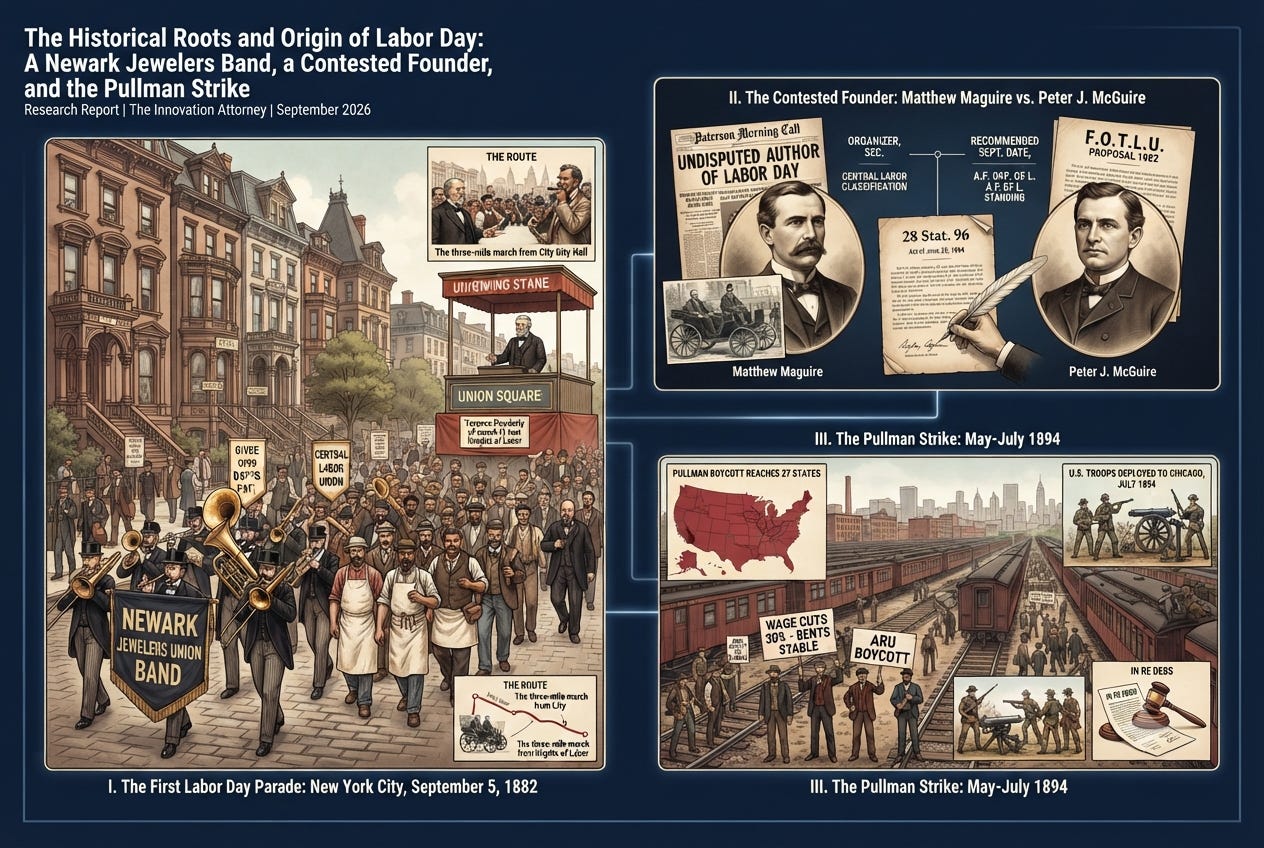
The Historical Roots and Origin of Labor Day
Description
Research Report | The Innovation Attorney | September 2026
Labor Day originated with a September 5, 1882 union parade in New York City and became federal law under the Act of June 28, 1894, 28 Stat. 96. The holiday was created twice. Working people made it first, giving up a day’s pay to march past the Fifth Avenue houses of the men who employed them. A President and a Congress made it again twelve years later, in the week a rail boycott spread across twenty seven states and six days before the Army entered Chicago. The second act explains why the American labor holiday sits in September and says nothing about the eight hour day that started the argument.
A. Executive Summary
The first Labor Day observance took place on Tuesday, September 5, 1882, in New York City, organized by the Central Labor Union at the urging of Matthew Maguire, a Paterson machinist who served as the union’s secretary. Newspaper counts of the marchers ran from 12,500 to 20,000, and about 25,000 people spent the afternoon at a picnic ground on Ninth Avenue. Nobody was paid for the day. A voluntary wage loss, staged as a public procession by trades that were partly operating in secret to avoid discharge, is the actual origin of the holiday.
Credit for proposing it is contested between Maguire and Peter J. McGuire, the carpenter who co founded the United Brotherhood of Carpenters and Joiners on August 8, 1881. The Department of Labor’s published history states that recent research supports Maguire. A Paterson newspaper editorial of July 2, 1894 called him the undisputed author of the holiday. Maguire also ran for Vice President on the Socialist Labor Party ticket in 1896, and a labor federation courting employers and a Democratic administration had reason to prefer a founder who had not.
Federal recognition came from different pressure. Senator James Henderson Kyle of South Dakota introduced S. 730 on August 28, 1893, and it sat for ten months. In May 1894 Pullman Palace Car Company workers walked out over wage cuts of twenty to thirty percent taken while company town rents held steady. On June 26 the American Railway Union began a national boycott of trains carrying Pullman cars. Two days later President Grover Cleveland signed the Labor Day act. Federal troops reached Chicago on July 4. September rather than May 1 was the date because May 1 already carried the eight hour general strike of 1886 and the Haymarket Square bombing of May 4, 1886.
B. Detailed Findings
What happened at the first Labor Day parade on September 5, 1882?
The first Labor Day was a parade and a picnic in New York City on Tuesday, September 5, 1882, and it nearly collapsed for lack of participants. The proposal came at a Central Labor Union meeting on May 14, 1882, at Science Hall on East Eighth Street, where Maguire moved for a large labor festival whose proceeds would go to the participating unions. A committee secured a picnic ground at Ninth Avenue and Ninety Second Street from a saloonkeeper named Louis Wendel, who financed fifty thousand picnic tickets at twenty five cents each.
By ten that morning the grand marshal, William G. McCabe, had a handful of men and no band. His own printers had not appeared. Spectators told him to call it off. Then a Newark band arrived with roughly two hundred members of the jewelers union, playing a Gilbert and Sullivan tune as the column turned onto lower Broadway. McCabe’s later recollection was that music never sounded sweeter to him. Forty bricklayers in white aprons formed a screen at the head of the line, which improved both its appearance and the attitude of the police. Unions fell in along the route, and the procession ran better than three miles from City Hall up through the wealthiest blocks of Fifth Avenue, past the houses of August Belmont and the Astors. That routing was the message.
The newspaper counts diverged, a