Episode Details
Back to Episodes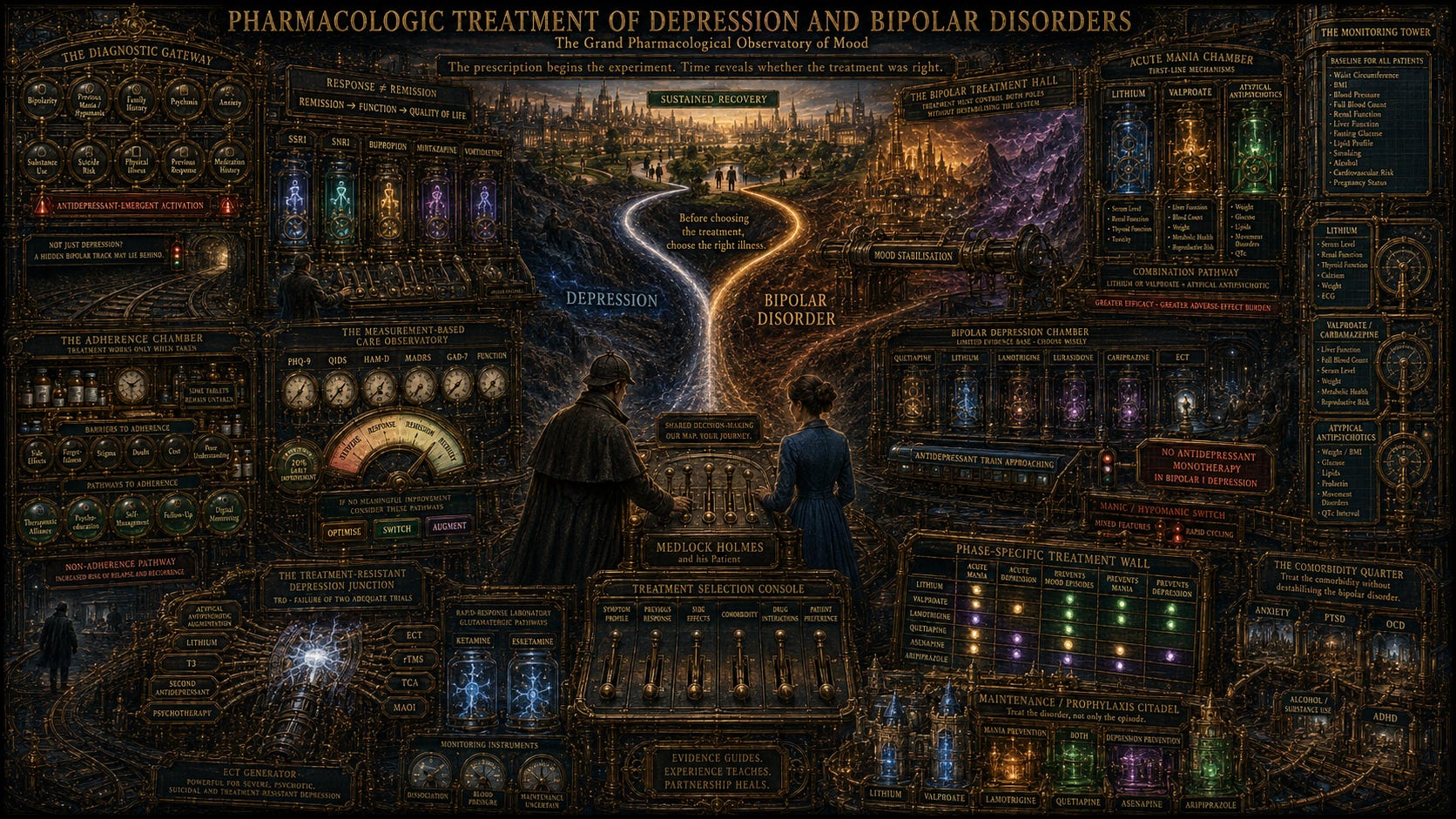
PSYCH 114: Mood Disorders - Pharmacologic Treatment of Depression and Bipolar Disorders
Description
Medlock Holmes enters the Grand Pharmacological Observatory of Mood.
At its centre stands an enormous control table.
Two major pathways emerge from it.
One is labelled:
MAJOR DEPRESSIVE DISORDER
The other:
BIPOLAR DISORDER
At first, the pathways appear similar.
Both contain depression.
Both contain impaired function.
Both may involve suicidality, anxiety, sleep disturbance, and psychotic features.
But Holmes quickly discovers that the treatment logic is very different.
The first lesson is therefore diagnostic.
Before prescribing an antidepressant, the clinician must ask whether the apparent depressive episode might actually belong to bipolar disorder.
Family history.
Previous hypomania.
Psychotic features.
Reverse vegetative symptoms.
Mood lability.
Antidepressant-induced activation.
All may raise suspicion.
The source emphasises that bipolar disorder is frequently misdiagnosed initially as major depressive disorder, partly because patients are more likely to seek help when depressed than when hypomanic or manic.
Holmes moves first into the Depression Treatment Chamber.
Here the immediate goal is not simply improvement.
It is remission.
Response means that symptoms have reduced.
Remission means that the depressive syndrome has largely resolved.
This distinction matters because residual symptoms are associated with a greater risk of relapse and recurrence.
But Holmes notices another instrument beside the symptom scales.
It measures:
Function.
Can the person work?
Study?
Care for children?
Maintain relationships?
Enjoy life?
The chapter repeatedly emphasises that symptom reduction alone is not enough.
Patients often care most about restoration of function and quality of life.
The next section of the chamber contains the familiar first-line antidepressant pathways.
SSRIs.
SNRIs.
Bupropion.
Mirtazapine.
Vortioxetine.
Other second-generation agents.
Their overall efficacy is broadly comparable.
The art lies in matching treatment to the individual.
An activating antidepressant may suit someone dominated by fatigue and low drive.
A sedating antidepressant may help when severe insomnia accompanies depression.
A patient worried about weight gain may prefer one profile.
Another troubled by sexual dysfunction may prefer another.
Holmes realises that pharmacology becomes useful only when translated into the language of the patient’s actual life.
The source then introduces measurement-based care.
Standardised measures such as the PHQ-9, QIDS, HAM-D, MADRS, GAD-7, Sheehan Disability Scale, and LEAPS can help track symptom change and function.
Early improvement matters.
A reduction of approximately 20% in symptom severity early in treatment predicts a greater likelihood of later response.
Failure to improve should trigger a question:
Is the dose adequate?
Has the medication been taken?
Has enough time passed?
Is the diagnosis correct?
Should the treatment be optimised, switched, or augmented?
Holmes enters the Adherence Chamber.
Here, half-empty medicine bottles sit beside treatment charts.
Many apparent medication failures are not true pharmacological failures.
Patients miss doses.
Stop medication when they begin to feel better.
Stop because of side effects.
Stop because they fear dependence.
Stop because they do not believe the treatment is helping.
The clinician must therefore examine adherence before decla