Episode Details
Back to Episodes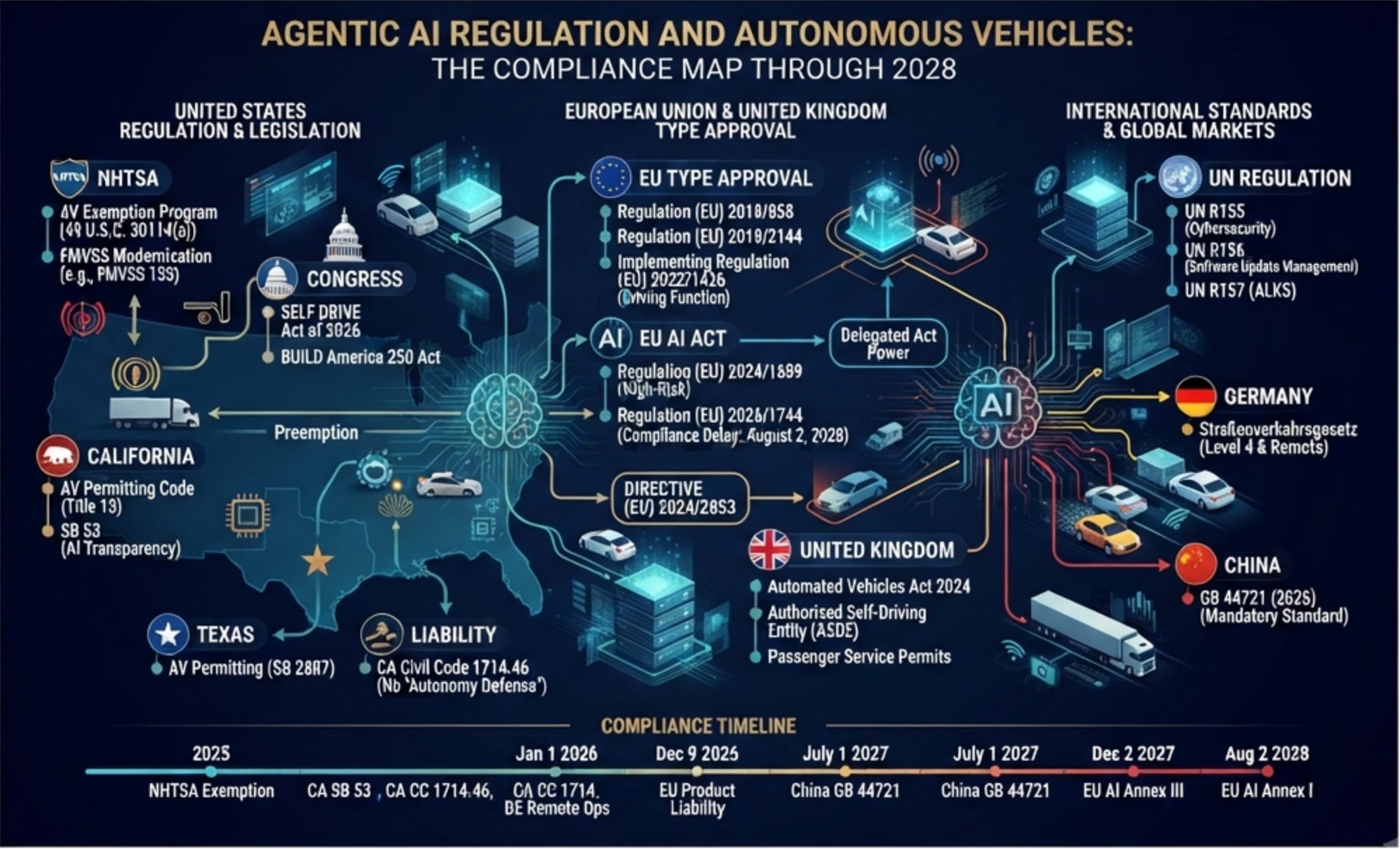
Agentic AI Regulation and Autonomous Vehicles
Description
Agentic AI regulation reaches autonomous vehicles through vehicle type approval and product safety law, a route that Regulation (EU) 2026/1744 delayed to August 2, 2028 for automotive artificial intelligence. The artificial intelligence statutes moving through American legislatures were written for models and for decisions about people. Almost none of them govern the driving task. What governs the driving task is older and narrower: the Federal Motor Vehicle Safety Standards and the exemption sections of 49 U.S.C. Chapter 301, the state permit codes in California and Texas, the United Nations vehicle regulations, and the type approval rules underneath the European artificial intelligence rules. If you are budgeting compliance for a driving stack, that is where the money goes.
On June 26, 2026, the National Highway Traffic Safety Administration withdrew the voluntary oversight program it had proposed eighteen months earlier, at 91 Fed. Reg. 38619. The withdrawal notice is unusually candid. Industry commenters said the reporting burden outweighed the benefit. Safety commenters said a voluntary program was no substitute for approval of unproven technology on public roads. The agency agreed with both and killed it. What replaced it is narrower and harder to argue with: a standard by standard rewrite of the Federal Motor Vehicle Safety Standards for vehicles built without manual controls, starting with FMVSS No. 102, No. 103, and No. 104 in March 2026 and reaching the brake standard, FMVSS No. 135, in June. Stopping distance performance stays exactly where it was.
why do the new AI statutes barely touch self driving cars
Because they regulate the wrong thing. California Senate Bill 53, effective January 1, 2026, reaches developers training foundation models above 10 to the 26th floating point operations and imposes catastrophic risk reporting and civil penalties up to $1,000,000 per violation on those with more than $500,000,000 in annual revenue. Colorado’s replacement statute, Senate Bill 189, effective January 1, 2027, covers automated decision technology used in consequential decisions across seven domains. Vehicle operation is not one of them.
There is one artificial intelligence statute that will matter enormously to this industry, and it is one sentence long. California Civil Code Section 1714.46, effective January 1, 2026, provides that a defendant who developed, modified, or used an artificial intelligence system may not assert as a defense that the artificial intelligence autonomously caused the harm. Causation, foreseeability, and comparative fault survive. The autonomy argument does not. Every plaintiff’s firm building an automated driving practice read it the week it took effect.
what does agentic ai actually change about vehicle liability
It changes what can be proved. A rule based planner leaves an audit trail. Engineers point to the branch that fired and the threshold that produced it. A driving model trained end to end from sensor input to steering command produces a trajectory and nothing else. NHTSA engineering analysis EA26002, opened March 18, 2026 across roughly 3.2 million Tesla vehicles, is built on that gap. The alleged defect is that the system’s own degradation detection failed to recognize that glare and airborne obscurants had degraded its perception, and failed to warn the driver in time. Nine incidents, two injuries, one death.
Europe has already decided who carries that evidentiary burden. Directive (EU) 2024/2853, with transposition due December 9, 2026, brings software and artificial intelligence systems inside the definition of a product, extends it to post sale software updates, and creates rebuttable presumptions of defect and causation where technical complexity makes proof excessively difficult for the claimant. For a model whose reasoning cannot be reconstructed after a crash, that presumption decides the case before the expert reports are exchange