Episode Details
Back to Episodes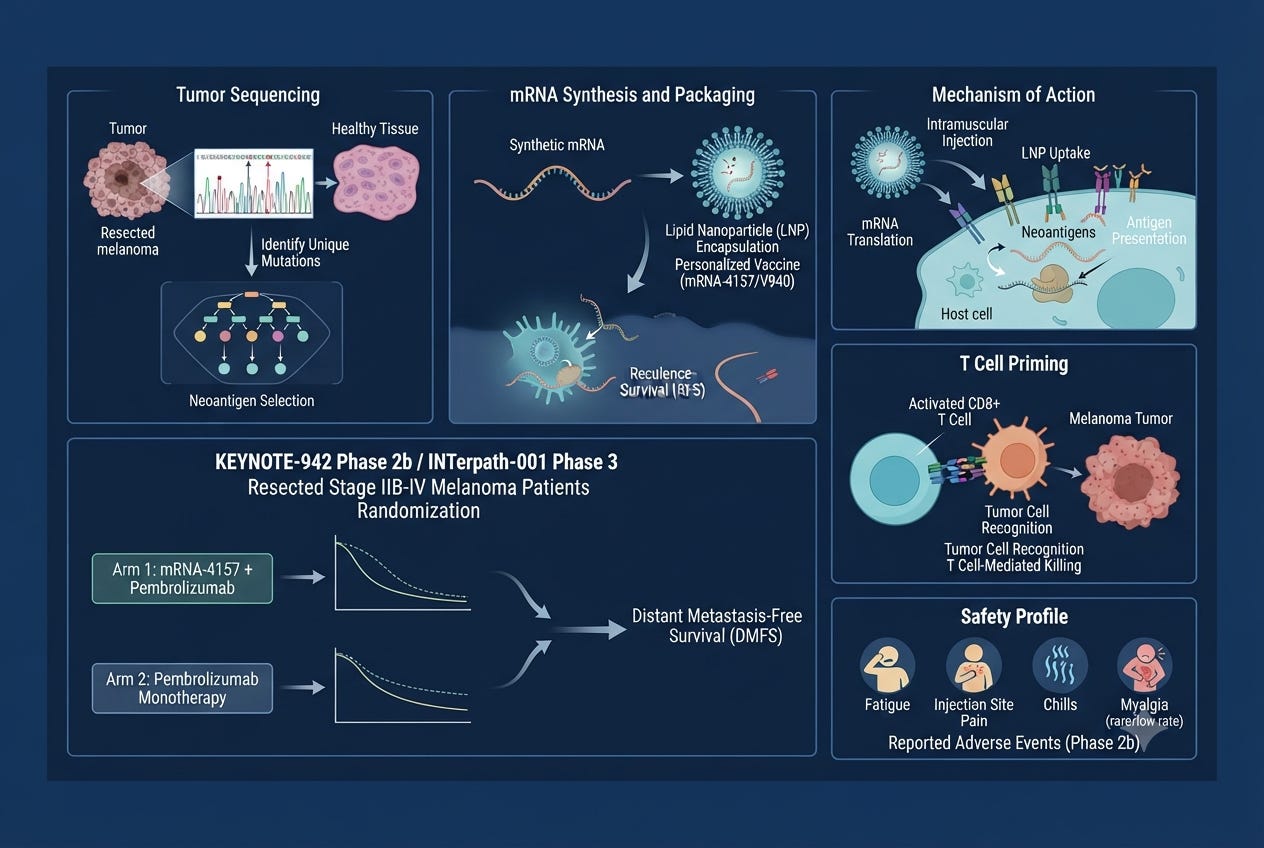
From COVID-19 to Oncology
Description
Merck and Moderna’s personalized mRNA cancer vaccine met its recurrence free survival and distant metastasis free survival endpoints in the Phase 3 INTerpath-001 melanoma trial announced on August 19, 2026. The vaccine, known as intismeran autogene or mRNA-4157, is manufactured individually for each patient from the mutations found in that patient’s own resected tumor, then paired with the checkpoint inhibitor pembrolizumab. In the earlier Phase 2b KEYNOTE-942 trial, the combination cut the three year risk of melanoma recurrence or death by 49 percent compared with pembrolizumab alone. The Phase 3 result confirms that finding in a larger, 1,137 patient population and moves the therapy toward a regulatory filing for adjuvant use in resected stage IIB through IV melanoma.
An estimated 112,000 Americans will be diagnosed with invasive melanoma in 2026, and a share present at the high risk stage where recurrence after surgery remains common even after checkpoint immunotherapy. The mRNA delivery method behind intismeran autogene is the same nucleoside modified, lipid nanoparticle platform that carried the Pfizer BioNTech and Moderna COVID-19 vaccines, work recognized by the 2023 Nobel Prize in Physiology or Medicine. This report also examines what a decade of mRNA vaccine use in the general population, mostly through the COVID-19 program, has shown about the safety of that technology, including the myocarditis finding in young men.
The melanoma data below rest on a Phase 2b trial with three and five year follow up and a Phase 3 trial not yet published in full. The myocarditis association is established through multiple surveillance systems and is no longer detected above the general population baseline in the current vaccine formulation. Clinicians and patients should weigh the specific, quantified risk described here rather than the surrounding public debate. This report is confined to the clinical medical evidence; readers seeking FDA regulatory, insurance, or litigation analysis should consult a legal domain analysis.
Detailed Findings
How Does Merck and Moderna’s Personalized mRNA Melanoma Vaccine Work?
Intismeran autogene works by teaching a patient’s own immune system to recognize as many as 34 mutation derived proteins unique to that patient’s tumor. DNA and RNA sequencing of a patient’s resected melanoma, compared against sequencing of that same patient’s healthy tissue, identifies the specific mutations present only in the cancer. A selection process ranks those mutations by their likelihood of provoking a T cell response and encodes the strongest candidates, up to 34 of them, into a single strand of synthetic messenger RNA manufactured specifically for that patient.
The synthetic mRNA is packaged in a lipid nanoparticle, the same delivery method used in the Pfizer BioNTech and Moderna COVID-19 vaccines, and given by injection on a schedule of nine doses every three weeks, a course lasting about six months. Host cells take up the lipid nanoparticle, and the cell’s own ribosomes translate the mRNA into the neoantigen proteins. The cell’s normal antigen processing machinery then displays fragments of those proteins on its surface, where they prime CD8 positive T cells to recognize and destroy any melanoma cell carrying the same mutations.
Pembrolizumab, a PD-1 checkpoint inhibitor given every three weeks for up to 18 cycles, is added because tumors routinely display proteins that suppress that same T cell response. Blocking PD-1 keeps the T cells primed by the vaccine active long enough to find and kill residual melanoma cells that might otherwise cause a recurrence. The nucleoside modified mRNA chemistry that keeps the injected genetic material from triggering an immediate innate immune shutdown is the same chemistry that earned the 2023 Nobel Prize in Physiology or Medicine, awarded for the discoveries that made the COVID-19 mRNA vaccines possible.
What Do the Melanoma Cli