Episode Details
Back to Episodes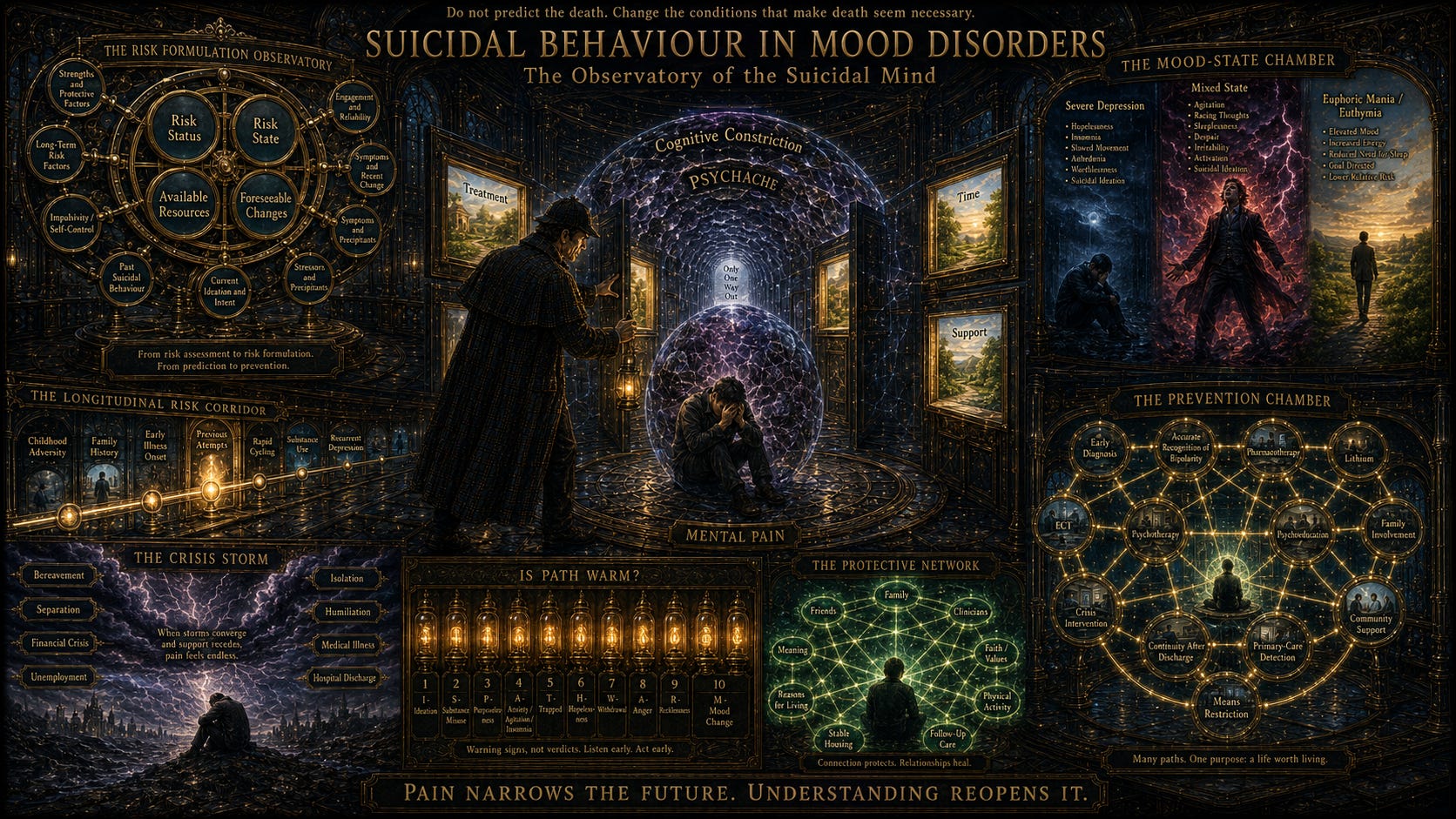
PSYCH 113: Mood Disorders - Suicidal Behaviou
Description
Medlock Holmes enters the Observatory of the Suicidal Mind.
At first, the room appears to contain a familiar psychiatric chart:
Depression → Suicide Risk
Holmes immediately rejects it.
The relationship is far more complex.
Mood disorders are among the strongest contributors to suicidal behaviour, but most people with depression do not die by suicide, and suicidal crises can occur outside formal diagnostic thresholds. What matters is not simply the presence of depression, but the interaction between illness severity, hopelessness, agitation, mixed affective states, impulsivity, previous attempts, family history, adversity, substance use, social support, and rapidly changing life circumstances.
The central concept Holmes encounters is psychache: unbearable psychological pain.
For some people, suicide is not experienced primarily as a movement towards death, but as an imagined escape from intolerable consciousness. The person becomes cognitively constricted, unable to perceive alternatives, and increasingly convinced that the suffering cannot change.
This is why understanding the suicidal mind requires more than counting risk factors.
The clinician must ask:
Where is the pain coming from?
Why has it become intolerable now?
What has changed?
What still connects this person to life?
The chapter moves from traditional risk assessment towards suicide risk formulation.
Rather than assigning a simplistic label of low, medium, or high risk, formulation integrates four questions:
* What is this person’s risk status relative to others in a similar population?
* What is their current risk state compared with their own baseline?
* What resources and protective factors are available?
* What foreseeable changes could rapidly increase danger?
The prevention-oriented model shown on page 3 of the source visually reinforces this shift. It brings together enduring factors such as prior suicidal behaviour and long-term vulnerability with dynamic factors such as current ideation, stressors, suffering, engagement, available resources, and foreseeable change.
Holmes then examines mood states themselves.
The greatest danger usually lies not in euthymia or euphoric mania, but in severe depressive episodes and mixed states.
Hopelessness.
Insomnia.
Anxiety.
Agitation.
Worthlessness.
Guilt.
Appetite loss.
Psychosis.
Substance use.
A person may be severely depressed yet lethargic. Another may be equally hopeless but agitated, sleepless, impulsive, and internally accelerated.
The second presentation may be especially dangerous because despair has acquired energy.
Mixed depressive states therefore deserve particular attention.
The investigation then turns backwards in time.
A previous suicide attempt is one of the strongest predictors of future suicidal behaviour.
Early illness onset, rapid cycling, predominantly depressive course, prior suicidal ideation, family history of suicide, childhood adversity, cyclothymic or irritable temperament, and impulsive–aggressive traits may further increase vulnerability.
But these factors are not destiny.
They are the landscape upon which the current crisis unfolds.
Life events frequently supply the trigger.
Bereavement.
Separation.
Financial collapse.
Unemployment.
Isolation.
Humiliation.
Illness.
Hospital discharge.
Relationship breakdown.
Yet even severe events rarely act alone. They become dangerous when they interact with psychiatric illness, personality, reduced support, and an individual’s sense that t