Episode Details
Back to Episodes“A case that whole brain emulation research is net-harmful by default” by TsviBT
Description
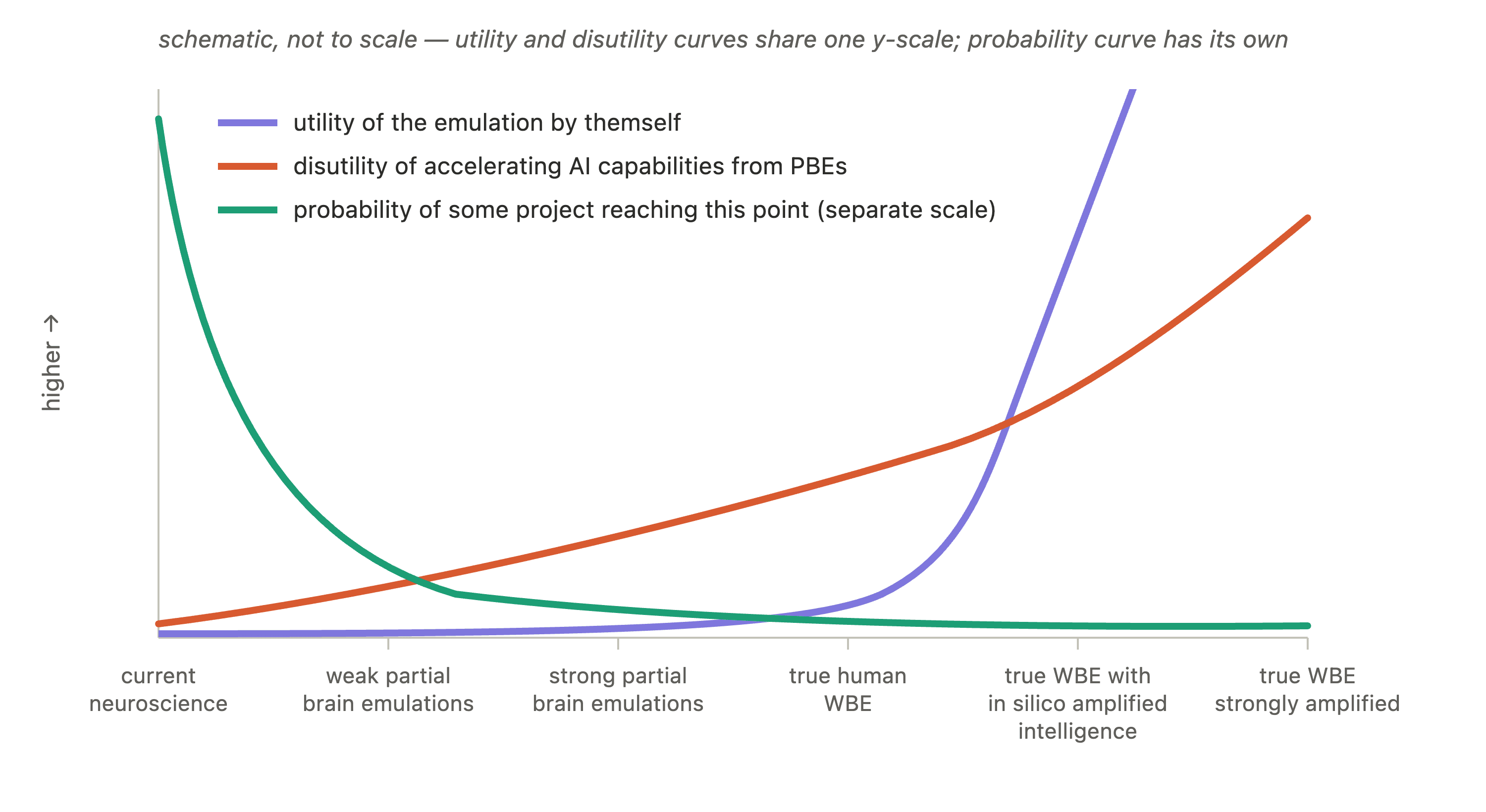
Graphical abstracts
Summary
A true human whole brain emulation would be very helpful to humanity. The WBE could increase their own intelligence through self-modification and then somehow prevent AGI from killing everyone. However, if a research project made any serious progress towards WBE, it would likely contribute to existential risk from AI by contributing to AI capabilities progress.
Here is the argument that a successful WBE research project would accelerate AI capabilities:
- Creating a WBE is very hard. Therefore, it's very unlikely that a research project, unless extremely well-resourced, could reliably create a WBE very quickly (in less than five years, say).
- There is a wide spectrum of difficulty within the set of problems building up to WBEs. Some are easy, some are pretty difficult, some are very difficult, some are extremely difficult. Therefore, a project is likely to make some initial progress partway to WBEs, and then to stall and not quickly get all the way to WBEs.
- Therefore, it's very likely for a WBE project to spend a significant amount of time having already made partial progress, but not being very close to WBEs.
- If a project makes serious [...]
---
Outline:
(00:12) Graphical abstracts
(00:37) Summary
(03:41) Caveats
(04:27) Some of the ways this article could be wrong
(06:36) Things I'm not saying
(09:32) Context: AI capabilities research expropriates any partial understanding of intelligence
(10:24) Order-dependency: AGI alignment research passes through partial understanding of intelligence
(12:49) What is whole brain emulation research?
(16:34) There are many ways to have strictly partial brain emulation
(18:36) There will be incremental progress towards WBEs with many stages of partial understanding
(20:41) There is a wide spectrum of access difficulty for brains and algorithms
(30:16) Filling in gaps with learning creates the capabilities expropriation pipeline
(37:24) Avoiding emulating some neural details doesn't make WBEs easy
(40:48) Generalizable models of small components would be dangerous PBEs
(42:40) A siloed one-shot leap to WBEs is highly implausible
(47:20) Getting a powerfully intelligent WBE requires emulating powerful algorithms
(49:50) Getting a truly human WBE is probably a very high bar
(55:14) Brain elements will be expropriated by AI capabilities even if they haven't been historically
(58:30) What to do instead of WBE research
---
First published:
September 5th, 2026
---
Narrated by TYPE III AUDIO.
---
Images from the article:
Listen Now
Love PodBriefly?
If you like Podbriefly.com, please consider donating to support the ongoing development.
Support Us