Episode Details
Back to Episodes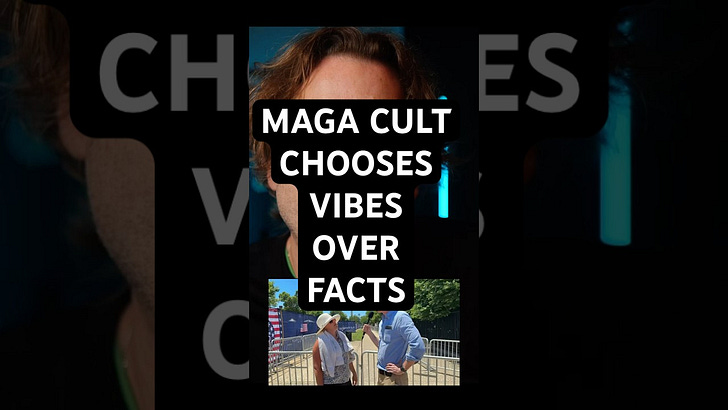
Truthiness: Why MAGA Says Things with Total Confidence That Are Completely Made Up
Description
A woman looked directly into a camera and said illegals must have dumped algae into the Lincoln Memorial Reflecting Pool.
She did not cite a source. She did not reference an investigation. She did not pause for one second to consider whether what she was saying was based on anything real. She just said it. With total confidence. Like she was reporting a fact she had personally verified.
She had not. There is no evidence that anyone dumped algae into the reflecting pool. Environmental scientists from Tufts University, the University of North Carolina at Chapel Hill, and Wright State University all confirmed that algae blooms are a natural and expected occurrence in a shallow, still, unshaded pool fed by nutrient-rich water that had been painted dark blue. The pool has been prone to algae since it was built in 1922. The National Park Service’s own internal documents confirmed the algae was caused by residual algae left in supply lines that sat dormant during eight weeks of construction.
But none of that mattered to this woman. It felt true. And feeling true was enough.
If you watched the video, you already know what psychologist Eryn Newman calls this. Truthiness. This Substack goes deeper into the research, the reflecting pool disaster, and why this one cognitive bias explains how the entire MAGA information ecosystem works.
What Is Truthiness?
The word was coined by comedian Stephen Colbert on the very first episode of The Colbert Report on October 17, 2005. Colbert defined truthiness as “truth that comes from the gut, not books.” He was satirizing the George W. Bush administration’s tendency to make claims based on feeling rather than evidence. The American Dialect Society named it the Word of the Year for 2005. Merriam-Webster followed in 2006.
But Colbert was a comedian. He was making a joke. Psychologist Eryn Newman turned it into science.
Newman completed her PhD at Victoria University of Wellington in New Zealand. She is now an Associate Professor at the Australian National University. Her research focuses on distortions of memory and cognition, specifically how people come to believe things are true even when they are not.
In 2012, Newman and her colleagues Maryanne Garry, Daniel Bernstein, Justin Kantner, and D. Stephen Lindsay published a landmark paper in the Psychonomic Bulletin and Review titled “Nonprobative Photographs (or Words) Inflate Truthiness.” The study examined what happens when people evaluate claims that are paired with information that looks relevant but actually proves nothing.
Their finding was specific and alarming. When people saw a claim paired with a related but completely uninformative photograph, they were significantly more likely to judge the claim as true. The photograph did not contain any evidence. It did not prove the claim. It just made the claim feel more real.
Newman found that truthiness operates most powerfully under conditions of uncertainty. When people are evaluating an unfamiliar claim, when they do not already know the answer, they are most vulnerable to the truthiness effect. Their brains take the feeling of familiarity or ease produced by the photograph and interpret it as evidence of truth. The claim feels true. So it must be true.
This is not a minor effect. Newman’s research showed that truthiness persists over time. A follow-up study with Kathy Pezdek published in Acta Psychologica in 2013 found that the truthiness boost from photographs did not fade. People who were influenced by nonprobative photos continued to believe the false claims days later.
Newman described truthiness as “using feelings and pseudo-evidence to decide what is real, instead of drawing on facts.” That is the single most accurate description of how MAGA supporters process information.
The Reflecting Pool: A Case Study in Truthiness
The Lincoln Memorial Reflecting Pool is a perfect case study in how truthiness o