Episode Details
Back to Episodes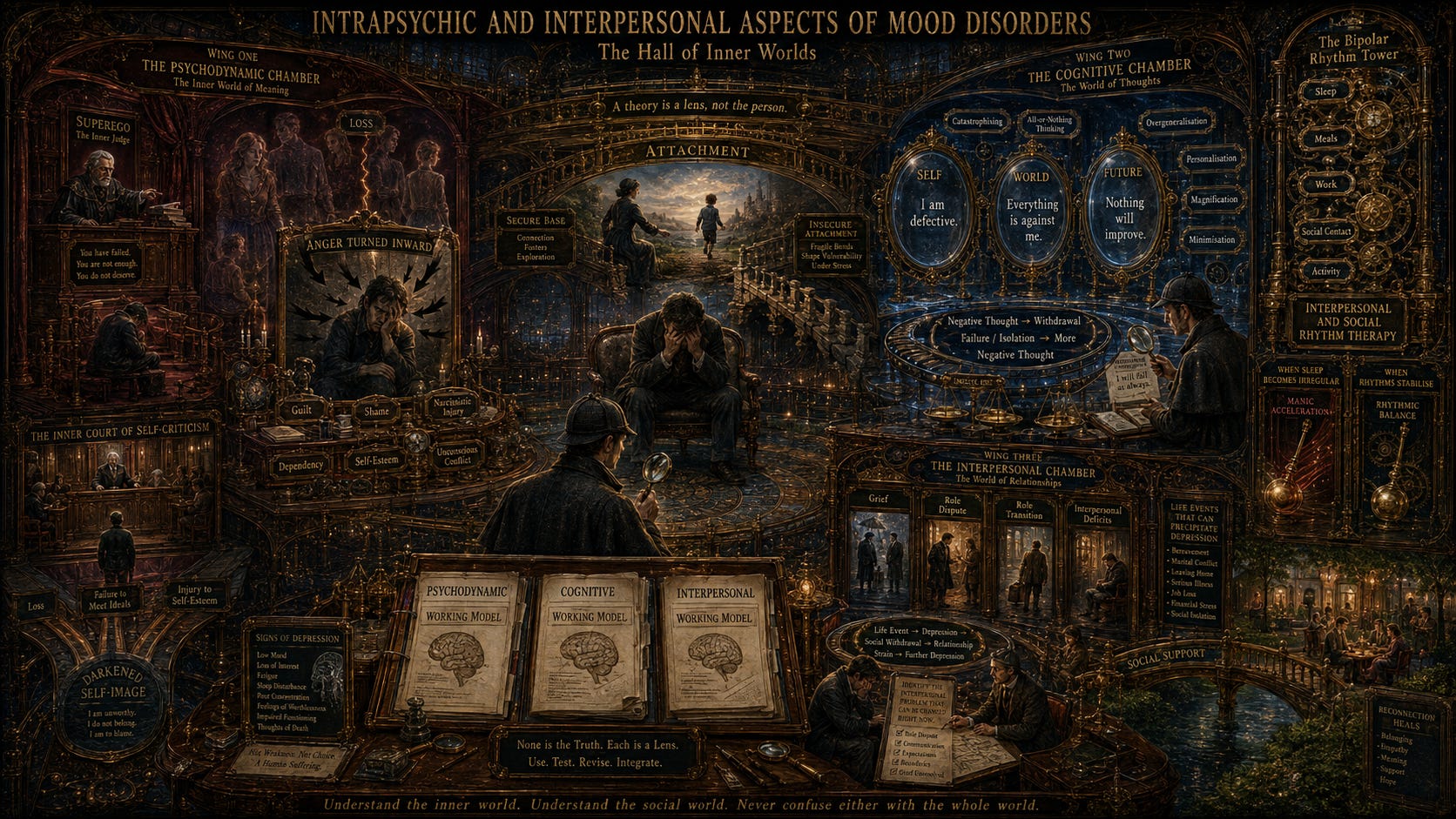
PSYCH 112: Mood Disorders - Intrapsychic and Interpersonal Aspects
Description
Medlock Holmes enters the Hall of Inner Worlds, where three different investigative rooms attempt to explain the same depressed patient.
The first is the Psychodynamic Chamber.
Here, the focus is on what lies beneath conscious experience: loss, unconscious conflict, guilt, anger turned inward, injured self-esteem, and the enduring influence of early relationships.
Freud’s classic account of melancholia proposed that after a painful loss, hostility towards an ambivalently loved person may be redirected towards the self. The patient attacks themselves instead of the lost or disappointing other.
Later psychoanalytic thinkers broadened this picture.
Some emphasised guilt.
Others narcissistic injury.
Others the effects of emotionally unavailable or depressed caregivers.
Across many psychodynamic formulations, one theme repeatedly appears: the depressed person experiences themselves as damaged, inadequate, unlovable, or morally deficient. Self-esteem collapses, and aggression is directed inward.
Holmes then enters the second room.
Three enormous mirrors are labelled:
SELF
WORLD
FUTURE
This is Aaron Beck’s cognitive triad.
The depressed patient sees themselves as defective.
The world appears hostile or overwhelming.
The future seems hopeless.
Around the mirrors appear familiar cognitive distortions:
* all-or-nothing thinking;
* catastrophising;
* overgeneralisation;
* selective attention to failure;
* minimising success;
* personalisation.
These automatic thoughts reinforce withdrawal and inactivity, which then generate further evidence for the patient’s negative beliefs.
Cognitive therapy intervenes by making these thoughts visible, examining the evidence for them, testing them behaviourally, and replacing unquestioned assumptions with more balanced appraisals.
Holmes notices that cognitive theory does not explain all of depression.
Nor does psychodynamic theory.
Each illuminates a different part of the same room.
He now enters the third chamber.
There are no mirrors.
There are people.
A grieving spouse.
A couple locked in conflict.
A student leaving home.
A patient adjusting to illness.
A lonely person without support.
This is the Interpersonal Chamber.
Interpersonal theory focuses less on the hidden inner world and more on the person’s present relationships and life events.
Loss, interpersonal conflict, role transitions, social isolation, and inadequate support can precipitate or perpetuate depressive episodes in vulnerable individuals.
Once depression begins, symptoms themselves damage relationships and functioning, creating a vicious cycle:
Life event → Depression → Impaired relationships → More life events → Deeper depression
Interpersonal psychotherapy, or IPT, uses this model pragmatically.
The therapist identifies a current interpersonal focus and helps the patient work towards change in areas such as grief, role disputes, role transitions, or interpersonal deficits.
The aim is not to prove that relationships caused the illness.
It is to identify a meaningful point where treatment can intervene.
Holmes sees that all three theories are useful, but none is absolute truth.
Psychodynamic theory asks:
What unconscious meanings and conflicts are shaping this suffering?
Cognitive theory asks:
How is the person interpreting themselves, the world, and the future?
Interpersonal theory asks:
What is happening in this person’s relationships and social world?
The wisest clinician does not become a pr