Episode Details
Back to Episodes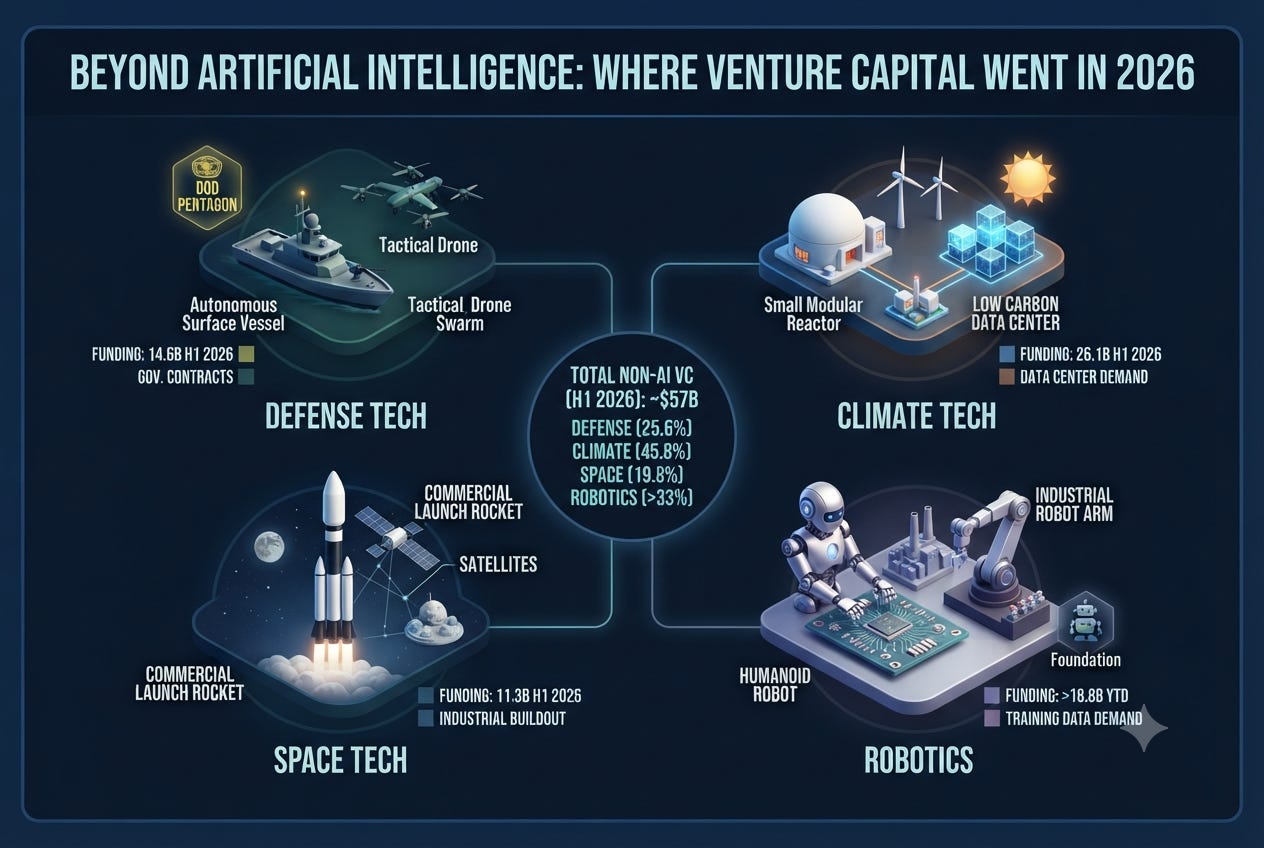
Beyond Artificial Intelligence
Description
Defense technology and climate technology drew most non artificial intelligence venture capital in 2026, with defense startups raising $14.6 billion through May and climate companies $26.1 billion by June 30. Artificial intelligence companies took $355.9 billion of the $412.7 billion invested across United States venture deals in the first half of 2026, which left roughly $57 billion for every other category combined. Two sectors claimed most of that remainder. Defense technology passed its entire 2025 total of $9.6 billion before the end of May. Climate technology grew 55 percent year over year while its deal count fell 25 percent to a five year low.
The two sectors are funded for different reasons. Defense capital follows a customer with an $858.9 billion appropriation and a procurement system that Congress rewrote in December 2025 to favor commercial products and companies that have never held a prime contract. Climate capital follows electricity demand from data centers, which is why low carbon power for computing became the largest climate category in the first half of 2026 after growing more than 800 percent, while carbon removal funding fell 61 percent and low carbon fuels fell 56 percent as their tax credits sunset.
For founders the practical questions are narrower than the sector headlines suggest. What proof points move a defense company from a research contract to a production award. What happens to a fundraising timeline when a foreign limited partner sits in the fund that wants to lead. Which tax credit deadlines govern whether a climate company has a business at all. Those answers are written into statutes and regulations with dates attached, and they are more predictable than the valuations now being paid. Early stage defense companies are clearing 17 to 50 times revenue. That pricing assumes procurement reform works. Some of it will.
Detailed Findings
Which sectors beyond artificial intelligence attracted the most venture capital in 2026
Defense technology, climate and energy technology, space technology, and robotics absorbed the large majority of non artificial intelligence venture dollars in 2026. United States venture deal value reached $412.7 billion in the first half of 2026. Artificial intelligence companies took $355.9 billion of that, or 86 percent. Rounds of $100 million or more accounted for 87.5 percent of all value deployed, and everything below $100 million totaled $51.4 billion across the entire market.
Against that concentration, the four sectors below are large enough to matter and small enough that a single round moves the total. Defense technology recorded $14.6 billion across 107 announced rounds in the first five months of 2026. Climate technology recorded $26.1 billion in the first half. Space technology recorded $11.3 billion across 244 deals in the first half, which already exceeded the $10.1 billion raised across 433 deals in all of 2025. Robotics passed $18.8 billion by the middle of June against $15 billion for all of 2025 and a prior peak of $14.1 billion in 2021.
The category boundaries overlap, and the overlap is where most of the money sits. An autonomous surface vessel company is defense and robotics. A microreactor developer selling to a data center operator is climate, energy, and, when the customer is a military installation, defense. Sector totals published by different data providers diverge by billions for exactly this reason, and a founder benchmarking a round against a published sector total should first ask which definition produced it.
How much money actually went to defense technology in 2026
Defense technology raised $14.6 billion across 107 announced venture rounds between January and the end of May 2026, against $9.6 billion across 206 deals in all of 2025 and $1.6 billion in 2020. One widely reported alternative count puts first quarter 2026 defense investment at $19.8 billion across 262 deals, a figure that