Episode Details
Back to Episodes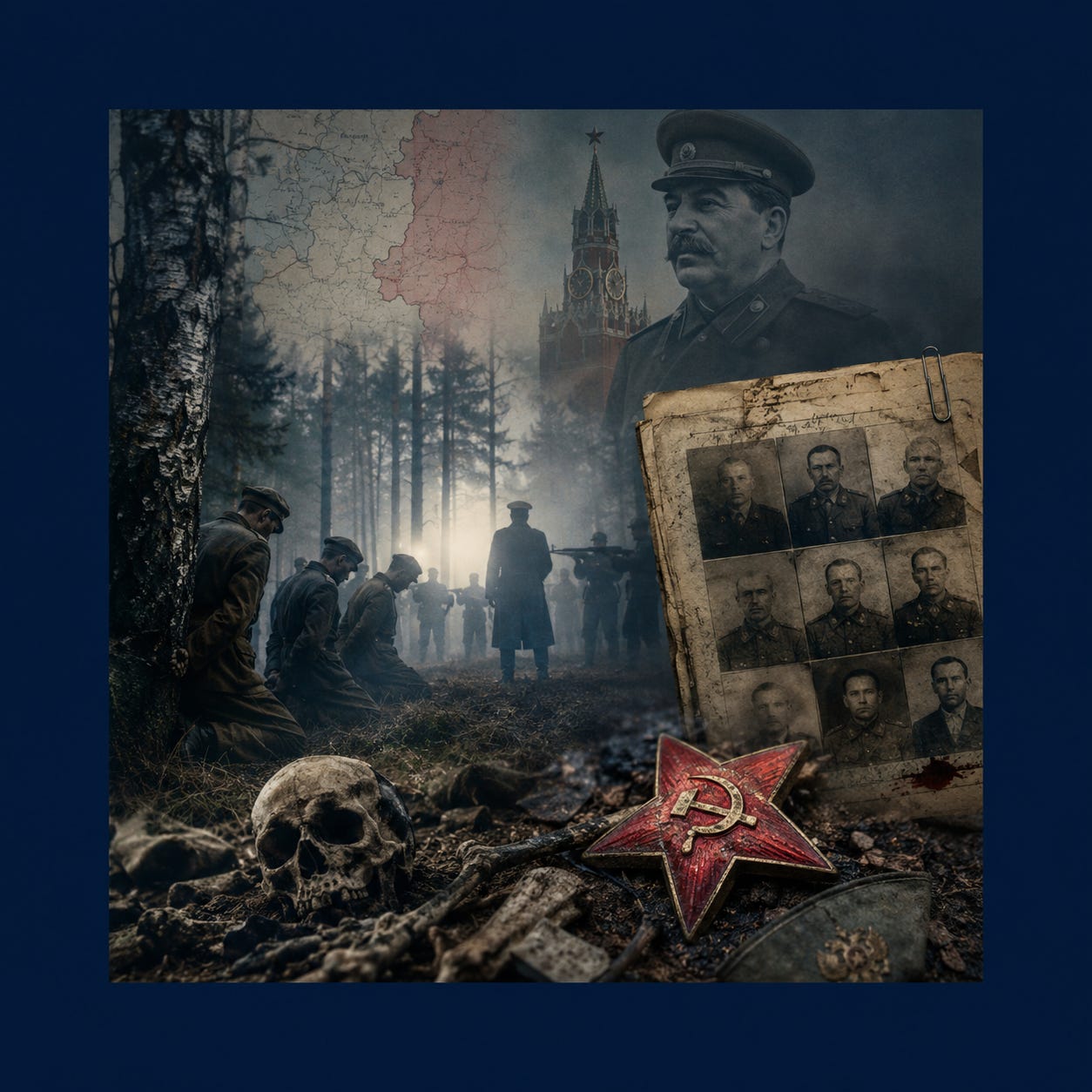
The Katyn Forest Massacre of 1940
Description
The Katyn Forest massacre was the Soviet execution of 21,857 Polish prisoners between April 3 and May 19, 1940, ordered by the Politburo on March 5, 1940. The dead were officers, police officials, border guards, prosecutors, engineers, physicians, teachers and clergy taken captive after the Red Army crossed into eastern Poland on September 17, 1939. Three special camps supplied most of the victims. Kozelsk supplied the graves in the Katyn Forest near Smolensk. Ostashkov supplied the sandbagged execution cell in the Kalinin prison and the burial pits at Mednoye. Starobelsk supplied the Kharkiv prison and the pits at Piatykhatky. A further 7,305 prisoners held in jails across western Ukraine and western Belarus were shot under the same order.
Soviet responsibility is settled. The Politburo decision, the transport schedules, the memorandum of March 1959 recording the figure of 21,857 and the names of the three security officials empowered to sign the sentences all sit in the documentary record released after 1990. Two matters remain contested: the legal name of the crime and the completeness of the file. Russian prosecutors closed their criminal investigation on September 21, 2004, declined the genocide characterization, and kept 35 of the 183 investigation volumes classified. The European Court of Human Rights held on October 21, 2013 that it had no competence to examine the adequacy of that investigation, while finding unanimously that Russia had breached its duty to furnish evidence to the Court.
For military readers the operation is a study in the deliberate destruction of a command and administrative class as a precondition of occupation. Roughly half the Polish officer corps in Soviet hands died in six weeks, killed with small caliber pistols at a nightly rate the executioners themselves capped at 250 men. For legal readers it is a study in how a state can concede every material fact of a mass killing and still defeat every attempt to name the crime in a court.
Detailed Findings
How did 21,857 Polish citizens end up in Soviet custody?
They were captured by the Red Army in the autumn of 1939 and transferred to the custody of the internal security ministry rather than the armed forces. The Soviet Union crossed the Polish frontier on September 17, 1939, sixteen days after the German attack. Soviet records put the number of prisoners taken at 190,584, and published estimates range from about 125,000 to 450,000 depending on whether reservists and civilians rounded up in the first weeks are counted.
On September 19, 1939, two days into the operation, the People’s Commissariat for Internal Affairs created an Administration for Affairs of Prisoners of War and Internees to hold them. That single administrative choice determined everything that followed. Prisoners taken in a military campaign were placed under a secret police organization with no obligation to the laws of war and no external reporting line.
The population was then sorted. Roughly 42,400 enlisted men of Ukrainian and Belarusian origin were released in October 1939. About 43,000 prisoners from the German occupation zone were transferred to German custody, and 13,575 came the other way. By November 19, 1939, the security ministry had retained between 8,000 and 8,500 officers and warrant officers. Three camps held the men who mattered: Kozelsk with about 5,000, Ostashkov with 6,570 and Starobelsk with about 4,000, a total near 15,570. Smaller camps operated at Jukhnovo, Yuzhe, Oranki, Tyotkino, Vologda and Gryazovets.
From October 1939 through February 1940 the camp population was interrogated repeatedly. The interrogations were recorded as political work. They functioned as selection. Officers who showed willingness to serve a Soviet controlled Polish formation were separated out; 395 men from the three camps survived, 205 from Kozelsk, 78 from Starobelsk and 112 from Ostashkov.
Who ordered the Katyn massacre and