Episode Details
Back to Episodes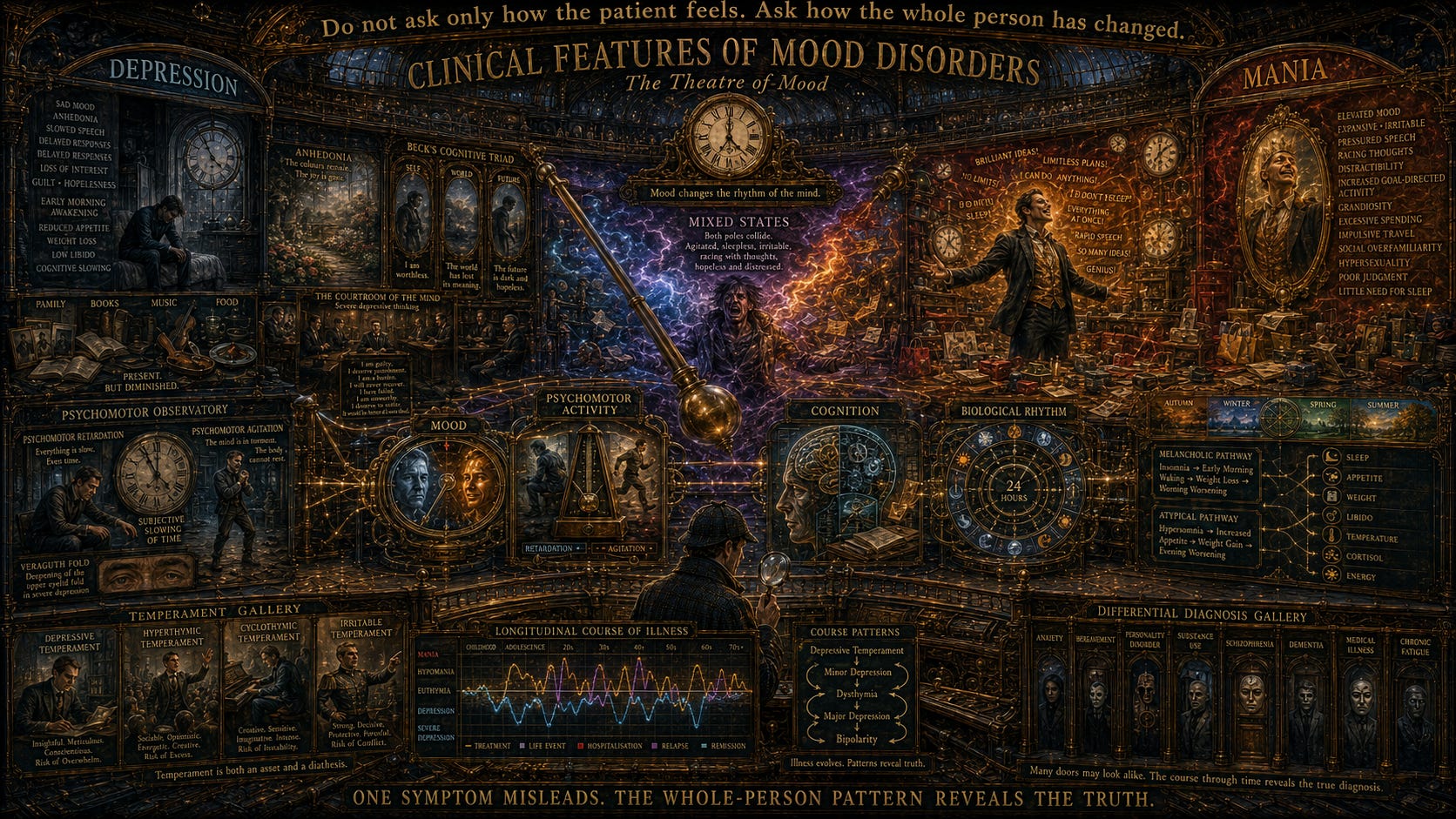
PSYCH 111: Mood Disorders - Clinical Features
Description
Medlock Holmes enters the Theatre of Mood.
At first, the stage appears simple.
One side is darkened by depression.
The other glows with mania.
But as the lights rise, Holmes realises that mood is only one part of the performance.
Behind every emotional state lies an entire orchestra of change.
Movement slows or accelerates.
Sleep contracts or expands.
Appetite disappears or increases.
Thought becomes constricted or races.
Self-esteem collapses or inflates.
Time itself seems to change speed.
This chapter explores the clinical phenomenology of mood disorders: how depression, mania, hypomania, mixed states, dysthymia, cyclothymia, psychosis, cognition, vegetative disturbance, and temperament appear in real patients.
Holmes begins with an essential distinction.
Affect is what the observer sees.
Facial expression.
Tone of voice.
Gesture.
Posture.
Mood is what the person experiences within.
The two may agree.
Or they may not.
A person may smile while profoundly depressed.
Another may claim to feel fine while their behaviour communicates despair.
Clinical understanding therefore begins not with a checklist, but with careful observation and empathic enquiry.
Holmes moves next into the gallery of normal emotion.
Sadness is universal.
Grief is universal.
Joy and elation are universal.
These states are not illnesses simply because they are intense.
The boundary is crossed when mood becomes disproportionate, autonomous, sustained, recurrent, and impairing.
The source describes pathological mood states as endoreactive: they may begin in response to an event, but once released, they can continue under their own momentum even after the precipitating event has faded.
This distinction matters.
Normal grief remains responsive to the environment.
Pathological depression becomes increasingly sealed from it.
The same applies to elation.
Ordinary happiness follows success.
Mania does not require success to sustain itself.
It creates its own internal momentum.
Holmes then enters the Hall of Temperament.
Before illness fully develops, many people have enduring affective styles.
Depressive temperament.
Hyperthymic temperament.
Cyclothymic temperament.
Irritable temperament.
These are not diagnoses in themselves.
They may carry both strengths and vulnerabilities.
The depressive temperament can bring dependability, conscientiousness and sensitivity.
The hyperthymic temperament may confer energy, extroversion, humour and leadership.
The cyclothymic temperament may carry emotional intensity and creativity.
The irritable temperament may confer assertiveness and forcefulness.
But the same traits can become unstable.
Temperament is therefore not simply pathology.
It is the terrain upon which pathology may later emerge.
Holmes now enters the depressive chamber.
The first thing he notices is that depression is not synonymous with sadness.
Some patients describe unbearable psychic pain.
Others feel emotionally numb.
Some cannot cry.
Some deny feeling depressed altogether and instead present with headache, abdominal discomfort, chest pain, fatigue, or vague bodily distress.
Others primarily complain that they have lost the capacity to enjoy anything.
Anhedonia becomes one of the most important clues.
A patient stops reading.
Stops gardening.
Stops listening to music.
Stops enjoying food.
Stops feeling warmth towards people they love.
The world has not become objectively empty.
The patient’s ability to resonat