Episode Details
Back to Episodes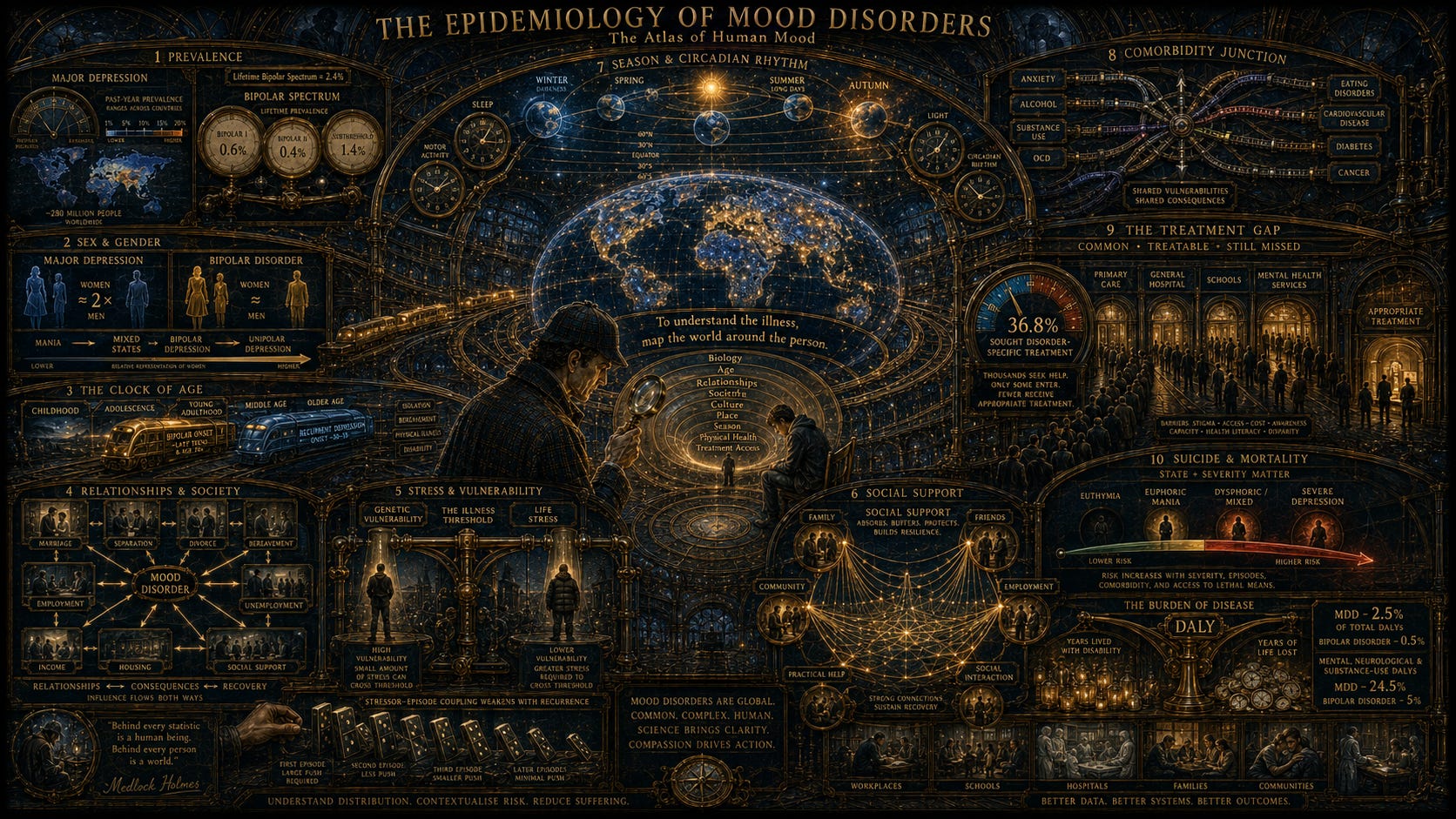
PSYCH 110: Mood Disorders - Epidemiology
Description
Medlock Holmes enters the Atlas of Human Mood.
It is an extraordinary observatory.
Suspended at its centre is an enormous illuminated globe. Across every continent, thousands of small lights pulse between blue and gold.
Blue represents depression.
Gold represents mania and hypomania.
But the lights are not distributed randomly.
Holmes notices patterns.
They cluster differently according to sex.
Age.
Social circumstances.
Relationships.
Latitude.
Season.
Comorbidity.
And access to treatment.
This is the domain of epidemiology.
Its task is not simply to ask:
Who develops a mood disorder?
It asks something more ambitious:
Where does illness occur, when does it emerge, who is most vulnerable, what travels alongside it, what protects against it, and what happens when societies fail to recognise or treat it?
The investigation begins with bipolar disorder.
Historically, the lifetime prevalence of bipolar I disorder has generally been estimated at around 1%.
But the number changes depending upon where investigators draw the diagnostic boundary.
The WHO World Mental Health surveys estimated a cross-national lifetime prevalence of the broader bipolar spectrum at approximately 2.4%:
0.6% bipolar I
0.4% bipolar II
1.4% subthreshold bipolar disorder
Other studies using broader definitions have produced still higher estimates.
Holmes immediately encounters one of epidemiology’s central principles:
Prevalence depends partly upon where we draw the diagnostic frontier.
Move the boundary outward and more human experience enters the territory called illness.
The same principle applies to depression.
Across the WHO World Mental Health surveys, lifetime major depressive disorder averaged approximately 11.1% in low- and middle-income countries and 14.6% in high-income countries.
Twelve-month prevalence was approximately 5.9% and 5.5%, respectively.
On page 5 of the source, the international bar chart makes the point visually: prevalence varies considerably between individual countries, yet major depression is clearly present across both lower/middle- and higher-income settings.
But beneath the threshold of major depression lies a much larger territory.
Some people experience recurrent brief depression.
Others have minor depressive syndromes.
Others experience subthreshold hypomania.
These states may not satisfy the duration or severity requirements of formal diagnostic systems.
Yet they can still produce considerable suffering and disability.
When spectrum definitions are used, estimates can reach approximately 5% for bipolarity and 20% for depression.
Holmes therefore draws the first epidemiological lesson into his notebook:
Diagnostic thresholds create categories; human suffering remains continuous.
He turns next towards sex and gender.
Here one of psychiatry’s most reproducible epidemiological findings emerges.
Major depressive disorder is approximately twice as common in women as in men.
The difference develops around early adulthood, becomes particularly pronounced between approximately 30 and 45 years, and persists into older age.
No single explanation accounts for it.
Biological and hormonal factors may contribute.
So may differences in stress exposure and sensitivity.
Coping.
Social roles.
Earlier anxiety disorders.
And differences in how depressive symptoms are expressed or recognised.