Episode Details
Back to Episodes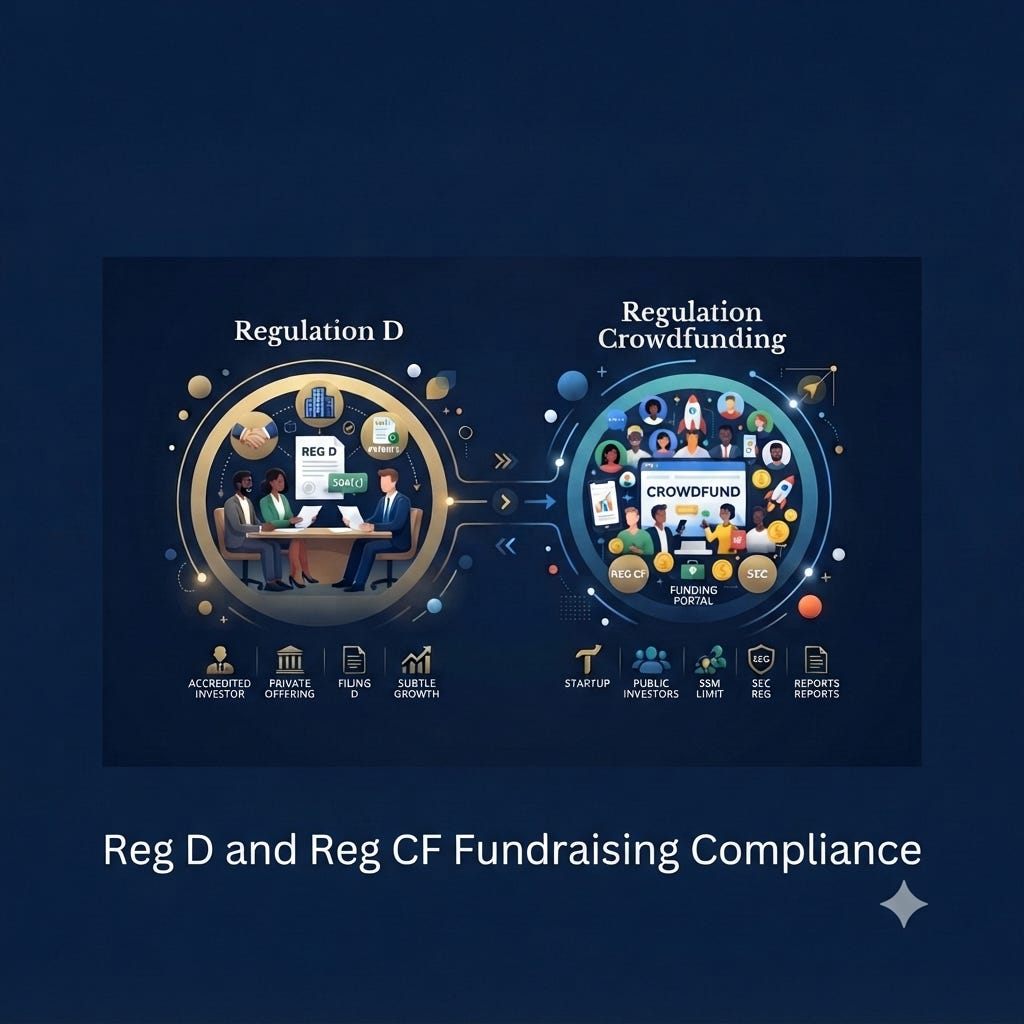
Regulation D and Regulation Crowdfunding Compliance
Description
Rule 506 of Regulation D carried $2.4 trillion of reported private capital in 2025 across 34,553 offerings. Regulation Crowdfunding, in the same twelve months, delivered roughly $378 million. Those two exemptions serve different purposes for different companies, and treating them as interchangeable line items on a financing menu is where founders lose money. The expensive failure is quieter than a bad valuation. A founder announces a round from a stage, admits a nonaccredited friend two weeks later, and every purchaser in that round now holds a rescission right under Section 12(a)(1) of the Securities Act of 1933 for the full purchase price plus interest, with no requirement to prove reliance, scienter, or loss.
Executive Summary
Regulation D and Regulation Crowdfunding compliance turns on whether the issuer advertises, whether nonaccredited investors buy, and whether the raise fits the $5,000,000 cap in 17 CFR 227.100(a)(1). Rule 506(b) carries no dollar ceiling and no verification duty, and it forbids advertising. Rule 506(c) permits advertising to the world and requires the issuer to take reasonable steps to verify that every purchaser is accredited. Section 4(a)(6) of the Securities Act permits a public raise from anyone through a registered intermediary, capped at $5,000,000 in any rolling twelve month period, with purchase limits on nonaccredited buyers and audited financial statements once the target exceeds $618,000.
The market has already shown where institutional money goes. In the first quarter of 2026, issuers reported $767.2 billion raised under Regulation D. Rule 506(b) accounted for $708.1 billion of that across 8,752 offerings, Rule 506(c) for $59.1 billion across 1,111 offerings, and Rule 504 for $0.05 billion across 55 offerings. Roughly nine of every ten Regulation D dollars went to pooled investment vehicles, not to operating companies.
Two changes since 2020 matter more to practice than anything else in the rules. Rule 152, effective March 15, 2021, made concurrent offerings workable by replacing the old five factor integration test with a general principle and four safe harbors. Staff guidance issued March 12, 2025 accepted high minimum investment amounts plus written purchaser representations as reasonable verification steps under Rule 506(c)(2)(ii), which removed the document collection burden that had kept most private funds inside Rule 506(b).
Settled: the mechanics of each exemption and the strict liability that follows a failed one. Moving: the accredited investor definition, the Regulation Crowdfunding ceiling, and whether a finders exemption arrives from the Commission in 2026.
Detailed Findings
What is the difference between Regulation D and Regulation Crowdfunding
Regulation D is a safe harbor for private placements with no offering ceiling under Rule 506, and Regulation Crowdfunding is a standalone exemption under Section 4(a)(6) capped at $5,000,000 in any rolling twelve month period and conducted only through a registered intermediary. Rule 506(b) permits an unlimited raise from an unlimited number of accredited investors and up to 35 nonaccredited purchasers who satisfy the sophistication standard in Rule 506(b)(2)(ii). The moment a single nonaccredited investor is admitted, the information delivery obligations of Rule 502(b) attach, and an early stage company must hand that investor the same categories of disclosure a registered offering would require.
Rule 506(c) trades the advertising prohibition for a verification duty. Every purchaser must be accredited, and the issuer must take reasonable steps to verify that status under Rule 506(c)(2)(ii). A purchaser questionnaire alone does not satisfy the rule.
Section 4(a)(6) works differently at every step. The offering runs through a funding portal registered with the Commission and a member of the Financial Industry Regulatory Authority, or through a registered broker dealer. The