Episode Details
Back to Episodes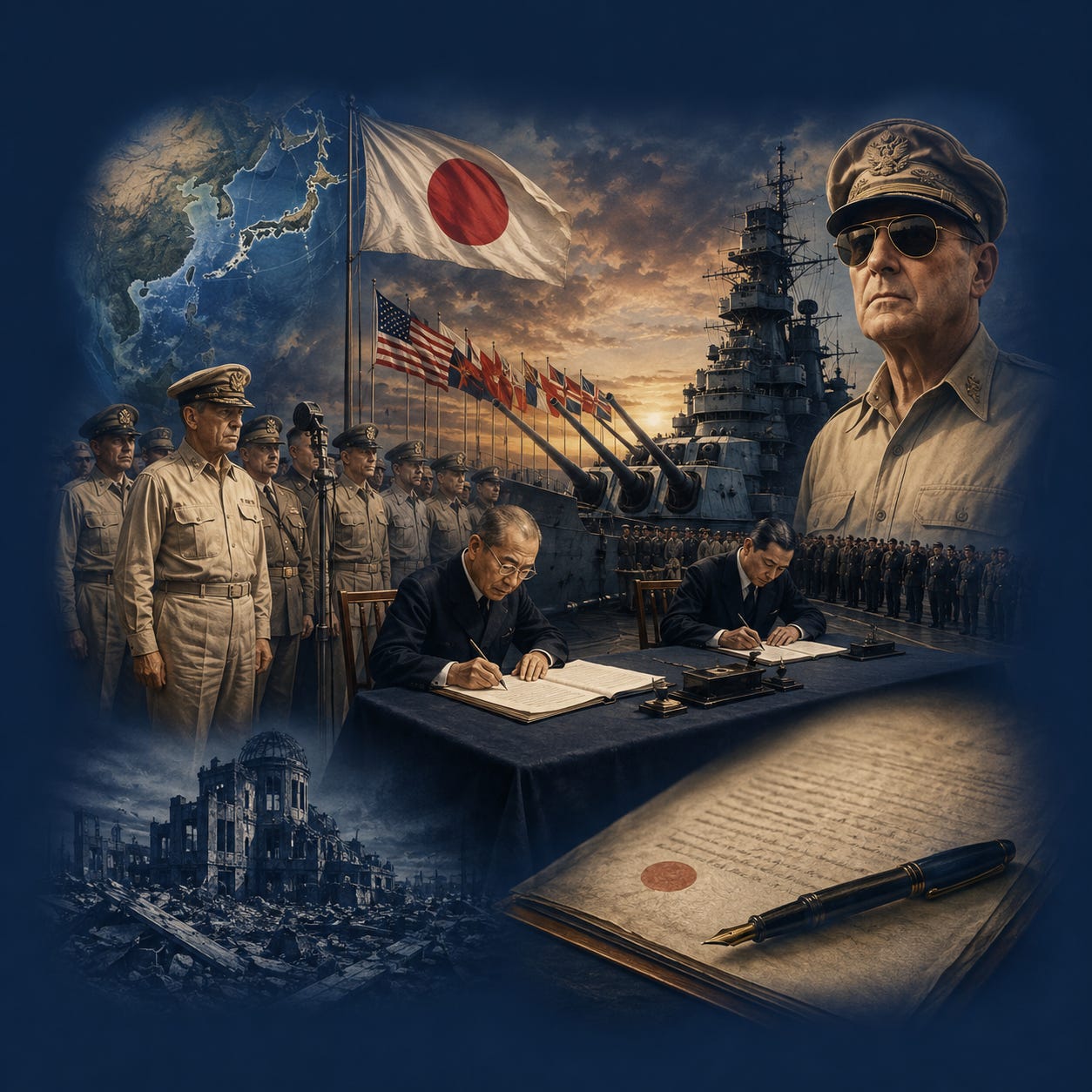
Eight Paragraphs That Shaped Modern Asia
Description
Military History and National Security Research Report
Bottom Line Up Front
Japan surrendered on a legal instrument of eight paragraphs, not on a peace treaty, and that choice of document controlled the next seven years of Japanese sovereignty. The surrender signed at 0904 on September 2, 1945 aboard the USS Missouri transferred the governing authority of the Emperor and the Japanese Government to a single American officer, and it created the command relationship that the United States and Japan still operate under today through the Treaty of Mutual Cooperation and Security of January 19, 1960. Anyone who reads conflict termination as a diplomatic formality should read those eight paragraphs and count how much power they moved.
Executive Summary
The Japanese Instrument of Surrender, signed at 0904 aboard the USS Missouri in Tokyo Bay on September 2, 1945, ended World War II by accepting the Potsdam Declaration. The document runs eight paragraphs. It commanded the cessation of hostilities, ordered the preservation of ships, aircraft, and property, required Japanese Imperial General Headquarters to issue surrender orders to every commander in the field, bound all Japanese civil and military officials to the directives of the Supreme Commander for the Allied Powers, and required the immediate liberation of Allied prisoners of war and civilian internees.
Two Japanese representatives signed, followed by eleven Allied signatures across ten nations, and the whole ceremony ran about twenty five minutes. The instrument is held in the Records of the U.S. Joint Chiefs of Staff, Record Group 218, at the National Archives, which accessioned it on October 1, 1945. The Japanese copy sits in the Diplomatic Archives of the Japanese Foreign Ministry.
The substantive terms had been settled three weeks earlier. The Potsdam Declaration of July 26, 1945 demanded in paragraph 13 the unconditional surrender of all Japanese armed forces and limited Japanese sovereignty in paragraph 8 to Honshu, Hokkaido, Kyushu, Shikoku, and such minor islands as the Allies determined. The American reply of August 11, 1945 stated that from the moment of surrender the authority of the Emperor and the Japanese Government to rule the state would be subject to the Supreme Commander of the Allied Powers. Japanese leadership read that sentence as preserving the throne, and it accepted.
What the instrument did not do is end the war as a matter of United States law. Hostilities were declared terminated at noon on December 31, 1946 by Proclamation 2714, which stated plainly that a state of war still existed. The legal state of war with Japan ended only when the Treaty of Peace with Japan entered into force on April 28, 1952, after 48 of 51 participating nations signed at San Francisco on September 8, 1951. Three refused: the Soviet Union, Poland, and Czechoslovakia. That gap of six years and eight months between the ceremony and the peace is the most misunderstood fact about V-J Day, and it carried real consequences for war powers statutes, claims, and the disposition of territory.
Detailed Findings
What did the Japanese Instrument of Surrender actually require of Japan?
The instrument required total obedience to a foreign commander, effective immediately, with no reciprocal obligation stated. Its opening clause has the signatories acting by command of and in behalf of the Emperor of Japan, the Japanese Government, and Japanese Imperial General Headquarters, accepting the provisions of the Potsdam Declaration issued at Potsdam on July 26, 1945 by the heads of the Governments of the United States, China, and Great Britain, later adhered to by the Soviet Union.
From there the document reads like an operations order. Diplomatic phrasing disappears. Hostilities cease at once. All forces wherever situated are proclaimed to surrender unconditionally. Ships, aircraft, and military and civil property are pre