Episode Details
Back to Episodes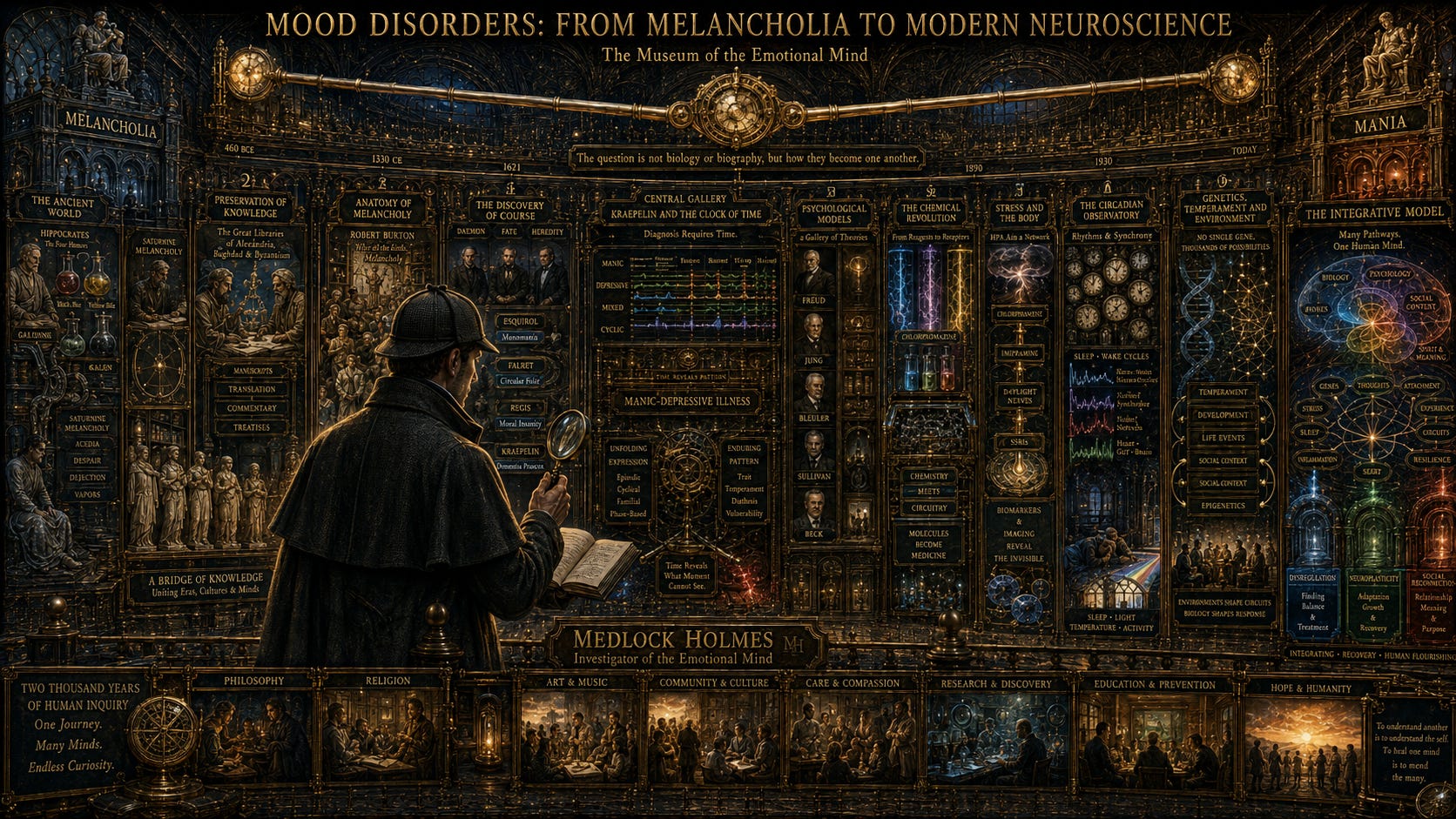
PSYCH 109: Mood Disorders - Historical Introduction and Conceptual Overview
Description
Medlock Holmes enters the Great Museum of the Emotional Mind.
It is unlike any museum he has visited before.
Instead of paintings, its galleries contain theories.
Instead of fossils, there are abandoned explanations of human suffering.
And running through the centre of the building is an enormous pendulum.
At one extreme is engraved:
MELANCHOLIA
At the other:
MANIA
The pendulum has been swinging for more than two millennia.
Holmes soon discovers that the history of mood disorders is not simply the history of old psychiatric diagnoses.
It is the story of psychiatry itself attempting to answer one enduring question:
How do biology, temperament, experience, relationships, thought, environment, and time combine to alter human mood?
The investigation begins not in a modern laboratory, but in ancient Greece.
Hippocrates described melancholia as a state characterised by despondency, disturbed sleep, reduced appetite, irritability, fear, and restlessness.
The explanation was black bile.
The theory was wrong.
But the intellectual move was revolutionary.
Mental suffering was being placed within nature rather than attributed solely to supernatural forces.
The ancient physicians also recognised something remarkably modern: depression was not simply sadness.
It affected sleep.
Appetite.
Activity.
Thought.
Emotion.
Behaviour.
And sometimes the wish to remain alive.
They also recognised the relationship between anxiety and melancholia and described agitated forms of depression in which distress, fear, excessive speech, restlessness, and behavioural activation coexisted with depressive mood.
The boundaries between depression and mania were already becoming complicated.
The Greeks and Romans described mania as a state of excitement, increased activity, altered mood, grandiosity, reduced sleep, disinhibition, aggression, and sometimes psychosis.
Aretaeus of Cappadocia made the crucial observation that melancholia and mania might not be separate diseases.
They could be different expressions of the same underlying disorder.
The pendulum had been discovered.
Ancient medicine also introduced another idea that would survive for centuries:
temperament.
The melancholic temperament was contemplative, brooding, and sombre.
The sanguine temperament was energetic, sociable, and active.
The choleric temperament was irritable and explosive.
The phlegmatic temperament was inhibited and passive.
Disease emerged when balance was lost.
The four-humour biology disappeared, but the deeper idea survived: enduring temperamental traits might create vulnerability to particular forms of psychopathology.
The knowledge then travels through the Islamic Golden Age.
Holmes finds manuscripts belonging to scholars including Ishaq Ibn Imran and Avicenna.
They preserve and elaborate earlier descriptions of melancholia and temperament.
Avicenna describes different combinations of inactivity, anger, restlessness, and excitement and recognises transitions from melancholic states towards mania.
Ishaq Ibn Imran considers inherited vulnerability, temperament, mental overexertion, and disturbances of sleeping and waking.
The language is ancient.
The architecture of the idea is strikingly contemporary:
predisposition + environment + disturbed biological rhythms → illness.
Holmes moves forward to Oxford in 1621.
There he finds Robert Burton’s monumental Anatomy of Melancholy.
The actual frontispiece reproduced on page 12 of the source resembles a visual map of melancholia itself: Burton sits centrally, surr