Episode Details
Back to Episodes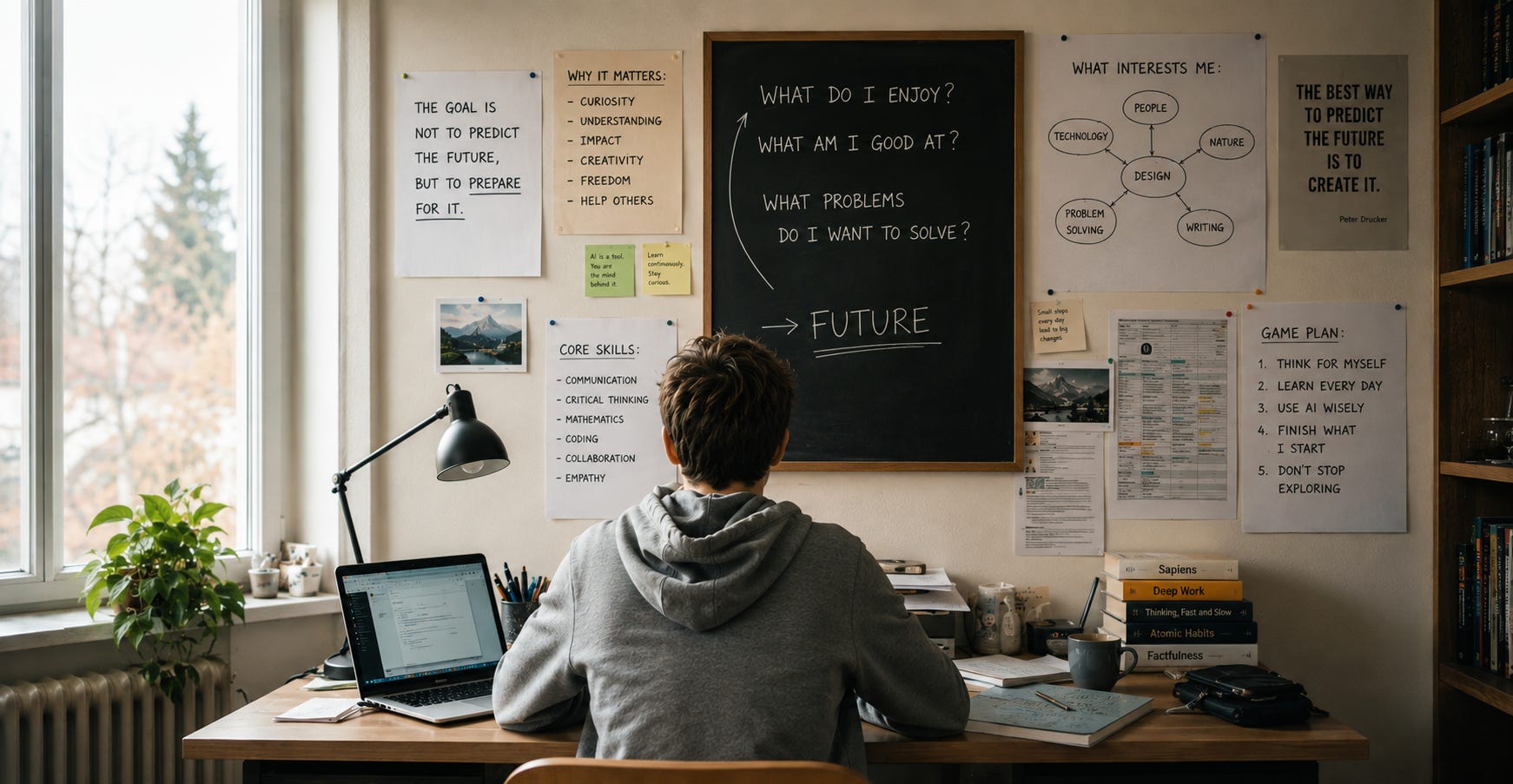
Where should you send your kid to school in the age of AI? 👩🏫
Description
Imagine you’re fourteen and you have to pick a school. It’s 1995. Your parents tell you: learn to use a computer, that’s the future. Or go study law. And they’re right. Now imagine you’re fourteen today. Could you give a kid good advice?
My son is 15. In a few days he starts secondary school - for now at a gymnázium, the Czech academic track, so he still has a little time before he has to decide. In these hard-to-read times I see that as a big advantage. How do I advise him? I decided to write it down and try writing my son a letter. I’d have appreciated one at his age. Or maybe I’d have laughed at it and shoved it in a drawer, because at fifteen you don’t think of your dad as the smartest person you know :-). Either way, I’d have regretted not at least trying.
So here’s my letter - maybe it’ll give you something to think about if you’re in a similar situation. And below the letter you’ll find how I got there. If you want to go deeper, the option is there!
Dear Son,
I know you hate it when I give you advice. So this isn’t advice. It’s more what I’d want to hear from my own dad if I were fifteen today. Stash this scrap of paper somewhere and try to look at it now and then.
First, a confession. When I was choosing a school, the world was reasonably predictable. You graduate, you find a job, you do it, eventually you get promoted. Or you go into business, but it played out much the same way. Studying was something you got out of the way at the start of your life, and then you worked for forty years. That model died during my lifetime, and during yours it won’t exist at all. You’ll be learning your whole life. Not because it sounds nice, but because the world will change faster than any school can rewrite its curriculum. So if there’s one single thing you should learn in secondary school, let it be this: learn how to learn. Work out how your head works, when it thinks best, how to get into something you don’t understand. That will stay with you even if everything else goes obsolete. And I think things are going to go obsolete damn fast.
Second thing. When I was young, “IT people” were a strange caste who understood computers, and the rest of the world came to watch them. Being average, or even below average, was enough not to starve. That’s ending. Anyone who wants to be successful will have to become an IT person - but an average IT person will be worthless. Not that everyone will program, but everyone will build their own tools, their own little apps, their own ways of working with AI. Whoever can do that will have a multiplied advantage in any field. That’s why I’m not telling you “go study computer science”. I’m telling you: wherever you go, take this with you. AI is the new basic skill, the way reading was for me and English was for my generation. But on its own it won’t be enough. Combine it with something. With a field, a craft, a subject that’s yours.
The third thing is uncomfortable, so I’ll say it straight. You’re smart. You know it and I know it. And that’s exactly why I have to warn you about the trap smart people fall into. Everything comes fast to a smart person, and AI makes it faster still. It’ll spit out your homework, your essay, your code, whatever, and nobody can prove a thing (if you’re clever about it). It’ll be terribly tempting to use your intelligence to avoid doing any work at all. Use AI to make yourself smarter, not to make your life quiet. Have it explain things to you, argue with it, test whether it can catch you out. You’ll know which one you’re doing by whether you still know things when the wifi goes down. Smarts without work are just laziness in nice packaging, and the world spots it faster than you think.
The fourth thing may surprise you, because it comes from someone who has worked in technology his whole life. Don’t throw out the humanities and the arts. The world is being flooded with text, ima