Episode Details
Back to Episodes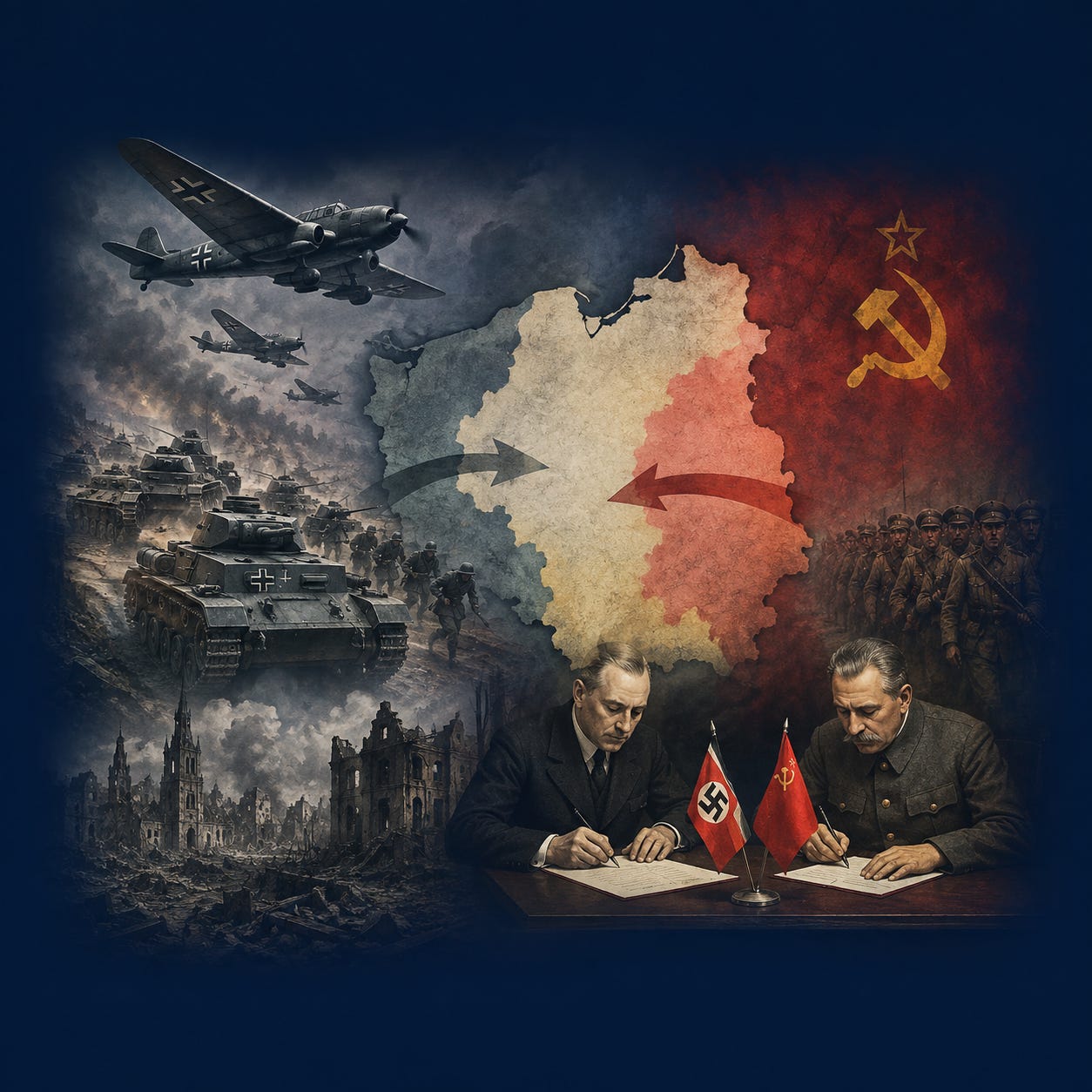
The German Invasion of Poland, September 1, 1939
Description
Germany invaded Poland on September 1, 1939, at the 4:45 a.m. hour named in Hitler’s Directive No. 1 of August 31, 1939, committing roughly 3,000 tanks. The campaign lasted 35 days. It ended with the capitulation of the last Polish field force at Kock, and no armistice and no peace treaty closed it, because the Polish government evacuated intact and never signed an instrument of surrender. The partition that followed was executed by two powers acting under a secret protocol signed nine days before the first shot.
Two army groups carried the attack. Army Group North under Generaloberst Fedor von Bock fielded 14 infantry divisions, two motorized infantry divisions, one Panzer division, one Panzer brigade, and one cavalry brigade. Army Group South under Generaloberst Gerd von Rundstedt fielded 21 infantry, four Panzer, two motorized infantry, four light, and three mountain divisions. Poland deployed seven armies and a general reserve under Marshal Edward Rydz Smigly across the entire frontier, a posture ordered on March 23, 1939.
The casualty record is contested at its source. The German Report Series prepared for the United States Army Center of Military History puts German losses at approximately 10,000 killed, 30,000 wounded, and 3,000 missing. A compilation drawn from Army High Command returns gives 16,343 German dead and 320 missing, a killed figure 63 percent higher. Warsaw surrendered on September 27, 1939 with a garrison of 102,000. Modlin surrendered the following day with 30,000.
The field has stopped treating the campaign as the debut of a finished doctrine and now argues about whether it displayed anything new at all. The consequence that outlasts that argument is legal. The Nuremberg Tribunal made the September 1 attack the paradigm case of a crime against peace, and that holding, not any battlefield lesson, is what the 1939 campaign put permanently into international law.
B. Strategic Setting and Chronology
why did germany invade poland in september 1939
The attack executed a decision taken in the spring of 1939 and recorded in Hitler’s own words to his commanders at Obersalzberg on August 22, 1939. The German Polish Non Aggression Declaration of January 26, 1934, signed in Berlin by Freiherr Konstantin von Neurath and Ambassador Josef Lipski, bound both states for ten years and committed them to the principles of the Pact of Paris of 1928. Germany denounced it in the spring of 1939. The documentary chain the Nuremberg Tribunal later followed begins earlier still.
An Armed Forces High Command directive of November 24, 1938 ordered preparations for the surprise occupation of the Free City of Danzig by German troops. An April 1939 directive stated that the operation against Poland could be carried out at any time from September 1, 1939 onward. At a military conference on May 23, 1939, minuted by Lieutenant Colonel Rudolf Schmundt, Hitler told Goering, Raeder, and Keitel that Germany would attack Poland at the first suitable opportunity, and stated that Danzig was not the object of the exercise.
Three overlapping records of the Obersalzberg address of August 22, 1939 survive as evidence documents L-3, 798-PS, and 1014-PS. In them Hitler states that the decision to attack Poland was made in the spring, that the aim of the war was the destruction of the Polish armed forces and not the seizure of a fixed line, and that the assault would begin on the morning of August 26. He also described a false flag operation using companies dressed in Polish uniforms. The postponement to September 1 followed the British guarantee, and the false flag operation became the Gleiwitz incident.
what did the nazi soviet pact secret protocol actually say
Point 2 of the Secret Additional Protocol of August 23, 1939 fixed the partition line by naming three rivers, and it did so nine days before the invasion began. The text reads that in the event of a territorial and political rearra