Episode Details
Back to Episodes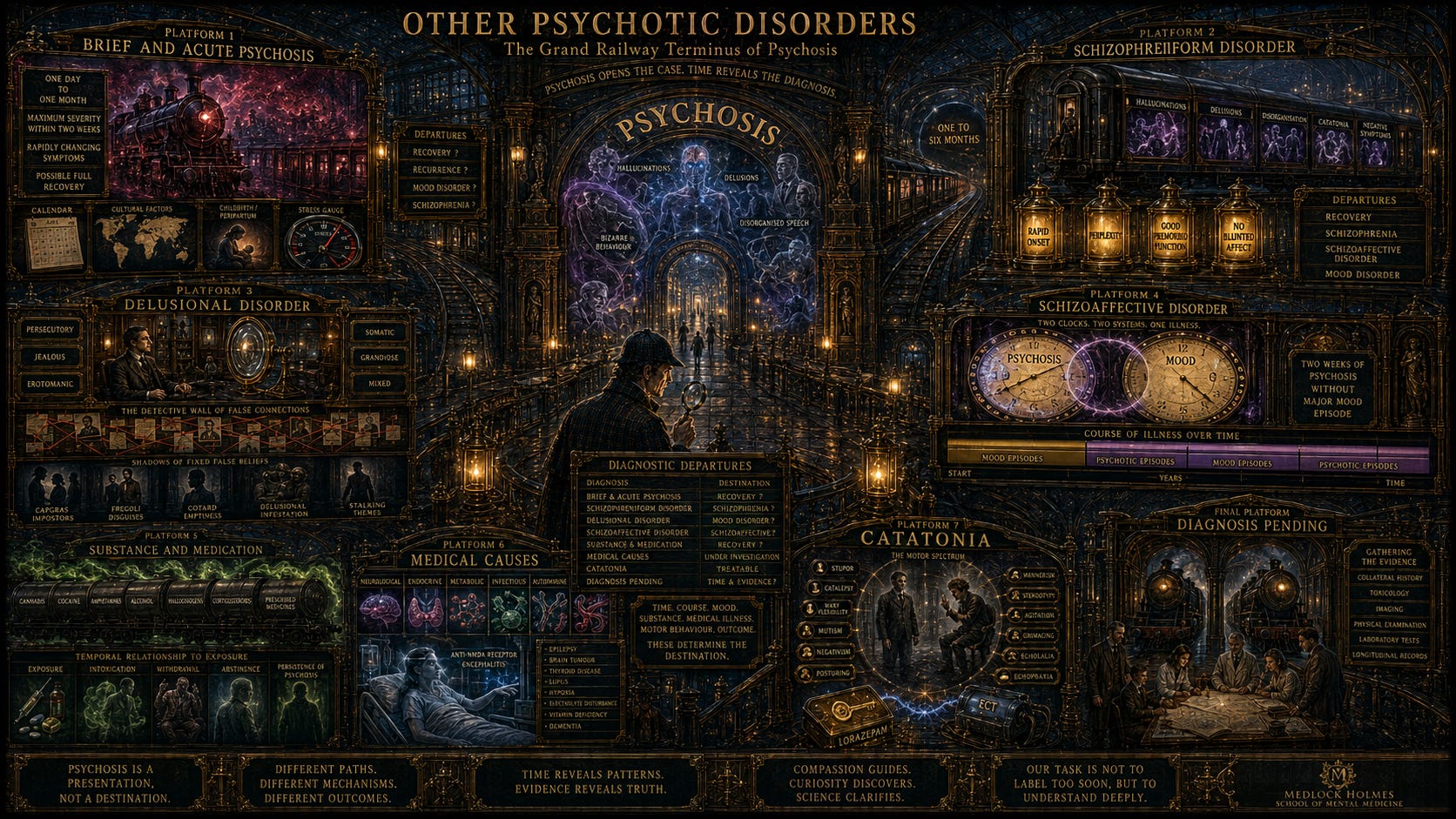
PSYCH 108: Other Psychotic Disorders
Description
Medlock Holmes enters the Grand Railway Terminus of Psychosis.
Every platform begins in the same central hall.
A patient may arrive with hallucinations.
Another with delusions.
Another with disorganised speech, bizarre behaviour, perplexity, agitation, or catatonic stillness.
At first glance, all appear to be travelling towards the same destination.
But the departures board tells a different story.
Some journeys last days.
Others months.
Some are driven by mood.
Some by drugs, prescribed medicines, neurological disease, endocrine disturbance, or autoimmune inflammation.
Some leave thinking and personality largely intact except for one immovable belief.
Holmes realises that the diagnosis cannot be solved from the psychotic symptom alone.
He must investigate time, context, consciousness, mood, medical causation, substances, function, and longitudinal course.
The first train arrives without warning.
A woman who had been functioning normally becomes perplexed, frightened, and intensely psychotic over several days. Her hallucinations and delusions shift rapidly. At one moment she is terrified; hours later she appears ecstatic. Her behaviour changes just as quickly.
This is the territory of acute and transient psychotic disorder and brief psychotic disorder.
Descriptions of such episodes have appeared throughout psychiatric history under names including cycloid psychosis, bouffée délirante, reactive psychosis, amentia, and oneirophrenia. Across languages and traditions, the shared pattern is striking:
Acute onset.
Rapidly changing symptoms.
Short duration.
The possibility of full recovery.
Under DSM terminology, brief psychotic disorder lasts at least one day but less than one month, followed by complete return to the premorbid level of functioning. A marked stressor may be present, but it is no longer required. Episodes may also arise during pregnancy or shortly after childbirth.
Under ICD terminology, acute and transient psychotic disorder reaches maximum severity within two weeks, often includes confusion, mood disturbance, or rapidly changing polymorphic symptoms, and may last up to three months.
The prognosis is often favourable-but Holmes remains cautious.
The diagnosis can only be confirmed retrospectively.
During the first days of psychosis, no one knows whether it will remit next week, persist for four months, or become the first episode of schizophrenia or bipolar disorder.
The apparent destination changes as the journey continues.
The next platform is marked One to Six Months.
Here Holmes meets a man with hallucinations, delusions, disorganised speech, and social withdrawal. His presentation is indistinguishable from schizophrenia, but the illness has not lasted long enough.
This is schizophreniform disorder.
It meets the core symptom requirements of schizophrenia but lasts at least one month and less than six months. Functional decline is not mandatory. When the diagnosis is made before recovery, it remains provisional.
Certain signs suggest a more favourable course:
Rapid onset of prominent symptoms.
Confusion or perplexity.
Good premorbid functioning.
Absence of blunted affect.
Yet the diagnosis is unstable. Many patients initially diagnosed with schizophreniform disorder later meet criteria for schizophrenia or schizoaffective disorder. A smaller proportion develop a mood disorder, while others recover and never experience another episode.
Again, time is not merely a measurement.
It is part of the diagnostic instrument.
Holmes then enters a quiet chamber occupied by a successful accountant.
The man works, pays bills, dresses carefully, and speaks coherently.
Yet he is