Episode Details
Back to Episodes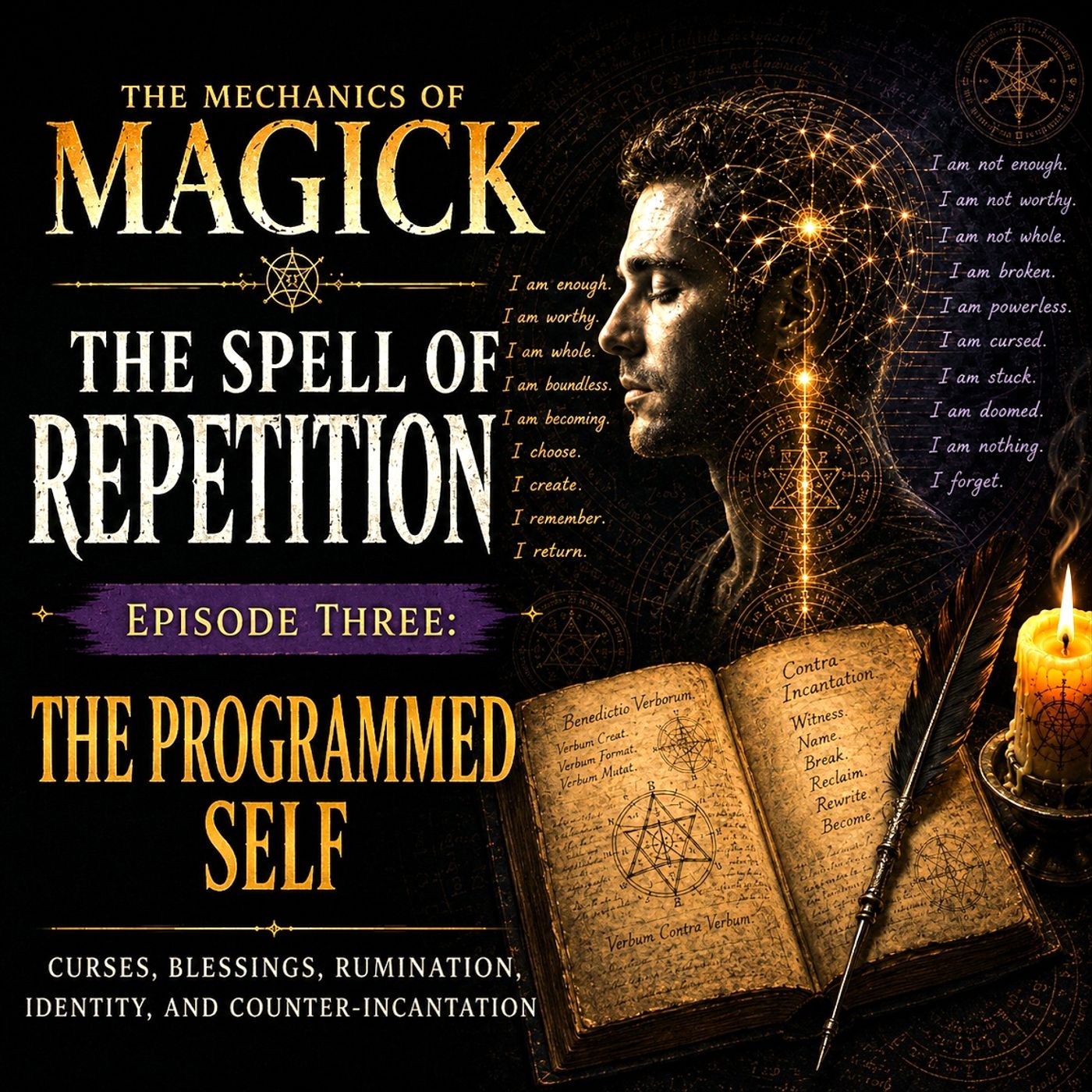
The Mechanics of Magick: The Spell of Repetition Episode Three: The Programmed Self
Published 1 month, 2 weeks ago
Description
Links For The Occult Rejects
https://linktr.ee/theoccultrejects
Occult Research Institute
https://www.occultresearchinstitute.org/
Substack
https://substack.com/@theoccultrejects?r=7auau0&utm_campaign=profile&utm_medium=profile-page
Cash App
https://cash.app/$theoccultrejects
Venmo
@TheOccultRejects
Buy Me A Coffee
buymeacoffee.com/TheOccultRejects
Patreon
https://www.patreon.com/TheOccultRejects
Bibliography
Curses, Blessings, and Ritual Harm
Cannon, Walter B. “‘Voodoo’ Death.” American Anthropologist 44, no. 2 (1942): 169–181.
Faraone, Christopher A. Ancient Greek Love Magic. Cambridge, MA: Harvard University Press, 1999.
Gager, John G., ed. Curse Tablets and Binding Spells from the Ancient World. New York: Oxford University Press, 1992.
Graf, Fritz. Magic in the Ancient World. Translated by Franklin Philip. Cambridge, MA: Harvard University Press, 1997.
Ogden, Daniel. Magic, Witchcraft, and Ghosts in the Greek and Roman Worlds: A Sourcebook. 2nd ed. New York: Oxford University Press, 2009.
Stratton, Kimberly B., and Dayna S. Kalleres, eds. Daughters of Hecate: Women and Magic in the Ancient World. New York: Oxford University Press, 2014.
Tambiah, Stanley Jeyaraja. “The Magical Power of Words.” Man 3, no. 2 (1968): 175–208.
Placebo, Nocebo, and Medical Communication
Barsky, Arthur J., Ralph Saintfort, Malcolm P. Rogers, and Jonathan F. Borus. “Nonspecific Medication Side Effects and the Nocebo Phenomenon.” JAMA 287, no. 5 (2002): 622–627.
Benedetti, Fabrizio. Placebo Effects: Understanding the Mechanisms in Health and Disease. Oxford: Oxford University Press, 2009.
Benedetti, Fabrizio, Marina Lanotte, Lorella Lopiano, and Luana Colloca. “When Words Are Painful: Unraveling the Mechanisms of the Nocebo Effect.” Neuroscience 147, no. 2 (2007): 260–271.
Colloca, Luana, and Fabrizio Benedetti. “Nocebo Hyperalgesia: How Anxiety Is Turned into Pain.” Current Opinion in Anaesthesiology 20, no. 5 (2007): 435–439.
Colloca, Luana, and Damien Finniss. “Nocebo Effects, Patient–Clinician Communication, and Therapeutic Outcomes.” JAMA 307, no. 6 (2012): 567–568.
Colloca, Luana, and Franklin G. Miller. “The Nocebo Effect and Its Relevance for Clinical Practice.” Psychosomatic Medicine 73, no. 7 (2011): 598–603.
Enck, Paul, Fabrizio Benedetti, and Manfred Schedlowski. “New Insights into the Placebo and Nocebo Responses.” Neuron 59, no. 2 (2008): 195–206.
Häuser, Winfried, Ernil Hansen, and Paul Enck. “Nocebo Phenomena in Medicine: Their Relevance in Everyday Clinical Practice.” Deutsches Ärzteblatt International 109, no. 26 (2012): 459–465.
Inner Speech and Development
Fernyhough, Charles. The Voices Within: The History and Science of How We Talk to Ourselves. New York: Basic Books, 2016.
Vygotsky, Lev S. Thought and Language. Revised and expanded ed. Edited and translated by Alex Kozulin. Cambridge, MA: MIT Press, 1986.
Winsler, Adam, Charles Fernyhough, and Ignacio Montero, eds. Private Speech, Executive Functioning, and the Development of Verbal Self-Regulation. Cambridge: Cambridge University Press, 2009.
Rumination and Repetitive Negative Thinking
Brosschot, Jos F., Bart Verkuil, and Julian F. Thayer. “Conscious and Unconscious Perseverative Cognition: Is a Large Part of Prolonged Physiological Activity Due to Unconscious Stress?” Journal of Psychosomatic Research 69, no. 4 (2010): 407–416.
Ehring, Thomas, and Edward R. Watkins. “Repetitive Negative Thinking as a Transdiagnostic Process.” International Journal of Cognitive Therapy 1, no. 3 (2008): 192–205.
Nolen-Hoeksema, Susan. “Responses to Depression and Their Effects on the Duration of Depressive Episodes.” Journal of Abnormal Psychology 100, no. 4 (1991): 569–582.
Nolen-Hoeksema, Susan, Blair E. Wisco, and Sonja Lyubomirsky. “Rethinking Rumination.” Perspectives on Psychological