Episode Details
Back to Episodes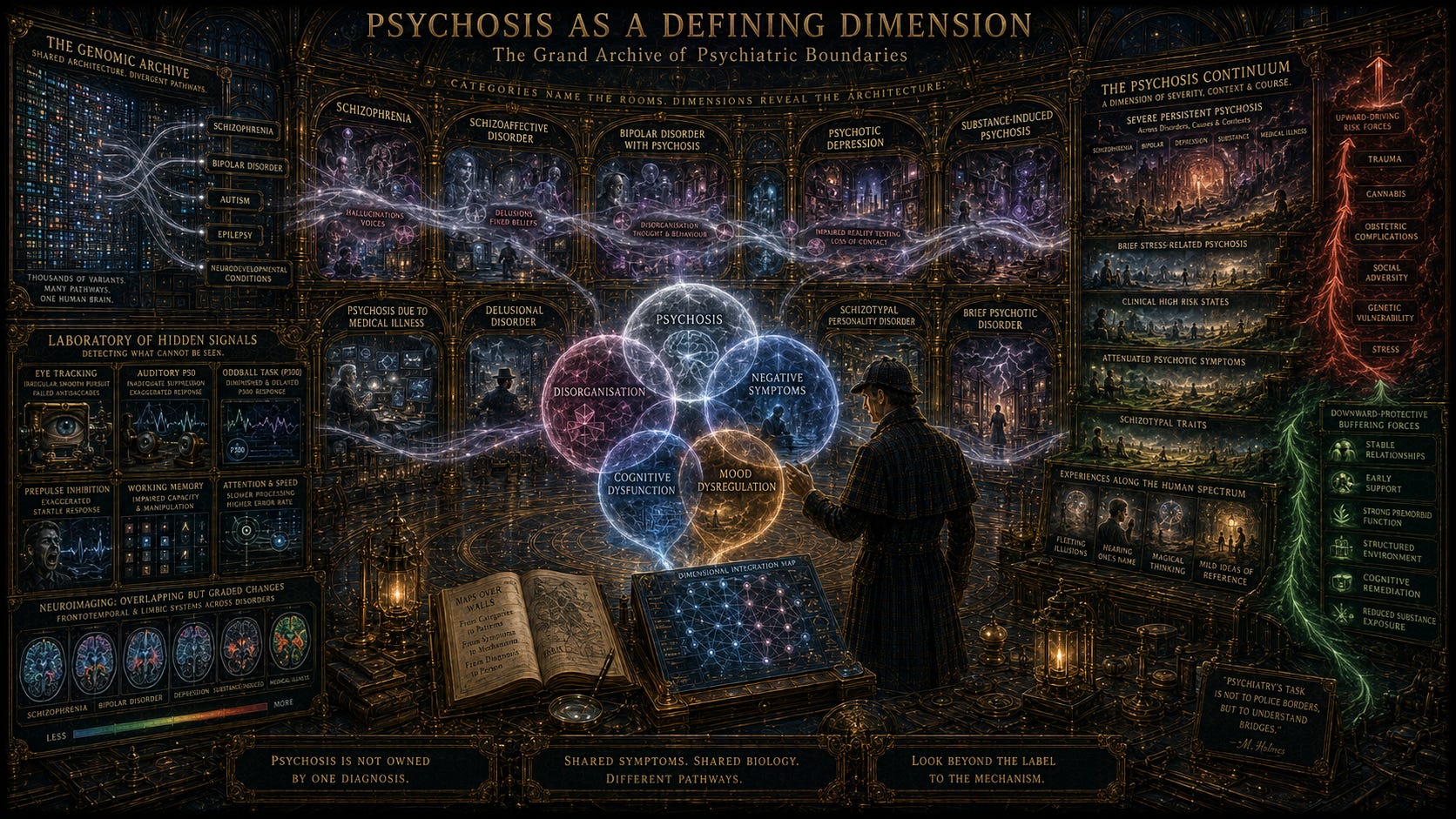
PSYCH 107: Psychosis as a Defining Dimension in Schizophrenia
Description
Medlock Holmes enters the Grand Archive of Psychiatric Boundaries.
The building is divided into rigid rooms.
One is labelled Schizophrenia.
Another Bipolar Disorder.
Another Psychotic Depression.
Beyond them lie chambers for substance-induced psychosis, psychosis caused by medical illness, delusional disorder, schizotypal personality disorder, and brief psychotic states.
Each room appears separate.
Yet from beneath every door, Holmes sees the same strange light.
Psychosis is moving between them.
He follows it into the central hall and discovers that hallucinations, delusions, disorganised thought, and grossly disorganised or catatonic behaviour are not unique possessions of schizophrenia. They occur across numerous psychiatric, neurological, medical, and substance-related conditions.
Even within schizophrenia, no single psychotic symptom is essential.
A person may meet diagnostic criteria without hallucinations or delusions if severe thought disorder, disorganisation, catatonia, and negative symptoms form the clinical picture.
The diagnosis is therefore not defined by one pathognomonic sign.
It is built from combinations of symptoms.
This makes schizophrenia clinically recognisable-but biologically heterogeneous.
Holmes turns towards an enormous map of the disorder.
Instead of one uniform syndrome, it contains overlapping domains:
* Psychosis
* Disorganisation
* Negative symptoms
* Cognitive dysfunction
* Mood and affective dysregulation
Psychosis includes distortions of perception and inferential thinking.
Disorganisation involves disrupted thought, speech, and behaviour.
Negative symptoms involve diminished emotional expression, speech, motivation, and goal-directed activity.
Cognitive dysfunction affects attention, memory, processing speed, and executive function.
Mood symptoms range from depression to mania.
These dimensions overlap, but they are not identical.
A patient may have severe psychosis with relatively preserved cognition.
Another may have fewer hallucinations but profound negative and cognitive symptoms.
A third may combine psychosis with mania.
Holmes realises that the categorical label hides these differences.
Dimensional assessment reveals them.
The investigation expands beyond schizophrenia.
In psychotic depression, mood disturbance dominates while psychosis appears at its most severe points.
In bipolar disorder, mania may become psychotic.
In substance-induced states, hallucinations and delusions arise in temporal relationship to exposure.
In medical and neurological disorders, psychosis may accompany altered brain function.
The clinical form overlaps even when the underlying causes differ.
This raises a provocative question:
Is psychosis itself a disease?
Or is it a shared clinical dimension produced by many diseases?
Holmes examines family records.
Schizophrenia and bipolar disorder do not segregate neatly across generations. Families may contain schizophrenia, schizoaffective disorder, bipolar disorder, depression with psychotic features, and substance-related psychoses.
The inherited liability appears broader than the diagnostic categories.
Twin studies reinforce the same conclusion. Identical twins show substantially greater concordance than non-identical twins, confirming a strong genetic contribution. Yet when one twin has schizophrenia, the other may develop an affective psychosis rather than the same diagnosis.
The vulnerability may be to psychosis and related dimensions-not to one perfectly bounded disorder.
Holmes then enters the genomic vault.
There is no single psychosis gene.
Instead, thousands of small genetic effects interact with ne