Episode Details
Back to Episodes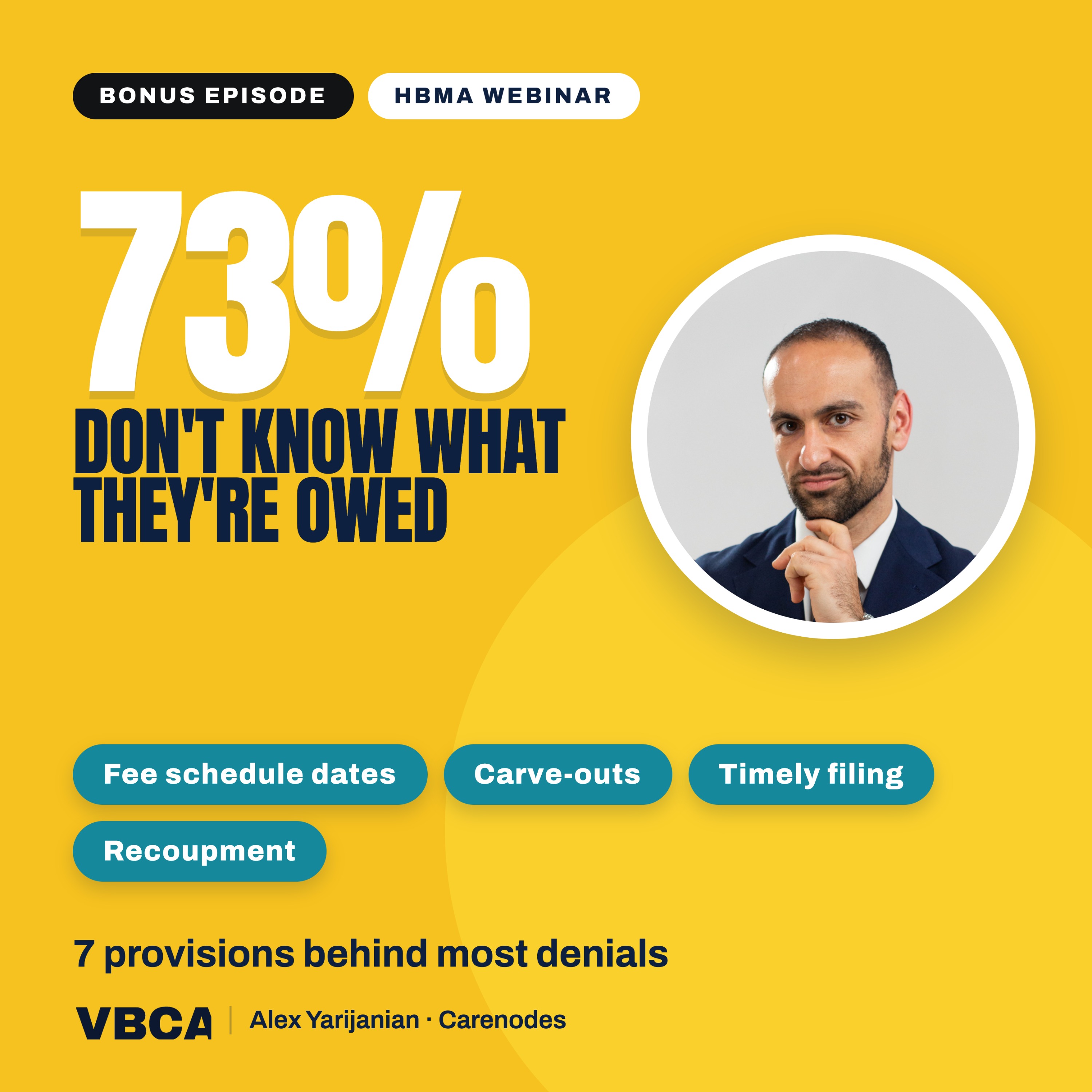
Bonus: 5 Contract Clauses Killing Your Reimbursement
Description
This bonus episode is the full recording of Alex Yarijanian's HBMA continuing-education webinar. It runs longer than a standard VBCA episode — treat it as a resource, not a highlight reel.
Most revenue cycle teams treat denials and underpayments as billing problems. A meaningful share of them are actually contract problems wearing a billing costume — and you can't fix a contract problem at the claims desk. This session walks through the five payer-contract provisions that generate the most downstream billing failures, a three-phase audit framework for finding them before they cost you, and a denial-routing model that keeps contract-based underpayments from getting silently written off in a clinical appeals queue.
What you'll learn:
- Why contract language — not coding errors — is where most systematic underpayment actually starts
- The five provisions to check first: fee schedule effective dates, carve-outs/exclusions, coordination of benefits, authorization & notification, and timely filing
- Why "rates effective upon execution by both parties" can quietly cost you weeks of underpaid claims
- Why vague terms like "experimental" or "time to time" in a contract are a red flag, not boilerplate
- Why state law — not the payer's internal policy — governs coordination-of-benefits primacy
- Why retroactive denial of an already-issued authorization is not just bad practice — it's against federal law for government-funded products
- A three-phase contract audit framework: highest-leakage provisions → highest-volume services → highest-friction appeal/recoupment timelines
- A three-bucket denial-routing model (clinical / administrative / contract-based) so contract-based underpayments get escalated instead of written off
Session outline:
- Introduction — Alex's background: clinic operations, Cardinal Health/HCA, head negotiator for Humana's West Territories, then founding Carenodes to close the payer/provider information asymmetry.
- The framing stat — a striking share of providers don't actually know what they're supposed to be paid, and contract language is where the error is born.
- Provision 1 — Fee schedule effective dates & updates.
- Provision 2 — Carve-outs & exclusions.
- Provision 3 — Coordination of benefits.
- Provision 4 — Authorization & notification.
- Provision 5 — Timely filing.
- The three-phase audit framework.
- Denial routing: clinical vs. administrative vs. contract-based.
- Close — pick your top two payers, run the checklist, renegotiate.
Resources: Contract audit checklist referenced in this session — request it at vbcapodcast.com
About the host: Alex Yarijanian is CEO & Founder of Carenodes. He spent seven years managing payer contracting operations for 600+ provider organizations across 48 states, including a prior role as leadership and negotiator for Humana's West Territories contracting and network management team.