Episode Details
Back to Episodes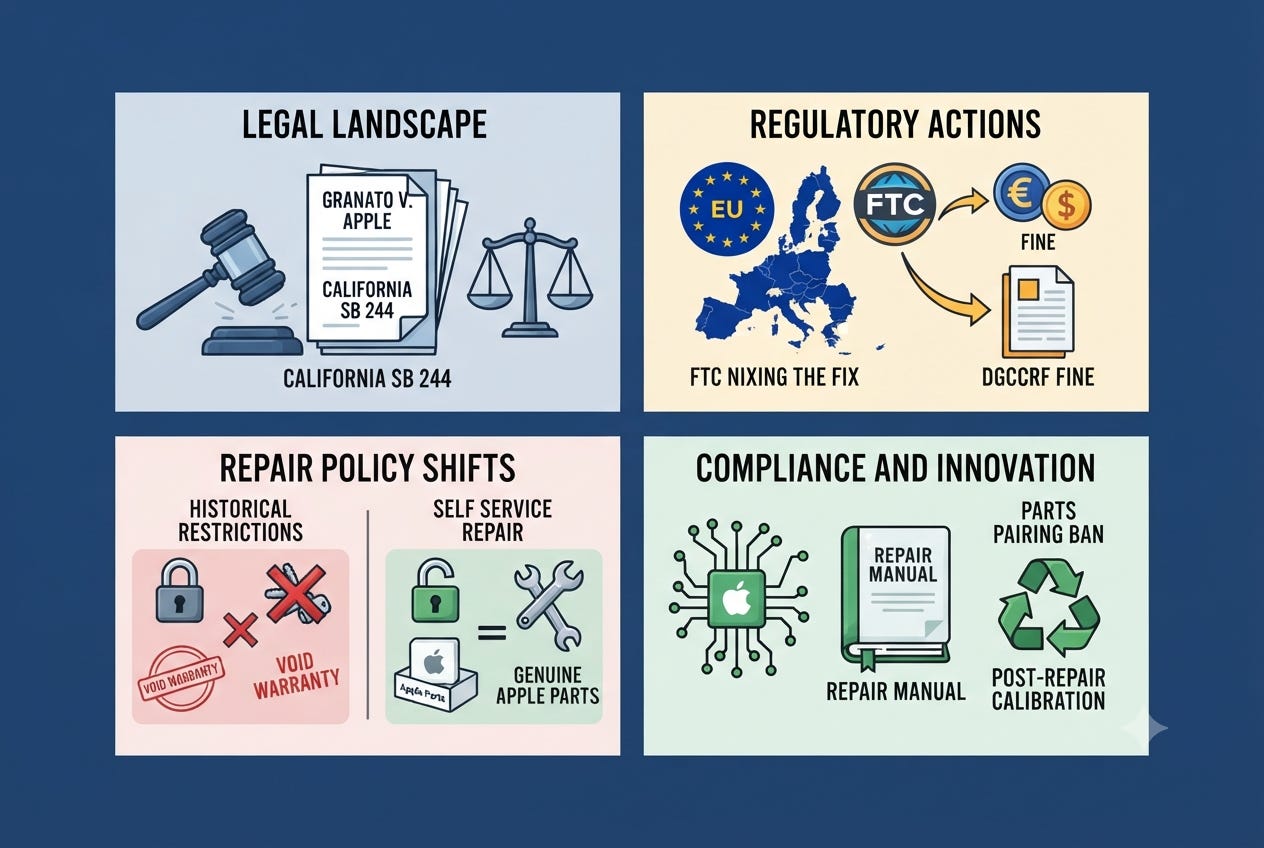
Right to Repair Compliance: Apple, Parts Pairing, and the Litigation History
Description
California’s SB 244 Forces Apple to Rethink Repair Restrictions
how did california right to repair law change apple repair policy
Apple spent 2022 defending a lawsuit in Santa Clara County accusing it of threatening warranty coverage over third party repairs, and by August 2023 the same company was writing to California legislators to endorse Senate Bill 244, the state’s new Right to Repair Act. That reversal did not happen because Apple’s engineering changed its approach to parts pairing. It happened because litigation, a federal regulator’s findings, and a wave of state statutes converged on the same conclusion within a single eighteen month window, and Apple’s public policy team responded to that convergence well ahead of any change to the underlying hardware.
The lawsuit is Granato v. Apple Inc., filed in early 2022 and removed to the United States District Court for the Northern District of California as case number 5:22cv02316. The plaintiffs alleged that Apple violated California’s Unfair Competition Law, the Consumers Legal Remedies Act, and the federal Magnuson Moss Warranty Act by threatening to void warranty coverage for customers who used third party repair shops, refusing service afterward, withholding parts, tools, and manuals, and disparaging aftermarket components. In July 2023, the presiding judge granted the plaintiffs’ motion to remand the case to Santa Clara County Superior Court, finding that the Magnuson Moss claim could not clear the statute’s one hundred named plaintiff threshold for federal jurisdiction and that the remaining state claims sought only equitable relief. The remand sent the underlying unfair competition theory back to state court, where it remains active against the exact repair practices Apple was, by then, publicly reconsidering.
Granato did not arrive in a vacuum. The Federal Trade Commission’s May 2021 report to Congress, Nixing the Fix, concluded that manufacturer repair restrictions are not supported by the safety and security rationale companies typically offer, and the Commission’s unanimous July 2021 policy statement committed it to pursue Section 5 unfair competition claims and Magnuson Moss violations against warranty language that penalizes independent repair. Three years earlier, in 2018, the Commission had already sent Apple, Sony, Microsoft, and Nintendo warning letters over exactly that kind of warranty language. France reached a parallel conclusion through a different mechanism: in March 2020, the Direction Generale de la Concurrence, de la Consommation et de la Repression des Fraudes fined Apple twenty five million euros under Article L. 121-3 of the French Consumer Code for failing to disclose that iOS updates throttled processor speed on aging iPhone 6 and iPhone 7 batteries, a nondisclosure that pushed owners toward paid battery replacement or a new device rather than an independent fix. Apple settled a related multistate attorneys general investigation in the United States the same month for 113 million dollars, and in 2023 paid another 50 million dollars to resolve a class action over the 2015 through 2019 butterfly keyboard mechanism, whose failure modes often required a full top case replacement instead of a simple keyboard swap.
By the time California’s Senate Bill 244 took effect on July 1, 2024, New York’s Digital Fair Repair Act had already been in force for a year, and Minnesota’s version had cleared its legislature months earlier with per violation penalties of up to 20,000 dollars. What none of the three statutes did was ban parts pairing outright, the practice of using serial number checks between a component and a device’s logic board so that a functioning part triggers a warning or a disabled feature unless Apple’s own servers authorize it. Oregon’s Senate Bill 1596 closed that gap when it took effect January 1, 2025, becoming the first state law to prohibit parts pairing for covered electronics manufactured after that da