Episode Details
Back to Episodes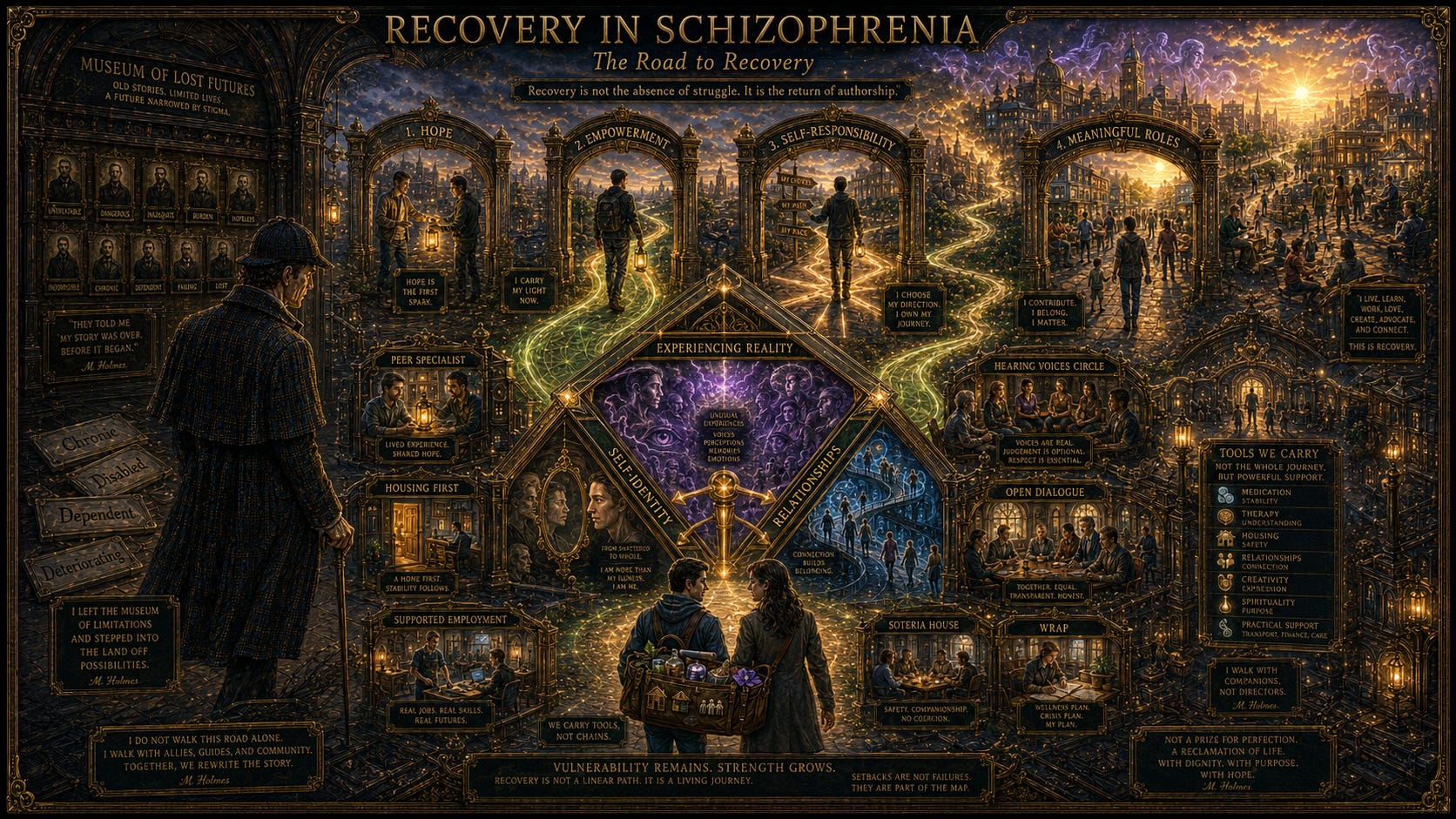
PSYCH 106: Recovery in Schizophrenia
Description
Medlock Holmes enters the Museum of Lost Futures.
The walls are lined with portraits of people diagnosed with schizophrenia. Beneath each portrait is the same inscription:
Chronic. Disabled. Dependent.
The museum presents these outcomes as inevitable.
Holmes is immediately suspicious.
He opens the historical ledgers and discovers that long-term studies tell a different story. Many people diagnosed with schizophrenia improve substantially. Some recover completely. Others continue to experience symptoms while living meaningful, connected, and productive lives.
The diagnosis describes a condition.
It does not issue a sentence.
Holmes follows a corridor out of the museum and into the Road to Recovery, where the investigation shifts from illness to personhood.
Traditional care asks:
What symptoms remain?
What medication is required?
How can relapse be prevented?
Recovery-oriented care asks different questions:
What happened to this person?
What matters to them?
What strengths remain?
What kind of life do they hope to build?
What support will help them move towards it?
At the beginning of the road stands the first milestone:
Hope.
Hope is not vague optimism. It is an image of a future worth pursuing. It may begin when someone else believes in the person before they can believe in themselves.
For one person, hope means returning to university.
For another, reconnecting with family.
For another, cooking, making music, having a relationship, or simply living without shame.
Without a personally meaningful future, treatment becomes mere containment.
The second milestone is Empowerment.
Recovery cannot be performed upon someone.
A clinician can prescribe, advise, accompany, and support-but cannot recover on another person’s behalf.
People need opportunities to make choices, take risks, experience success, and discover that their own actions can influence their lives.
Readiness often does not appear before action.
It emerges after someone has done something they were told they could not do.
The third milestone is Self-Responsibility.
This does not mean blame.
It means authorship.
The person begins to recognise that professionals, families, peers, and services may help, but no one else can determine the direction of the journey. Goals become personally chosen. Decisions become collaborative. Setbacks become lessons rather than proof of failure.
The fourth milestone is Meaningful Roles.
Recovery eventually requires an identity larger than patienthood.
Worker.
Student.
Parent.
Partner.
Artist.
Neighbour.
Advocate.
Friend.
Peer specialist.
Citizen.
A person may still hear voices or experience unusual beliefs, but these experiences no longer occupy the whole landscape of identity.
Holmes then encounters the Psychosis Triangle.
Its three sides are labelled:
* Experiencing Reality
* Self-Identity
* Relationships
The medical model often focuses primarily on distorted reality: hallucinations, delusions, paranoia, and disorganisation.
The recovery model examines all three dimensions.
Psychosis may emerge when changes in reality-testing interact with a fragmented sense of self and deteriorating relationships. Recovery may also begin through any side of the triangle.
Medication may reduce the force of voices.
A trusted relationship may restore belonging.
A meaningful role may strengthen identity.
Improvement in one dimension can help rebuild the others.
Holmes realises that persistent symptoms do not necessarily prevent recovery.
Someone may continue