Episode Details
Back to Episodes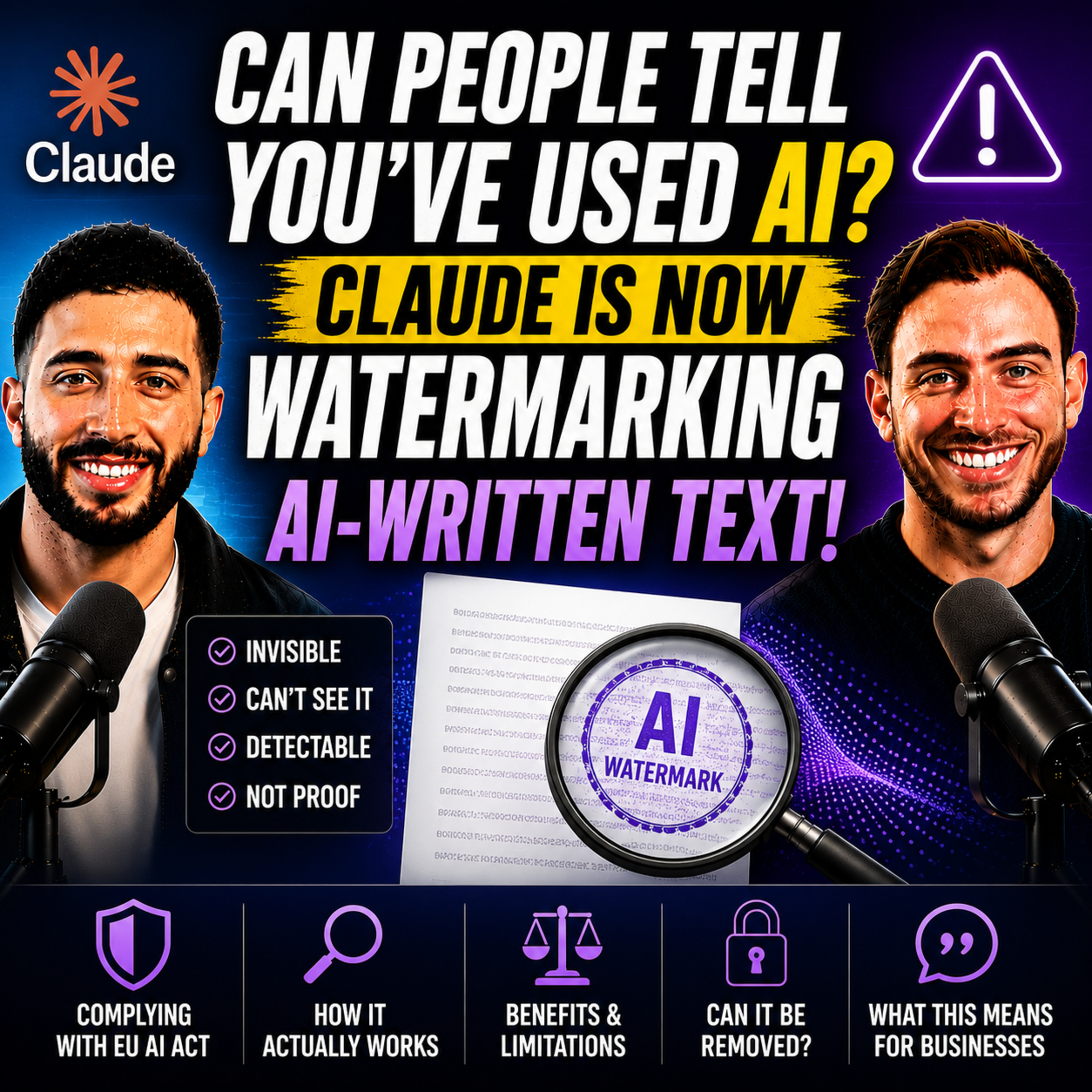
Can People Tell You’ve Used AI? Claude Is Now Watermarking AI-Written Text!
Description
🤖 Claude is about to start putting an invisible watermark inside AI-generated text. But can it actually expose when you have used AI?
There are no hidden characters. Nothing visible is added to the document. But through the statistical pattern of words Claude chooses, Anthropic says its technology could help determine whether Claude was involved in producing a piece of text.
In this episode of The AI and Marketing Podcast for Local Businesses, Adam and Josh break down Claude's new text watermark, how the technology actually works, why the EU is pushing AI companies towards greater transparency, and what it could mean for businesses using AI to create content.
Here is what we break down 👇
🔎 Can people finally detect when you have used AI? Anthropic's planned detector will estimate the likelihood that Claude was involved in creating text, but importantly, it cannot definitively prove who wrote it.
🕵️ How can a watermark be completely invisible? We explain how Claude can subtly influence word choices to create a statistical pattern without inserting hidden characters, secret messages or visible markers.
🧠 Will watermarking make Claude's answers worse? Anthropic says the technology should have negligible impact on speed, cost or quality. We also look at the Google DeepMind research behind the technology and what its testing found.
🇪🇺 Why is this happening now? The move comes as transparency requirements under the EU AI Act take effect, with major AI companies including Anthropic, OpenAI, Google, Microsoft, Meta and Mistral signing up to the European Commission's Code of Practice.
⚠️ What can an AI watermark actually prove? A positive detection could suggest Claude was involved, but it cannot establish who used Claude, whether the entire document was AI-generated, whether the information is accurate, or whether somebody has done anything wrong.
✍️ Can editing remove the watermark? Light editing may leave the statistical signal intact, while substantial rewriting can weaken or potentially remove it. This creates an interesting question about how useful watermarking will be against people actively trying to bypass detection.
📈 Could Claude-watermarked content hurt your SEO? There is currently no evidence that Claude's watermark itself will damage Google rankings. A watermark indicates possible AI involvement. It does not tell Google, or anyone else, whether that content is useful, accurate or high quality.
🏢 What should businesses do?
The answer is not to stop using AI.
Businesses should use AI in a way they would be comfortable explaining. Add genuine expertise and experience, fact-check important claims, retain human oversight and keep evidence of the research and editorial process behind important content.
🎯 The biggest takeaway
Claude's watermark could be an important step towards greater transparency around AI-generated content.
But a watermark is evidence of possible AI involvement, not a verdict on authorship, accuracy or wrongdoing.
--
💥 Exclusive Listener Offer:
Get 20% off Website Design or SEO and AI Search services when you quote PODCAST20.
Website Design: hello@websitedesigners.london | www.websitedesigners.london
SEO & AI Search: hello@improvemysearchranking.com | www.improvemysearchranking.com
--
Sources & Further Reading:
Anthropic, How Claude's text watermark works:
Listen Now
Love PodBriefly?
If you like Podbriefly.com, please consider donating to support the ongoing development.
Support Us