Episode Details
Back to Episodes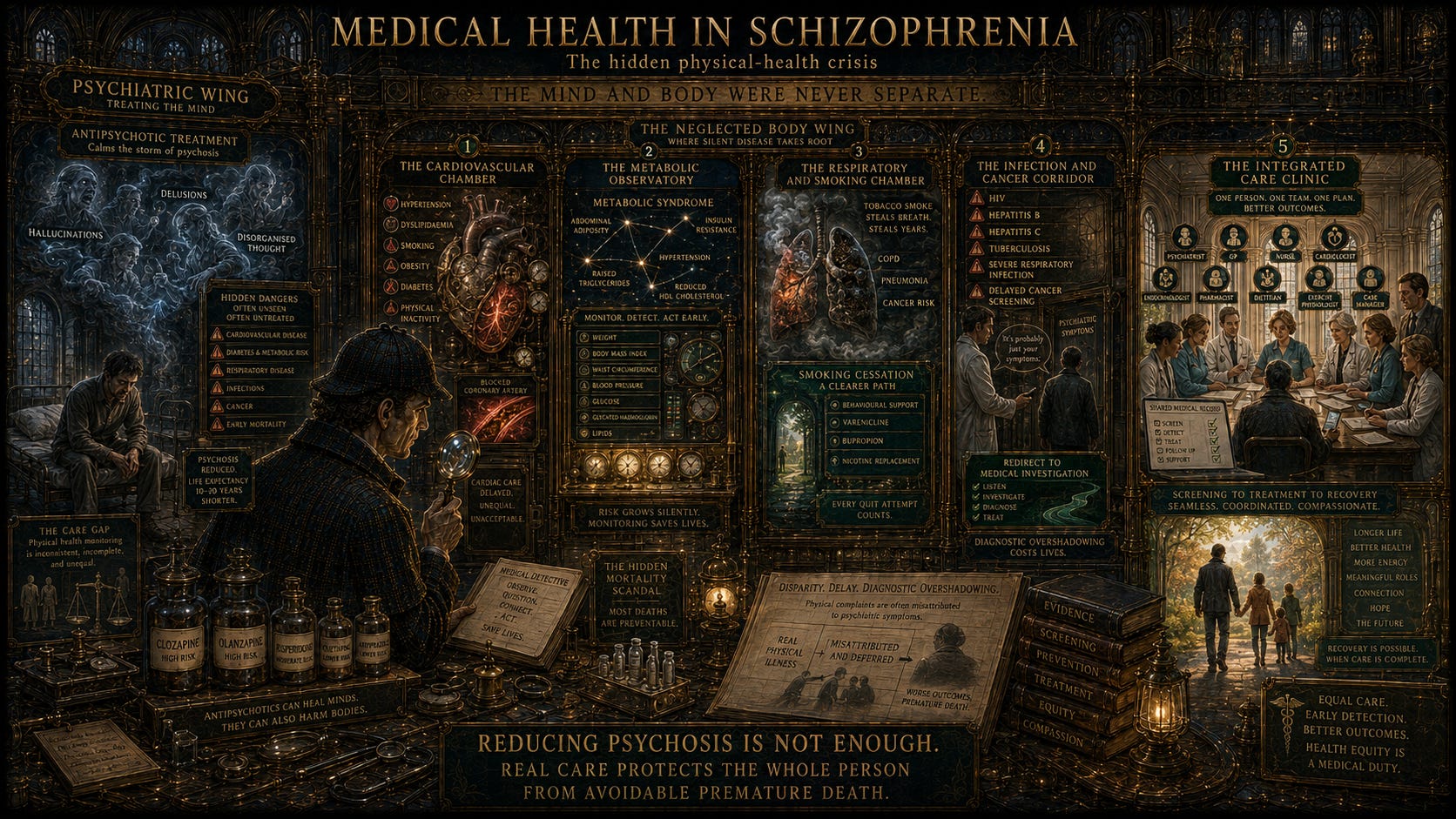
PSYCH 105: Medical Health in Schizophrenia
Description
Medlock Holmes is called to investigate a disturbing pattern.
The records appear unrelated.
A man with schizophrenia dies from a myocardial infarction in his fifties.
A woman develops diabetes that remains undetected for years.
Another patient is repeatedly treated for anxiety while an underlying respiratory illness worsens.
Someone else survives psychosis but dies from a preventable infection.
Holmes spreads the files across a long forensic table.
The pattern is unmistakable.
People with schizophrenia die approximately a decade or more earlier than the general population. Their mortality is two to four times higher, and most of the excess deaths arise not from suicide, violence, or accidents, but from ordinary physical diseases that should often be detectable and treatable.
The investigation begins in the Hall of Premature Death.
Above the entrance are four warnings:
* Earlier mortality
* Greater medical comorbidity
* Reduced access to appropriate treatment
* Poorer medical outcomes
Holmes first enters the cardiovascular chamber.
Heart disease is the leading cause of death in schizophrenia. Obesity, smoking, hypertension, dyslipidaemia, diabetes, physical inactivity, poverty, stress, and medication effects converge like tributaries feeding the same river.
Yet risk alone does not explain the whole mystery.
When people with schizophrenia experience acute coronary syndromes, they may be less likely to receive proven treatments, invasive investigations, angioplasty, or bypass surgery. Their symptoms may be dismissed, overlooked, or attributed to mental illness.
This is diagnostic overshadowing.
The psychiatric label becomes so large that everything else disappears behind it.
The next chamber contains glucose monitors, waist measurements, and lipid profiles.
Type 2 diabetes is substantially more common in schizophrenia than in the general population. Insulin resistance, obesity, inactivity, poor diet, smoking, socioeconomic disadvantage, and antipsychotic treatment all contribute.
Some antipsychotics carry greater metabolic risk than others. Clozapine and olanzapine are strongly associated with weight gain and abnormalities in glucose and lipid metabolism. Other agents generally carry lower risk, though no medication is entirely free from concern.
Holmes discovers that the danger often begins quietly.
Weight increases.
Waist circumference expands.
Triglycerides rise.
High-density lipoprotein falls.
Blood pressure creeps upwards.
Fasting glucose becomes abnormal.
Together these changes form the constellation known as metabolic syndrome-a powerful predictor of cardiovascular disease and type 2 diabetes.
Yet the true failure often occurs before treatment is needed.
Screening is simply not done.
The recommended measurements are straightforward:
Weight.
Body mass index.
Waist circumference.
Blood pressure.
Glucose or glycated haemoglobin.
Lipids.
Personal and family history.
Still, many patients are never monitored adequately.
Holmes moves into the respiratory wing.
Smoking rates are extraordinarily high among people with schizophrenia. Many smoke heavily, increasing their risk of chronic obstructive pulmonary disease, pneumonia, cardiovascular illness, lung cancer, and premature death.
For years, clinicians assumed smoking was too difficult to treat in schizophrenia or that stopping might destabilise mental health.
The evidence does not support such therapeutic pessimism.
People with schizophrenia can quit smoking. Medications such as varenicline and bupropion, alongside behavioural support, can help. Smoking cessation may improve not only physical health but also mood and quality of life.
The infectious disease chamber reveals anot