Episode Details
Back to Episodes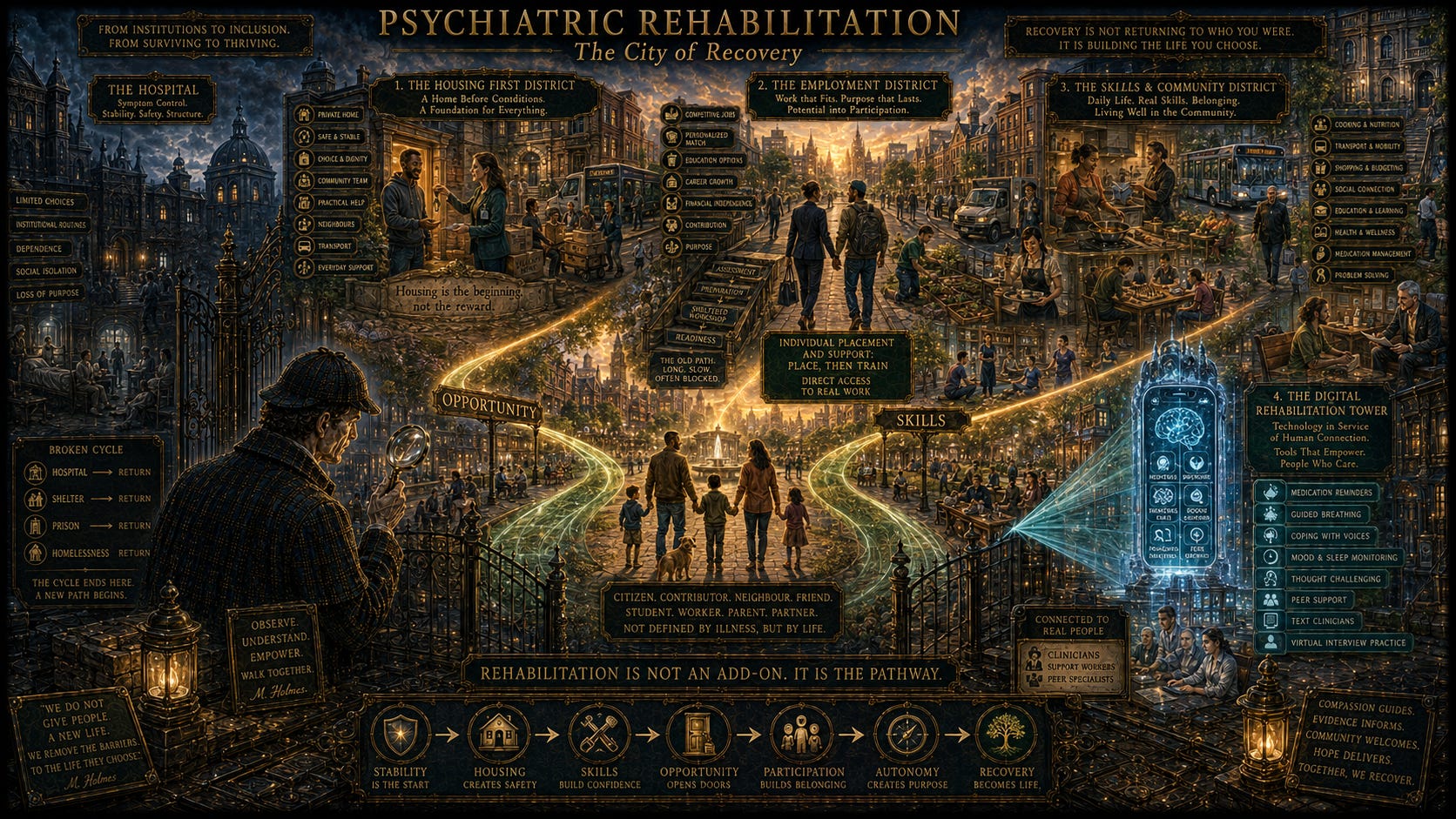
PSYCH 104: Psychiatric Rehabilitation in Schizophrenia
Description
Medlock Holmes enters a psychiatric hospital expecting to find the next mystery inside the consulting room.
Instead, the patient is waiting at the front gate.
His hallucinations have improved.
His delusions are less intense.
His medication is stable.
Yet he has nowhere secure to live, no employment, few relationships, and no meaningful reason to wake each morning.
The treatment has reduced the illness.
It has not restored the life.
Holmes follows the man beyond the hospital walls and discovers the City of Interrupted Lives.
Its streets contain empty apartments, locked workplaces, abandoned classrooms, silent social clubs, and train platforms leading nowhere. Each represents an ordinary adult role that severe mental illness can disrupt: tenant, student, employee, friend, partner, parent, neighbour, and citizen.
At the centre of the city stands the Office of Psychiatric Rehabilitation.
Its purpose is not simply to make patients less symptomatic.
It is to help people live successfully in the environments they choose.
Psychiatric rehabilitation therefore focuses on three essential elements:
Opportunity. Support. Skills.
The first district Holmes enters is the Quarter of Opportunity.
Here he finds barriers that medication cannot remove.
Landlords refuse applications.
Employers assume incompetence.
Educational systems offer no flexibility.
Services segregate people into psychiatric spaces rather than helping them enter ordinary community life.
Stigma has built walls around the city.
Rehabilitation begins by opening doors: access to housing, education, competitive employment, relationships, recreation, and full community participation.
The second district is the Bridge of Support.
People recovering from schizophrenia may need practical assistance to succeed in ordinary roles, especially at the beginning.
A clinician may help someone negotiate with a landlord.
A case manager may teach them to use public transport.
An employment specialist may accompany them to an interview.
A family worker may help relatives support rather than discourage a return to study or work.
Support is not intended to create dependence.
Its purpose is to make independence possible.
The third district is the Workshop of Skills.
Here people practise managing symptoms, organising medication, shopping, cooking, communicating, resolving conflict, maintaining routines, and coping with stress.
Yet Holmes notices an important change from older rehabilitation models.
The skills are no longer taught only inside clinics.
They are learned where they will actually be used.
A person learns to shop in the supermarket.
To travel on the bus.
To prepare meals in their own kitchen.
To manage anxiety in the workplace.
The community itself becomes the classroom.
Holmes first investigates housing.
For decades, services assumed that people with schizophrenia had to become stable, abstinent, compliant, and treatment-ready before they could earn the right to an independent home.
The Housing First model reverses this sequence.
Housing is not the reward at the end of treatment.
It is the foundation upon which treatment and recovery can begin.
People are offered safe, affordable accommodation without requiring sobriety or compulsory treatment as a precondition. Flexible community support is then offered according to their needs and choices.
Holmes meets a man who has moved repeatedly between hospitals, shelters, prisons, and the streets. His psychosis remains persistent and substance use has complicated his life. Previous programmes required him to prove readiness.
Housing First gives him an apartment.<