Episode Details
Back to Episodes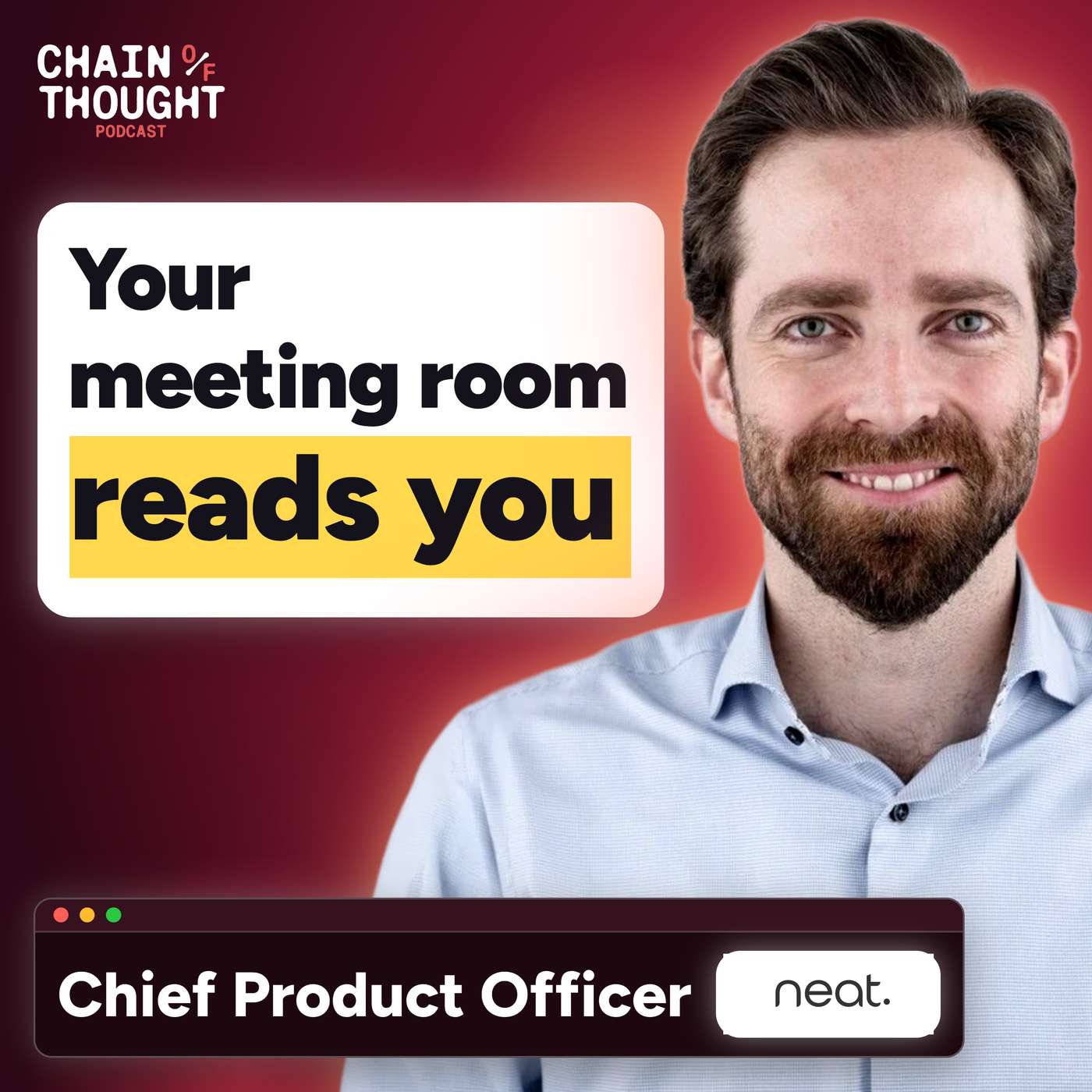
11 Cameras, Dozens of Mics: The AI That Reads the Room
Description
Tormod Ree puts 11 or more cameras and dozens of microphones into a single meeting room, then runs computer vision on all of it to figure out who is present, who is talking, and who is looking at whom. He is the chief product and engineering officer at Neat, the Zoom-backed video hardware company.
Before Neat, Tormod co-founded AVA, a computer vision security company Motorola acquired, and spent close to eight years at Cisco running the Spark Board. He explains how Neat turns a room into a system that directs the meeting instead of just framing whoever talks, why almost all of the AI has to run at the edge, and how the company builds computer vision models without ever collecting a customer's audio or video.
In this conversation:
- Why the real advantage is the harness that combines signals from different detectors, not the models themselves
- How Neat draws a hard line: no customer audio or video ever trains its models
- The "captain" device that orchestrates a room full of cameras and mics, directing from metadata rather than re-running inference on every stream
- Why the meeting "director" is still deterministic today, and what changes when it becomes a trained model
- Building AI under a five-year device lifetime and phone-class compute
- Agentic fleet management, an MCP server, and what Tormod calls "agentic healing"
- How Neat gets its own non-technical teams building with AI
(0:00) Reading the room: 11 cameras, dozens of mics
(0:27) Who is Tormod Ree
(2:07) Turning a meeting room into a system that directs itself
(3:39) What it takes to actually read a room
(5:13) Why the media path has to run at the edge
(6:27) Open models, in-house models, and the harness that matters
(7:51) The data problem when you can't touch customer meetings
(11:09) The captain device: distributing compute across the room
(15:38) Two users: the people in the room and the IT admin
(17:00) Agentic management and "agentic healing" for device fleets
(20:12) Why a meeting device has to stay useful for five years
(23:44) How agentic workflows evolve on an open platform
(25:53) When the meeting director becomes a trained model
(28:54) Building AI under five-year, phone-class hardware limits
(37:26) Where silicon caps what you can run locally
(39:18) AI pendants and other form factors
(41:48) How Neat adopts AI across its own teams
(49:20) Non-technical teams building their own MCPs
(50:27) Where Neat is headed
Connect with Tormod Ree:
- LinkedIn: https://www.linkedin.com/in/toree/
- Neat: https://neat.no
Connect with Chain of Thought host Conor Bronsdon:
- Newsletter: https://newsletter.chainofthought.show/
- Twitter/X: https://x.com/ConorBronsdon
- LinkedIn: https://www.linkedin.com/in/conorbronsdon/
- YouTube: https://www.youtube.com/@ConorBronsdon
More episodes: https://chainofthought.show
Thanks to Svix, presenting sponsor of season four of Chain of Thought. Svix delivers billions of reliable webhooks for startups and the Fortune 500. Get started at https://link.svix.com/cot. Qualified startups get $12,000 in credits, and YC companies get $50,000.
Thanks to Walrus Memory, presenting sponsor of season four of Chain of Thought. Walrus Memory gives AI agents portable, verifiable memory that carries context across apps, sessions, and other agents. Get started at https://walrus.xyz/cot
Listen Now
Love PodBriefly?
If you like Podbriefly.com, please consider donating to support the ongoing development.
Support Us