Episode Details
Back to Episodes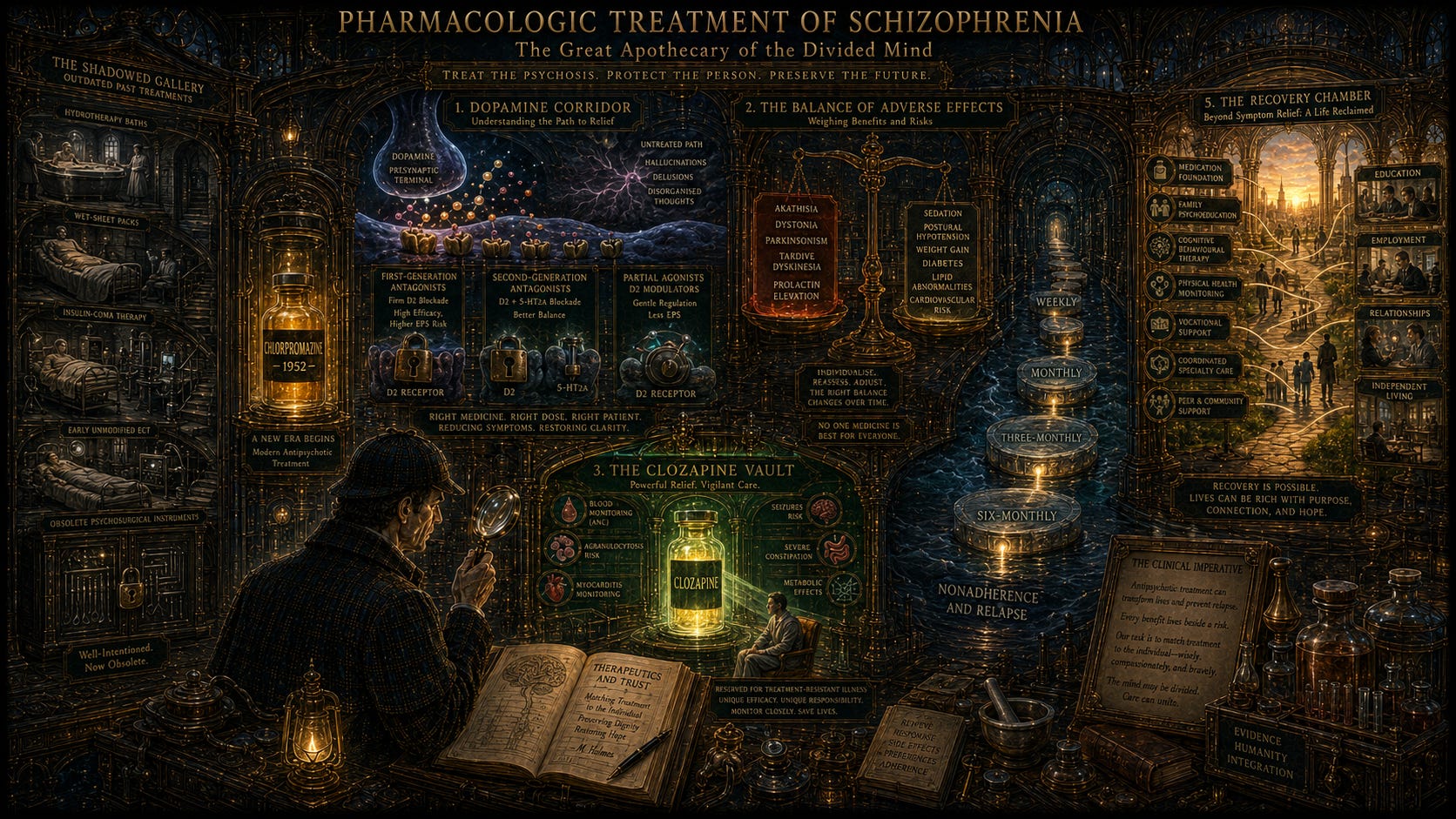
PSYCH 103: Pharmacologic Treatment of Schizophrenia
Description
Medlock Holmes enters the Great Apothecary of the Divided Mind.
The chamber is vast.
Along one wall stand the abandoned instruments of psychiatric history: wet-sheet packs, insulin syringes, barbiturate sleep chambers, convulsive machines, and the cold steel apparatus of prefrontal lobotomy.
Each represents an era in which clinicians tried to calm psychosis without understanding how to treat it.
Then Holmes finds a small amber bottle labelled Chlorpromazine, 1952.
Its arrival changed psychiatry.
For the first time, hallucinations, delusions, disorganised thought, agitation, and aggression could be reduced with a medicine that did not require coma, surgery, or prolonged restraint. Hospitals began to empty. Patients once considered destined for lifelong institutional care gained the possibility of returning to families and communities.
Yet Holmes quickly discovers that the bottle did not contain a cure.
Every currently established antipsychotic reduces postsynaptic dopamine-receptor activity, whether through D₂ antagonism or partial agonism. These medicines are often highly effective against positive symptoms, but they remain much less successful against negative symptoms and cognitive impairment-the very difficulties that frequently determine whether someone can work, study, maintain relationships, or live independently.
The Apothecary is divided into three treatment halls.
The first is the Acute Chamber.
Here, the priority is safety and rapid relief. The clinician must confirm the diagnosis, consider substance use and medical causes, perform physical and neurological examinations, and obtain baseline blood tests, metabolic measurements, and an electrocardiogram when indicated.
Medication choice is not simply a contest of efficacy.
Most antipsychotics have broadly similar effectiveness for ordinary acute psychosis. The major differences lie in their adverse-effect profiles.
High-potency first-generation drugs carry a greater risk of extrapyramidal symptoms: dystonia, akathisia, rigidity, tremor, and bradykinesia.
Lower-potency drugs more often produce sedation, postural hypotension, anticholinergic effects, and weight gain.
Second-generation medications generally reduce-but do not eliminate-the risk of movement disorders. Some instead bring substantial metabolic burdens.
Holmes sees that the correct medicine is therefore the one whose risks best match the patient’s vulnerabilities, previous response, physical health, preferences, and likelihood of continuing treatment.
The second hall is the Stabilisation Chamber.
The first weeks matter greatly. Most symptom improvement occurs within two to four weeks, and little or no improvement after the first two weeks-despite adherence and an adequate dose-predicts a poorer eventual response.
Yet the solution is rarely to push the dose indefinitely.
Above-standard doses usually add toxicity without adding meaningful benefit. When response is poor, Holmes checks the hidden variables first:
Was the diagnosis correct?
Was the medication actually taken?
Was the trial long enough?
Was the dose therapeutic?
Was the drug absorbed properly?
Could rapid metabolism or substance use explain the apparent resistance?
Only after these possibilities are examined should the treatment be declared ineffective.
The third hall is the Maintenance Gallery.
Here the danger is no longer acute psychosis but recurrence.
Without continued medication, relapse is common. With treatment, it is substantially reduced. Yet nonadherence remains one of the greatest preventable causes of relapse, hospitalisation, disrupted education, lost employment, homelessness, suicidality, and family distress.
Long-acting injectable antipsychotics become an impor