Episode Details
Back to Episodes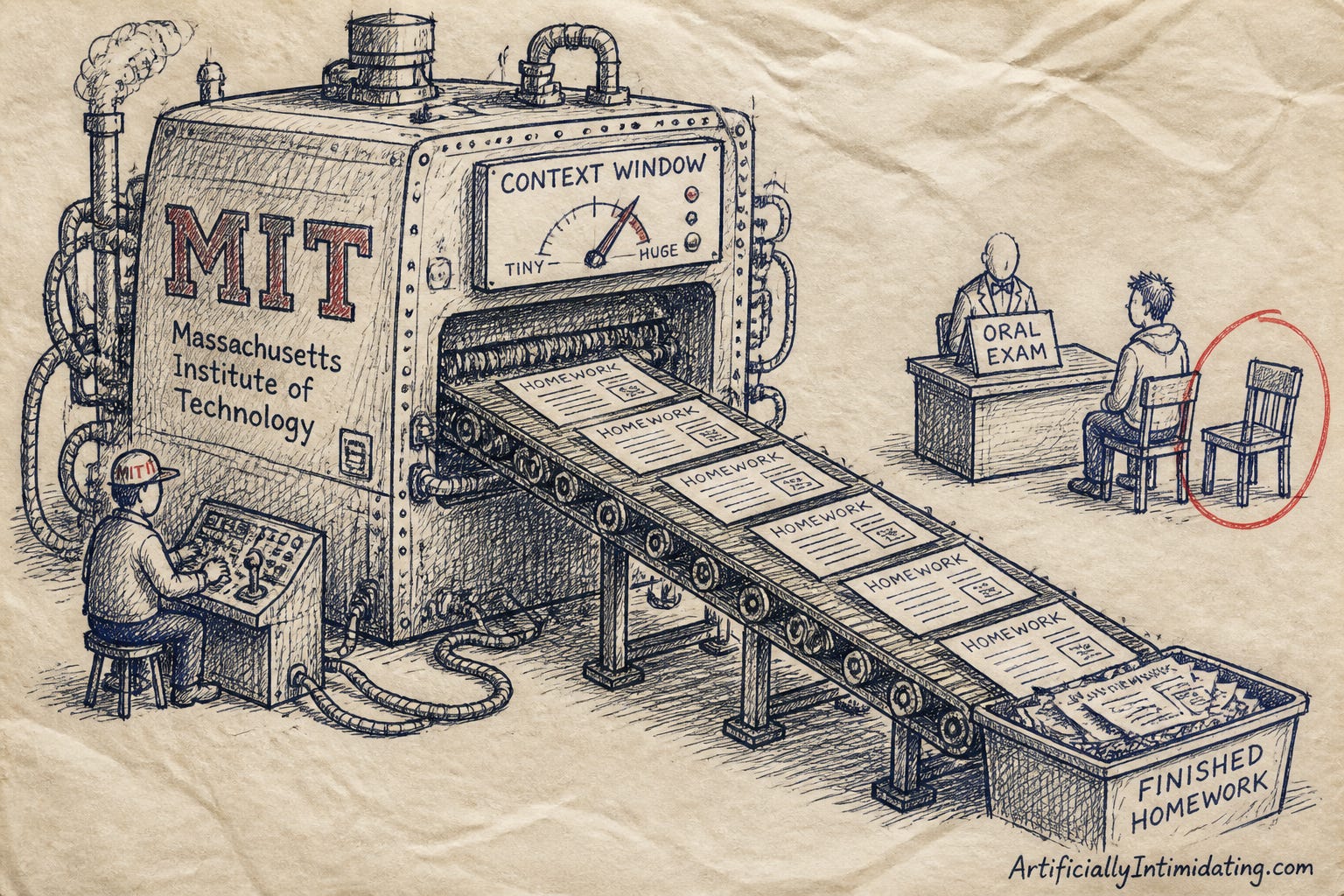
Nobody Can Tell Who Did the Work Anymore -- AI Brief August 26
Description
Good day, %%first_name%%. Today is about the gap between finished and done. MIT told its own faculty that AI can already pass most undergraduate assignments, and that it has no good way to grade around that. Apple shipped a desktop built to run agents while you sleep. A five-year study found the companies firing people over AI are getting less productivity out of the survivors, not more. Parag Agrawal thinks the ad-funded web has about eighteen months left. And three ex-DeepMind researchers started a nonprofit on the theory that AI should not be the only thing grading AI.
Before we start: Artificially Intimidating is now #62 Rising in Technology on Substack. That ranking is made entirely of readers and listeners -- every open, every forward, every episode played on somebody's commute. Thank you. We will keep earning it.
MIT Says AI Can Already Pass Your Degree
MIT Ad Hoc Committee on AI Use in Teaching, Learning and Assessment
What happened: MIT's ad hoc committee on AI in teaching and learning told campus on Tuesday that generative AI can now “credibly complete most undergraduate assignments.” President Sally Kornbluth, sharing the report, called the moment “a watershed for MIT -- and for all of higher education.” The committee, co-chaired by professors Eric Klopfer and Samuel Madden, says most classes should be reviewed and many will need substantial changes.
Why it matters: Every take-home problem set, essay and lab report is a measurement instrument, and this is MIT saying the instrument no longer measures the student. The committee's answer is to drag assessment back into the room: oral exams, portfolios, in-person conversations about work done outside class. It also warns against the lazy fix of just weighting in-class exams higher, which it says risks narrowing what an MIT degree even signifies. If the school with the hardest problem sets in America cannot grade homework, nobody's can.
What everyone's saying: The Washington Post, which first reported the committee's findings, framed it as the moment the elite tier admitted what high school teachers have been saying for two years. A Pew Research study from February found 64% of teens have used AI chatbots, more than half for schoolwork, and 59% say AI cheating happens regularly at their school. Some teachers have already given up and gone back to pencil and paper.
My read between the lines: The committee's co-chair already ran the experiment. Eric Klopfer split an MIT class three ways on a programming task in Fortran, a language none of them knew: one group with ChatGPT, one with Code Llama, one with nothing but Google. The ChatGPT group finished fastest. When they were tested from memory afterwards, as Klopfer told Communications of the ACM, they “remembered nothing, and they all failed.” Every student in the Google group passed. MIT is not discovering that AI can do the homework. It is conceding, in public, that it already knew what that costs.
📖 Further reading: AI Is a Trust Problem, Not a Tech Problem — MIT's crisis is not that the models got good, it is that a finished assignment stopped proving anything about the person who handed it in
MIT's problem is that