Episode Details
Back to Episodes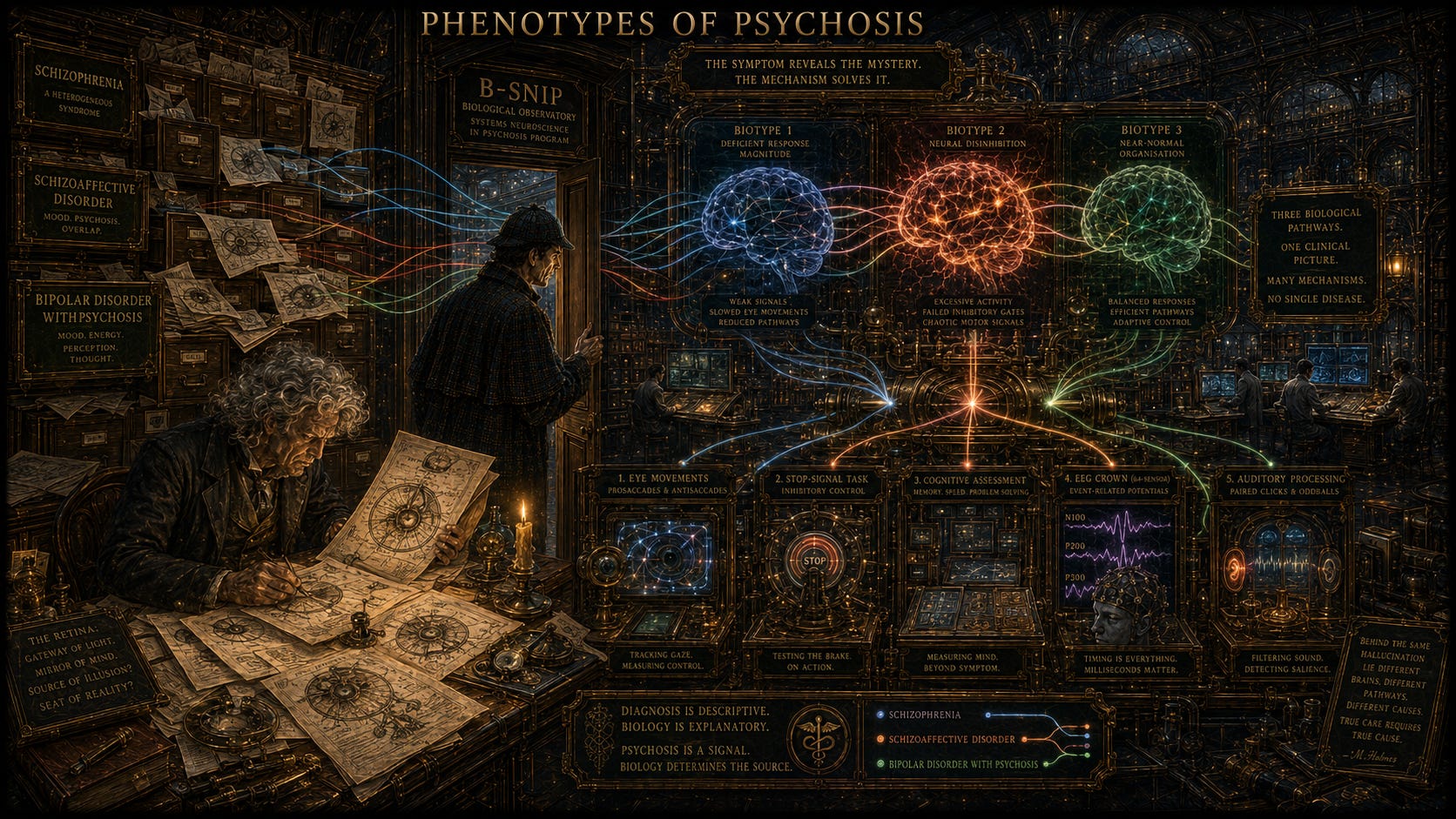
PSYCH 102: Phenotypes of Psychosis
Description
Medlock Holmes is summoned to a locked psychiatric ward to meet an extraordinary patient.
The man was once a distinguished professor of anatomy: intellectually formidable, artistically gifted, and professionally successful. Long after the age at which schizophrenia usually appears, he developed relentless visual hallucinations and an elaborate belief that the source of psychosis lay within the human retina.
Across a worn wooden table lie hundreds of precise anatomical drawings.
Each depicts an eye containing elaborate prisms designed to bend and transform visual information. The professor studies every diagram, attempting to discover how his own eyes could create the hallucinatory world that torments him.
The clinical label appears obvious.
Schizophrenia.
Yet Holmes hesitates.
The professor has chronic hallucinations, delusional explanations, profound functional decline and minimal recovery. But he retains exceptional intellectual capacity. He has no prominent formal thought disorder. His illness began unusually late, after decades of achievement.
The diagnosis describes what happened.
It does not explain why.
Holmes enters the Archive of Psychiatric Classification, where towering cabinets divide psychosis into schizophrenia, schizoaffective disorder and bipolar disorder with psychosis.
The labels are reliable enough for clinicians to use, but the biological boundaries between them are blurred.
Cognitive deficits, negative symptoms, affective disturbance, genetic vulnerability, brain abnormalities and treatment response overlap extensively. Families do not consistently transmit one diagnosis in isolation. Antipsychotic medications target psychosis across diagnostic categories rather than treating a unique biological mechanism within each one.
The cabinets classify experiences.
They may not classify diseases.
Holmes turns to a different kind of investigation: the Bipolar–Schizophrenia Network for Intermediate Phenotypes, known as B-SNIP.
Instead of beginning with diagnostic labels, B-SNIP studies large groups of people across the psychosis spectrum and measures features closer to brain function. These include cognition, eye movements, response inhibition, auditory processing and electrical brain activity.
The first instrument is the Brief Assessment of Cognition in Schizophrenia. It examines memory, processing speed, working memory, reasoning and problem-solving.
Next come the eye-movement chambers.
In a prosaccade task, the eyes must rapidly look towards a peripheral target. In an antisaccade task, they must resist that automatic response and instead look in the opposite direction. Delayed or incorrect movements reveal impaired inhibitory control.
A stop-signal task examines whether an initiated action can be rapidly cancelled.
Electroencephalographic experiments measure how the brain responds to repeated sounds, unexpected auditory targets and irrelevant stimuli. Components such as the N100, P200 and P300 reveal whether the brain detects salience, updates working memory and suppresses redundant information effectively.
Holmes notices that none of these biomarkers works well enough alone.
Psychosis is too complex to be captured by one measurement.
The investigators therefore combine multiple signals into integrated biological factors.
When the traditional diagnoses are compared using these measures, they largely arrange themselves along a single severity continuum. Schizophrenia tends to show greater impairment, bipolar psychosis less, with schizoaffective disorder often between them. But the groups overlap extensively.
The biology differs mainly in degree.
Not in kind.
Holmes then watches the investigators remove the diagnostic labels and cluster patients according to their biomarker patterns alone.
Three psychosis Biotypes emerge.
Biotyp