Episode Details
Back to Episodes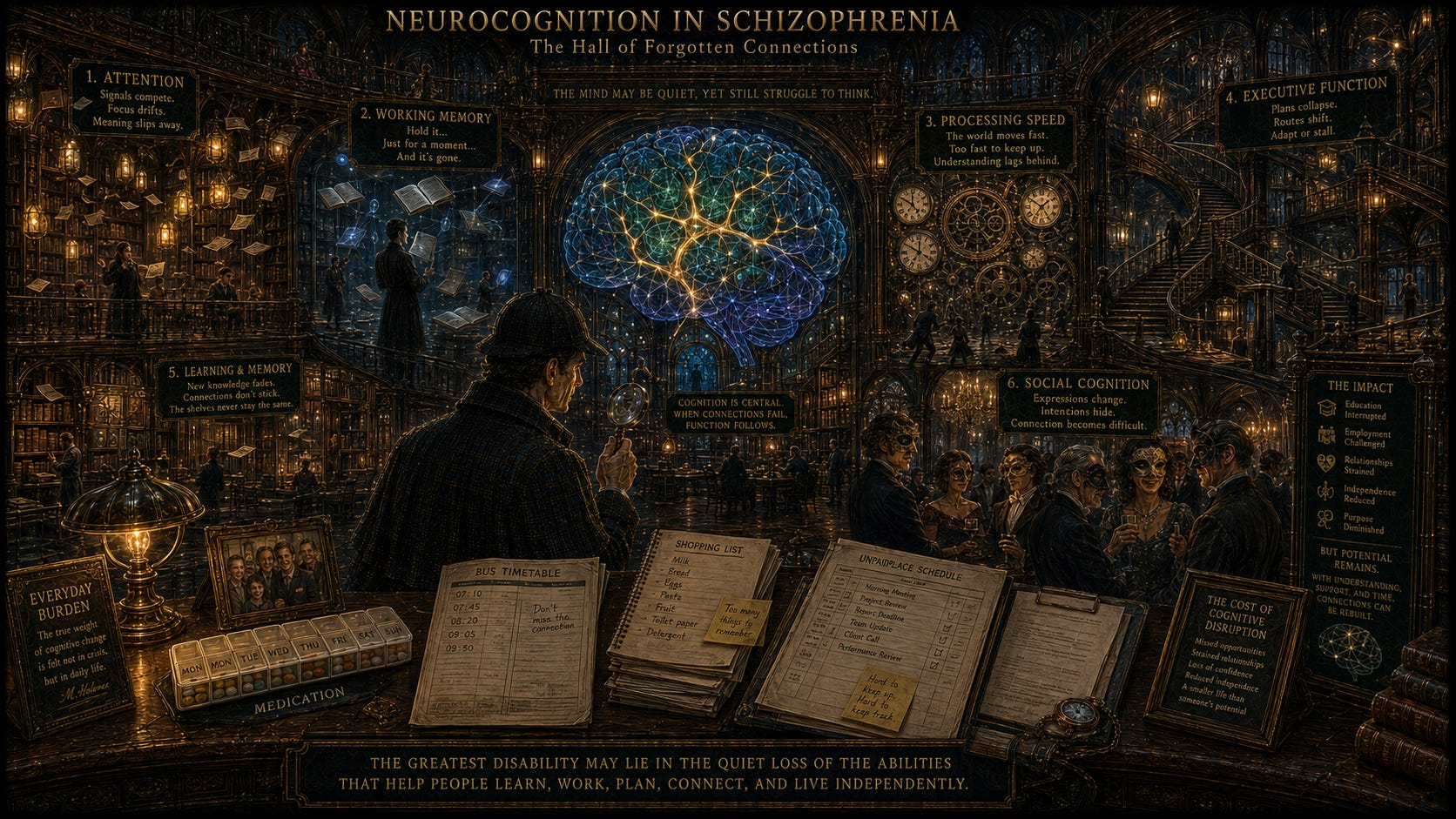
PSYCH 101: Neurocognition in Schizophrenia
Description
Medlock Holmes arrives at what appears to be the simplest of all investigations.
A patient is sitting quietly in an elegant Victorian library.
No voices.
No delusions.
No obvious distress.
To every casual observer, the illness seems well controlled.
Yet something is wrong.
The patient repeatedly loses track of conversations.
Simple instructions must be repeated.
Bills remain unpaid.
Appointments are forgotten.
Books are read without being remembered.
Employment slips away despite the disappearance of hallucinations.
Holmes realises that the greatest mystery of schizophrenia is not always what can be seen.
Sometimes it is what can no longer be thought.
The library transforms into the Hall of Forgotten Connections, where every shelf represents a different cognitive ability essential for daily life. Unlike hallucinations, these shelves do not collapse dramatically. Instead, their books slowly become harder to reach, their pages blur, and the pathways between them grow increasingly tangled.
Holmes begins his investigation with attention.
Without attention, the brain cannot decide which information deserves priority. Conversations become fragmented. Reading a page requires repeated attempts. Watching a film becomes exhausting because the thread of the story constantly slips away.
Nearby stands the Chamber of Working Memory.
Here, information must be held briefly while the mind manipulates it. A telephone number disappears before it can be dialled. Multi-step instructions evaporate halfway through completion. Everyday planning becomes an intricate puzzle.
Beyond lies the Gallery of Learning.
Patients with schizophrenia often struggle far more with learning new information than with retaining what they have already successfully learned. Holmes watches students repeatedly study the same material, making progress much more slowly than expected despite genuine effort. Their brains are not forgetting rapidly-they are finding it difficult to build the memory in the first place.
The next room contains the Laboratory of Processing Speed.
Everything moves just a fraction too quickly.
The outside world races ahead while the mind struggles to keep pace.
Instructions arrive before earlier ones have been processed.
Decisions that once took seconds now require minutes.
The problem is not intelligence.
It is speed.
Holmes notices that this slowing quietly affects nearly every other cognitive ability, making processing speed one of the strongest overall markers of cognitive impairment in schizophrenia.
The investigation continues into the Hall of Executive Function.
Here people must solve problems, adapt to changing rules, organise tasks, and make flexible decisions.
Some visitors persist with strategies that no longer work.
Others cannot plan several steps ahead.
Life itself becomes difficult to organise because the brain’s internal manager struggles to coordinate its workforce.
Further ahead lies perhaps the most fascinating chamber of all.
The Room of Social Understanding.
Faces display fear, happiness, anger and sadness.
Most visitors immediately recognise each emotion.
Some patients hesitate.
Others misinterpret expressions altogether.
Holmes realises that the difficulty extends beyond recognising faces. It involves understanding another person’s intentions, beliefs and emotions-a capacity known as theory of mind.
Without this ability, ordinary conversations become detective mysteries with missing clues.
Social withdrawal begins not because people dislike others, but because understanding them has become extraordinarily demanding.
As Holmes examines the evidence, a surprising pattern emerges.
These cognitive difficulties are not simply side effects of halluci