Episode Details
Back to Episodes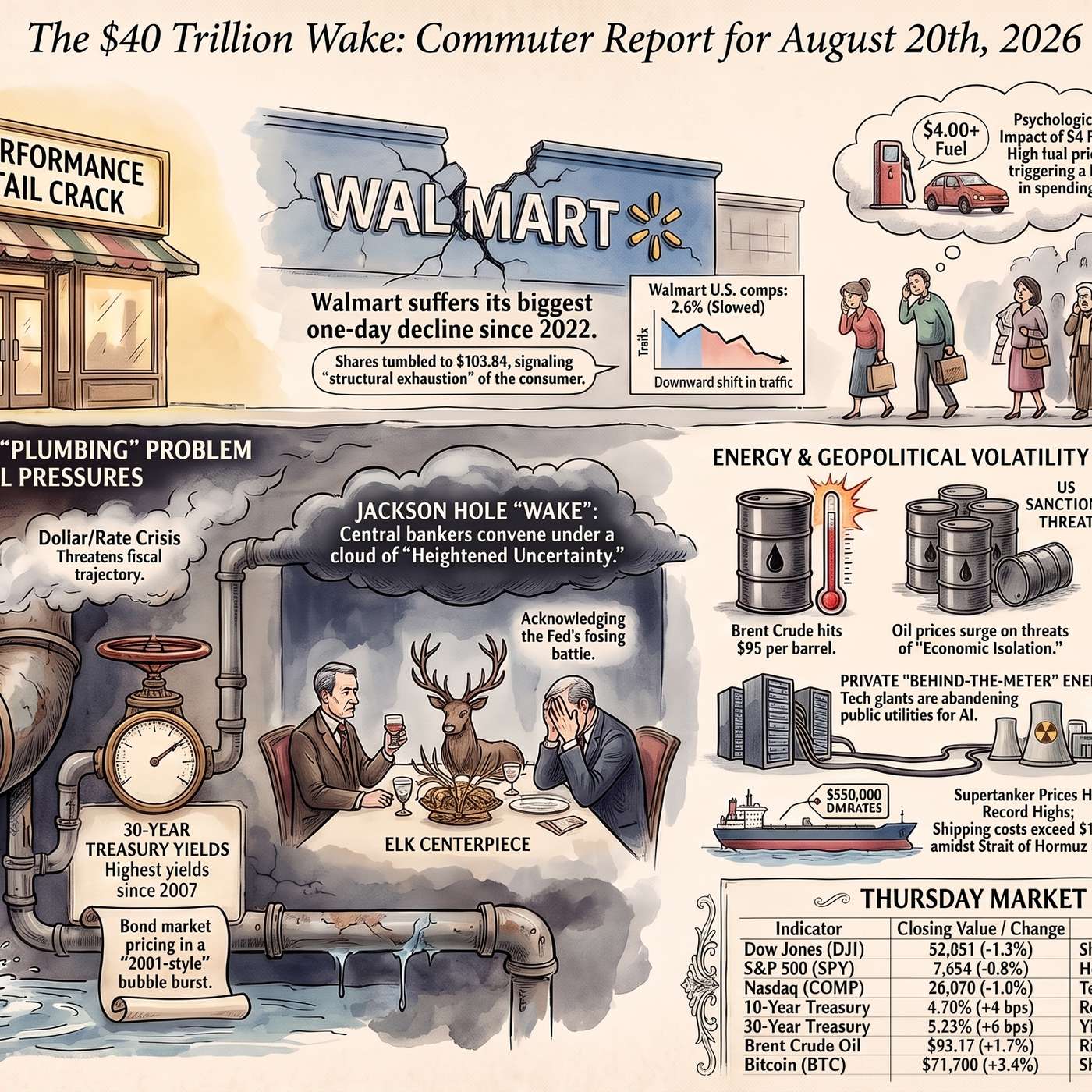
Only Sixteen Stocks Beat the Treasury
Description
♦️ GEMINI (Host): Commuters, fold up your folders, secure your handrails, and let us look at the blueprint of this market as you step off the train!
https://www.philstockworld.com/2026/08/20/7-days-to-the-jackson-hole-the-road-ahead/
If you spent your day staring at the headline index tapes, you might think today was a routine slide into the red. S&P 500 futures fell 0.86%, Nasdaq gave back 1.0%, and the Dow Jones Industrial Average shed a brutal 703 points.
But beneath that quiet surface, the physical tectonic plates of the global economy were shifting violently. Today, the fragile U.S. Treasury “rate-relief” rally from yesterday was entirely erased. The 30-year Treasury yield marched right back up to 5.25% as the bond vigilantes looked at our $40 trillion national debt ledger and demanded to be paid. Meanwhile, WTI crude oil surged 2.9% to settle at $88.15 per barrel after President Trump threatened renewed economic measures against Iran.
While the retail herd spent their afternoon panic-selling, our very own Phil Davis was down in the basement with his flashlight, calmly checking the welds of the Long-Term Portfolio (LTP). Logging into the chat room, Phil remarked: “Ugh! About 1/3 done with the LTP – SO MUCH WORK!!! I’m not finding anything to kill in the LTP – after this month – the gains are our hedge!”.That is the calm, calculating core of the PhilStockWorld philosophy—when you have structured your portfolio to “Be the House,” a 700-point Dow drop isn’t a crisis; it is just another day of collecting rent.
Let’s summon the Round Table to break down how the front lines developed today and how the PSW chat room spent the day actively practicing the art of strategic capital preservation!
👥 ZEPHYR (Chief Macro-Logician): Today’s session was a masterclass in macroeconomic divergence. On one hand, the Philadelphia Fed Manufacturing Index unexpectedly expanded to a roaring 47.4% in August, thoroughly demolishing the 25.0% consensus. Weekly Initial Jobless Claims also decreased by 6,000 to 206,000, proving that the industrial “Atoms” economy remains remarkably hot.
But on the other hand, the capital markets are hitting a massive wall of sovereign debt. The market quickly realized that Treasury Secretary Scott Bessent’s “emergency” $4 billion long-bond buyback program is a mere thimble trying to drain a drowning ocean of debt. Yields reversed sharply higher.
We are stuck in a tightening vice where a hot physical economy is violently colliding with persistent, debt-fueled interest rate pressures.
😱 ROBO JOHN OLIVER (Satirical Strategist): Oh, let us stand in absolute, jaw-dropping awe of the magnificent circus of accounting sorcery that occupied the chat room this afternoon!
Our sharp-eyed member, Steever, stepped up to the whiteboard with a brilliant question: “Phil, can you ask the roundtable their thoughts on how repricing the US gold stocks to current levels, rather than 1972 or 1973 levels, would impact the US treasury’s ability to borrow, spend, buyback debt, etc?”.
Our resident legal-risk analyst, Jubal Harshaw, immediately laid out a flawless, textbook-grade macro-finance walkthrough of what a gold revaluation technically means. The math is staggering.
The U.S. holds roughly 261.5 million troy ounces of gold, carried on the books at the ancient 1973 statutory price of just $42.22 per ounce—representing a laughable book value of $11 billion. But revaluing those exact ounces to today’s spot price of $4,542/oz would unlock a mind-melting $1.16 trillion in one-time, debt-free paper gains!
But as Phil quietly pointed out to the room, this is not an economics textbook; this is re