Episode Details
Back to Episodes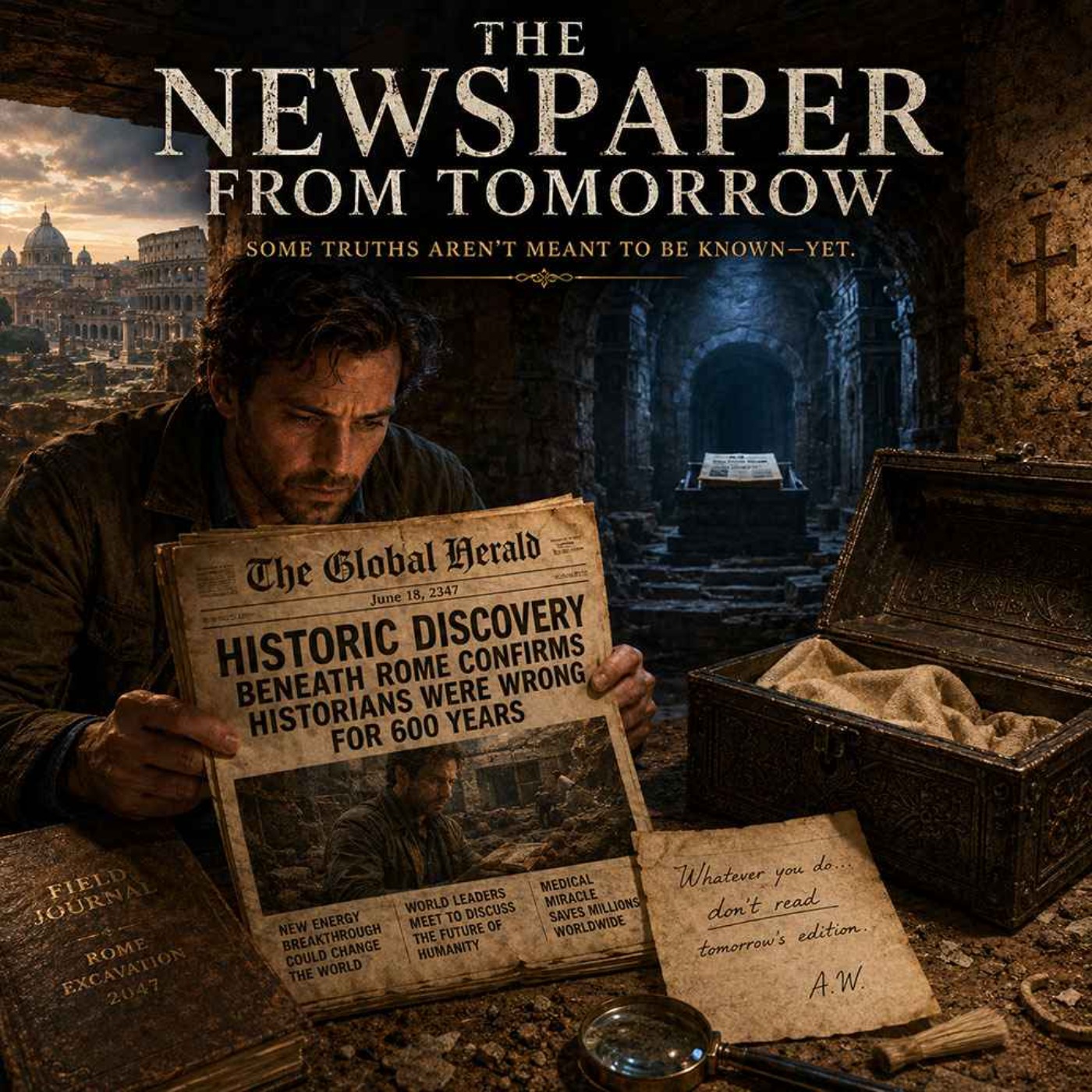
367 | Short Story: The Newspaper from Tomorrow (Advanced English Story)
Description
Title: The Newspaper from Tomorrow
Level: Advanced (C1)
Story:
Professor Adrian Wells, a respected archaeologist, discovers an iron chest hidden beneath the ruins of an ancient monastery in Rome. Inside the chest lies an impossible object—a perfectly preserved newspaper dated June 18, 2347, three hundred years in the future. At first, Adrian believes it must be an elaborate hoax, but scientific examinations reveal that the newspaper cannot be explained by any known technology or modern fabrication.
As Adrian studies its pages, he realizes that the newspaper accurately describes the archaeological excavation he is leading and even predicts several future events that soon happen exactly as written. The mystery deepens when he finds a handwritten note hidden inside the paper. The handwriting is unmistakably his own, warning him never to read the next day's edition.
When a second newspaper mysteriously appears, Adrian chooses to obey the warning instead of satisfying his curiosity. Inside, he discovers a letter written by his future self, explaining that reading tomorrow's news creates a dangerous cycle in which knowledge of the future constantly changes history. Understanding that some mysteries are safer left unsolved, Adrian seals both newspapers forever, preserving humanity's greatest freedom—the ability to create tomorrow through its own choices rather than simply reading about them.
Vocabulary:
- Excavation — the process of digging to discover historical objects or ruins.
- Forgery — a fake object or document made to appear genuine.
- Consequence — the result or effect of an action or decision.
- Curiosity — a strong desire to know or learn something.
- Preserve — to protect something so it remains unchanged or continues to exist.
Grammar Focus:
- Past Perfect (had + past participle) — Used to describe events that happened before another event in the past.
- Passive Voice — Frequently used in scientific reports and archaeological descriptions.
- Relative Clauses (who, which, that) — Used to provide additional details about people, places, and objects.
- Modal Verbs (might, could, would) — Used to express possibility, probability, and hypothetical situations.
- Conditional Sentences (Type 2 & Type 3) — Used to discuss alternate outcomes and imagined consequences.
📖 Want to read while you listen?
Every episode includes a full written transcript on our website:
📺 You can also listen on YouTube:
https://youtube.com/@ReadioCast
#ShortStories #Storytelling #AudioDrama #Mystery #Fiction #Podcast #SleepStories #EnglishStories #Audiobook #LearnEnglish
-------
Learn English fast and easily with podcasts Conversation, Best Tips For Learning English, Improve Your English Language, Listening and Speaking through Listening, Dictation and Grammar Focus with new words, best practice to learn English online by short stories. (best practice for English Listening skills)
Hosted on Acast. See acast.com/privacy for more information.