Episode Details
Back to Episodes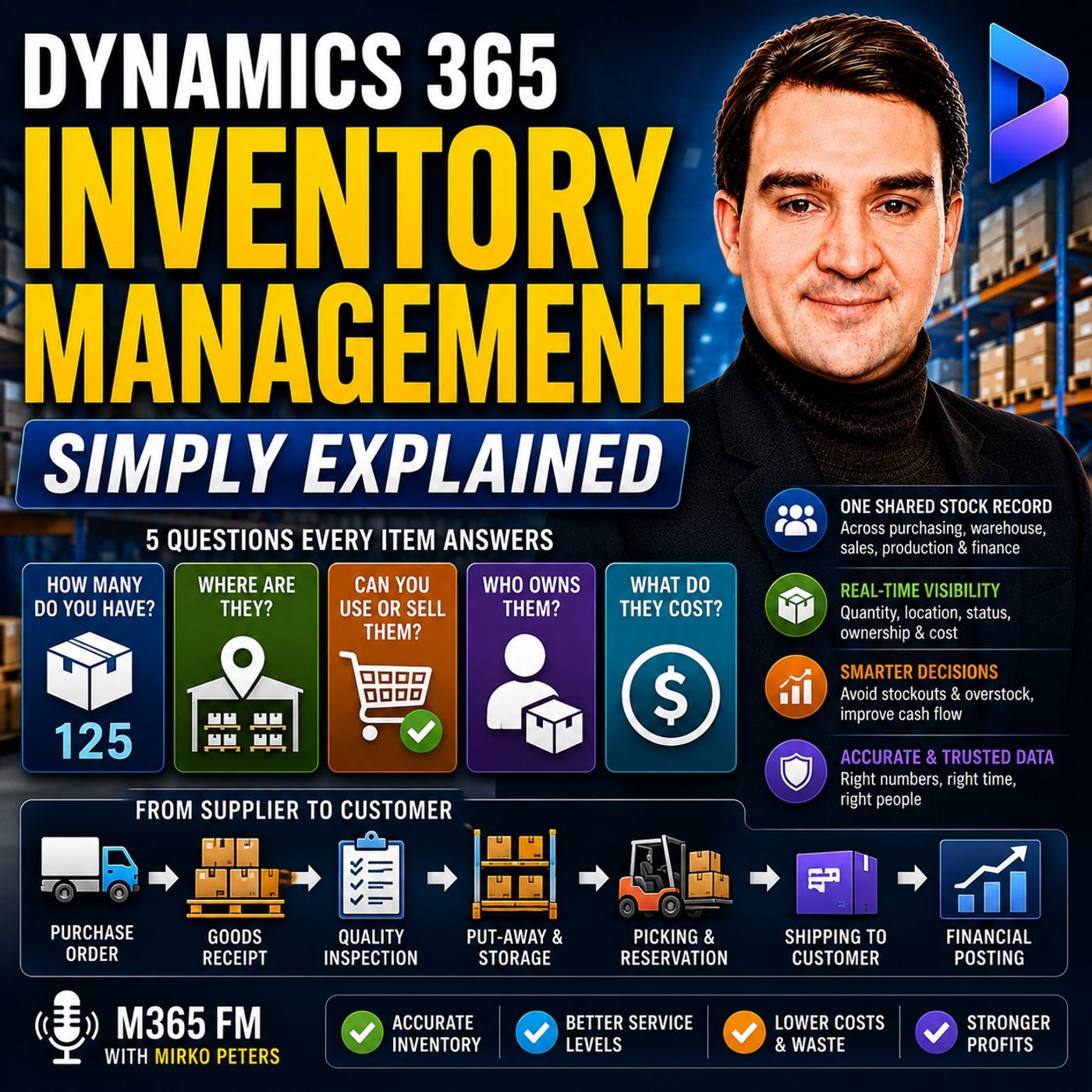
Dynamics 365 Inventory Management - Simply Explained
Season 3
Published 2 months, 1 week ago
Description
Dynamics 365 Inventory Management gives businesses one shared record for the products, materials, parts, and other stock moving through their organization. Instead of purchasing, warehouse, sales, production, and finance maintaining separate versions of inventory information, Dynamics 365 connects quantities, locations, availability, ownership, movements, and financial value. In this episode of M365 FM, Mirko Peters explains how Dynamics 365 Inventory Management works from supplier receipt to customer shipment — including inventory dimensions, reservations, transfers, costing, cycle counting, safety stock, consignment inventory, and the connection between inventory and finance. ㅤ
WHAT IS DYNAMICS 365 INVENTORY MANAGEMENT?
Inventory Management provides a shared stock record across the business. For every item, organizations need to answer five fundamental questions: How many do we have? Where are they? Can we use or sell them? Who owns them? And what are they worth? Dynamics 365 brings those answers together. Purchasing records incoming goods, warehouse teams record movements, sales records what leaves, production records materials consumed, and finance receives the financial value associated with those transactions. ㅤ
WHY INVENTORY MANAGEMENT MATTERS
Too little inventory creates stockouts, delayed customer orders, lost sales, and potentially interrupted production. Too much inventory creates a different problem: money becomes trapped on warehouse shelves. Products also carry risks while sitting in inventory. They can expire, become damaged, go out of style, or simply stop selling. Inventory management therefore isn't about maximizing stock. The objective is maintaining enough inventory to satisfy demand without unnecessarily tying up working capital. ㅤ
MORE THAN FINISHED PRODUCTS
Inventory doesn't only mean products waiting to be sold. A manufacturer might track raw materials such as wood, screws, fabric, or components. Materials being transformed into products can become work in progress, while completed products become finished goods. Businesses may also track spare parts, packaging, replacement components, cleaning supplies, and materials required for service operations. Dynamics 365 provides a common inventory structure for these different types of stock. ㅤ
THE DIGITAL RECORD BEHIND EVERY ITEM
Every inventory item needs an identity inside Dynamics 365. This normally includes an item number, description, and unit of measure. Units of measure become particularly important when organizations purchase and sell products differently. A supplier might sell something by the box while customers purchase individual packs. Dynamics needs to understand the relationship between those units so purchasing, sales, warehouse, and finance teams interpret inventory quantities consistently. ㅤ
PRODUCT VARIANTS
Some products have multiple variations. Clothing might differ by size and color, while manufactured products can have different styles or configurations. Dynamics 365 can distinguish between these combinations rather than treating them as one generic quantity. The organization can therefore know that it has twelve black medium shirts in one warehouse and six white large shirts somewhere else rather than simply knowing that eighteen shirts exist. ㅤ
INVENTORY DIMENSIONS EXPLAINED
Inventory dimensions are labels that help Dynamics distinguish where inventory is located and exactly which inventory is being tracked. Storage dimensions describe location. These can include site, warehouse, and the specific location within a warehouse. Tracking dimensions identify particular inventory through information such as batch numbers and serial numbers. Together, these dimensions transform a generic stock quantity into information people can actually use operationally. ㅤ
SITES, WAREHOUSES AND LOCATIONS
A site represents a broader business loca