Episode Details
Back to Episodes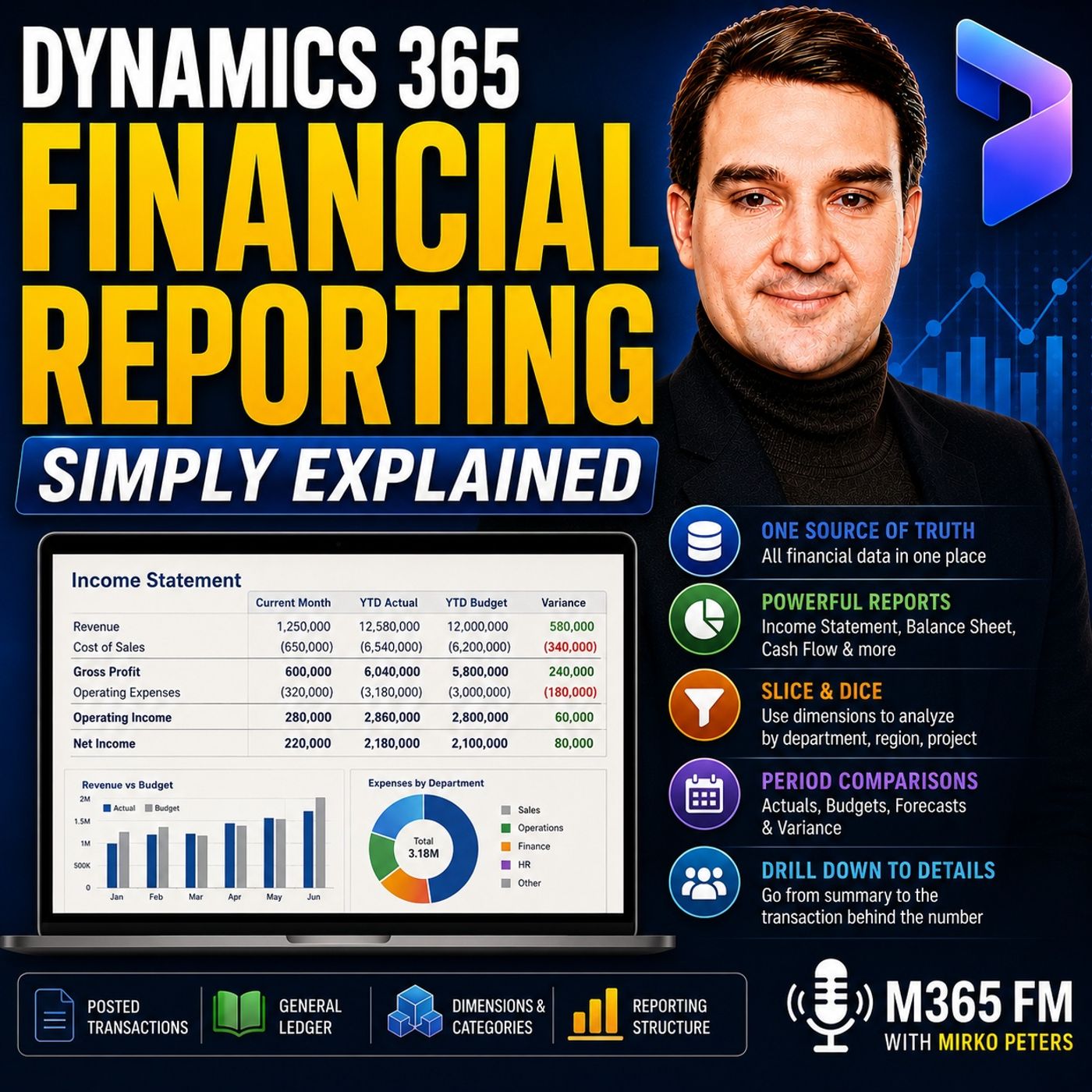
Dynamics 365 Financial Reporting - Simply Explained
Season 3
Published 2 months, 1 week ago
Description
Dynamics 365 Financial Reporting turns the financial data already posted in Dynamics 365 Finance into structured reports that finance teams, managers, auditors, and executives can actually use. Instead of rebuilding financial statements in multiple spreadsheets every month, organizations can use the general ledger, main accounts, financial dimensions, reporting categories, and predefined report structures to create consistent income statements, balance sheets, cash flow reports, trial balances, and budget-versus-actual reports. In this episode of M365 FM, Mirko Peters explains how Dynamics 365 Financial Reporting works and how organizations can move from financial transactions to reports people can trust.ㅤ
WHAT IS DYNAMICS 365 FINANCIAL REPORTING?
Financial Reporting is the Dynamics 365 Finance capability used to create, maintain, generate, and view financial statements based on general ledger information.It isn't another accounting ledger. Transactions such as invoices, payments, journals, payroll entries, and inventory adjustments are posted in Dynamics 365 Finance first. Financial Reporting then reads those financial results and organizes them into meaningful statements.Think of the general ledger as the financial filing cabinet and Financial Reporting as the report room that organizes those records into something people can understand.ㅤ
THE GENERAL LEDGER IS THE FOUNDATION
Every useful financial report starts with correctly structured accounting data.The general ledger contains the financial impact of customer invoices, supplier bills, payroll, bank payments, inventory adjustments, and other business transactions. Each amount is assigned to a main account representing what happened financially.Cash, sales revenue, rent expense, wages, accounts receivable, accounts payable, loans, and taxes can each have their own main accounts.Financial statements don't create these numbers. They organize and summarize balances that already exist in the ledger.ㅤ
MAIN ACCOUNT TYPES AND CATEGORIES
Main account types provide broad accounting classifications. Profit and loss accounts represent revenue and expenses for a period, while balance sheet accounts represent assets, liabilities, and equity.Main account categories provide another reporting layer.Several individual bank accounts, petty cash accounts, and clearing accounts might all belong to a broader cash category. A financial report can therefore show one clean cash line while finance retains the detailed accounts underneath it.Correct account types and categories make financial statements significantly easier to build and maintain.ㅤ
FINANCIAL DIMENSIONS ADD BUSINESS CONTEXT
Main accounts explain what happened financially. Financial dimensions explain where, who, or which part of the organization was responsible.Dimensions might represent departments, cost centers, business units, regions, locations, or projects.For example, three transactions could all post to the same rent expense account while their dimensions identify Head Office, Warehouse, and Retail North.Finance can see total rent expense while individual managers can analyze the portion associated with their area of responsibility.ㅤ
FINANCIAL DIMENSIONS VS FINANCIAL TAGS
Not every piece of transaction information should become a financial dimension.Dimensions are most useful for reusable values organizations expect to report against repeatedly, such as department, cost center, region, or business unit.Financial tags are better suited to flexible transaction references such as invoice numbers, purchase order numbers, payment references, or external system IDs.Creating dimensions for thousands of unique transaction references can make the financial structure unnecessarily complicated.ㅤ
DEFAULT FINANCIAL REPORTS
Dynamics 365 Finance includes 22 default financial reports that organizations can use as starting points.These include common